


In a Nutshell:
- Build a hotel booking app that helps hotels get direct bookings, reduce OTA commissions, and stay closer to their guests.
- Choosing the right app type and adding must-have hotel booking app features like search, payments, reviews, and booking management is very important.
- Advanced hotel booking app development features like AI chatbots, smart recommendations, dynamic pricing, and virtual room tours.
- The cost to develop a hotel booking app starts from around $25,000 for an MVP and can go beyond $200,000 for a full-featured app, depending on complexity and features.
- The hotel booking app makes money through transaction fees, listing fees, in-app ads, and commission-based models.
- Nimble AppGenie provides end-to-end hotel booking app development services that can increase the online visibility of your business.
If you have ever had a guest say, “I will just book on my phone,” you already know how guests behave today. In 2025, about 60% of hotel reservations were made using mobile devices.
This number is growing fast as travellers increasingly rely on apps and mobile phones for last-minute planning and bookings.
What is striking is not just mobile traffic. It is the speed and intent behind it. A large share of bookings via mobile phones occurs within 48 hours of search. This means travellers are often booking on the go.
For hoteliers, this shift presents a huge opportunity. A dedicated hotel booking app allows you to be where your users are, instead of hoping they find you through third-party sites.
If you want an online presence for your business, it is perfect to develop a hotel booking app. Having your own hotel booking app can help you capture direct reservations, offer loyalty perks, and reduce commission fees that come with intermediaries.
In this blog, we will discuss the process to build a hotel booking app in 2026, from choosing the right type and features to understanding development steps, costs, and the tech trends shaping the future of mobile travel.
Is It Profitable to Develop a Hotel Booking App in 2026?
This is the first question that comes to mind for hotel owners and startups. When names like Booking.com, Expedia, and Agoda already dominate the market, it’s natural to wonder whether developing another hotel booking app can be profitable.
The short answer is yes. It can be profitable, but only if the app is developed with the right purpose.
- The reality is that the best hotel booking apps are designed to serve everyone. They focus on scale, not personalization. This creates a gap for hotel businesses and niche players who want more control over their bookings and customer relationships.
- Large booking apps charge high commissions that range between 15% to 30% per booking. Over time, that significantly turns into profits, especially for small and mid-sized hotels.
- A dedicated hotel booking app like Agoda works differently. Instead of competing head-on with global giants, it allows you to own your audience.
- Users who already know your brand, have stayed with you before, or found you through other channels can book directly through your app. This means higher margins, better customer data, and more repeat bookings.
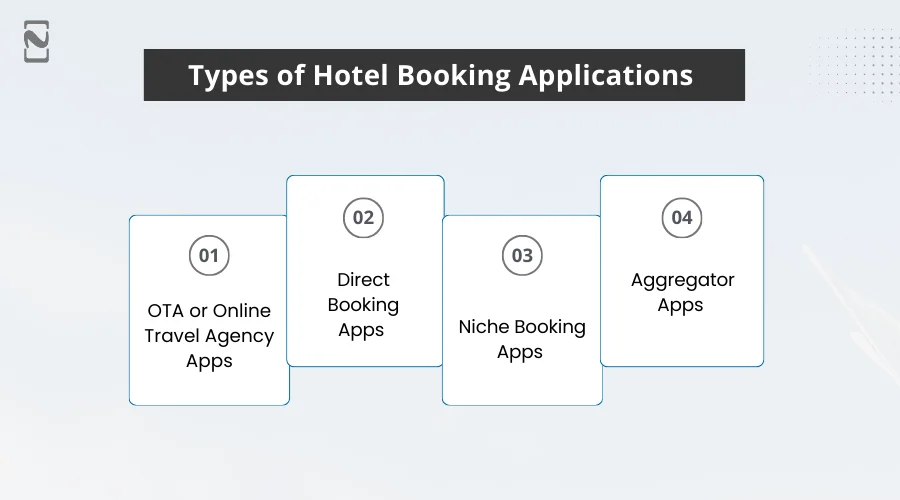
Types of Hotel Booking Applications
Before you develop a hotel booking app, it is vital to know which type of mobile app category you are going to choose.
We have jotted down the popular types of hotel booking mobile applications.
► OTA or Online Travel Agency Apps
OTA is a type of platform that lists multiple hotels and allows travelers to compare and book. Apps like Booking.com and Expedia are the best examples of the OTA model.
Pros for hotel owners:
- High exposure to international and local travelers.
- Handles marketing and payments.
Cons for hotel owners:
- High commission fees (15–30 % per booking).
- Limited control over guest data and branding.
When it’s suitable:
Hotels new to online bookings or wanting maximum reach without upfront app development.
► Direct Booking Apps
Direct booking apps are developed specifically for your hotel or chain to handle bookings directly. Users can directly book accommodations with the owner or manager, bypassing online travel agencies. For example, HotelTonight.
Pros for hotel owners:
- Full control over guest data, pricing, and promotions.
- Reduces OTA commissions — potentially saving thousands of dollars per year for small to mid-size hotels.
- Enables loyalty programs, push notifications, and personalized deals.
Cons for hotel owners:
Requires an initial investment in app development and marketing.
When it’s suitable:
Independent hotels, boutique chains, or hotels with repeat users who want to maximize direct revenue.
► Niche Booking Apps
Niche booking apps like Airbnb target a specific segment or type of traveler, like last-minute bookings, boutique hotels, luxury stays, or eco-friendly properties. For example, Hostelworld, AsiaYo.
Pros for hotel owners:
- Less competition than mainstream OTAs.
- Attracts high-intent travelers looking for specific experiences.
- Can integrate AI recommendations or personalized packages.
Cons for hotel owners:
- Smaller user base — marketing is key.
When it’s suitable:
Boutique hotels, luxury resorts, or properties with unique offerings.
► Aggregator Apps
Aggregator apps collect pricing and availability data from multiple OTAs and direct booking sites and allow users to compare options. Apps like Kayak are the best example of an aggregator model.
Pros for hotel owners:
- Increases visibility across channels.
- Can integrate dynamic pricing tools.
Cons for hotel owners:
- Limited control over direct bookings; still shares revenue with OTAs if they use affiliate models.
When it’s suitable:
Hotels that want to maximize bookings from comparison platforms while maintaining a presence on multiple channels.
Essential Features to Integrate in a Hotel Booking App
If you want to develop a hotel booking application, it is vital to integrate the features given in the table below. These features are just the same as travel app features, so you can consider them.
| User Panel | Descriptions | Admin Panel | Descriptions |
| User registration and profile management | Sign up or log in via email, phone, or social media; manage profile and view booking history | Dashboard and analytics | Monitor bookings, revenue, occupancy rates, and performance metrics |
| Hotel listings with images, videos and 360° tours | Browse hotels with detailed descriptions, images, and virtual tours | Room and availability management | Add, edit, or remove rooms; manage real-time availability |
| Search and filters | Search hotels by location, price, star rating, amenities, and room type | Booking and reservation management | Confirm, cancel, or modify users’ bookings |
| Booking and reservation system | Check real-time room availability, book multiple rooms, and get instant confirmation | User management | Manage users’ profiles, booking history, and special requests |
| Secure payments | Pay via credit or debit cards, UPI, wallets, and multi-currency support | Pricing management | Set base room rates and seasonal pricing |
| Ratings and verified reviews | View and leave reviews for hotels and rooms | Integration with PMS/OTAs | Connect to Property Management Systems, online travel agencies, and payment gateways |
| Booking history | Access past bookings and invoices | Notifications management | Send confirmation, reminder, or alert messages to guests |
| Notifications and alerts | Booking confirmations, reminders, and updates | Reports and insights | Generate basic occupancy, revenue, and booking reports |
| Cancellation and modification | Cancel or modify bookings within allowed policies | Payment Management | Track payments, refunds, and transactions |
| Room details and amenities | View detailed room info, including amenities, pricing, and policies | Staff and operations management | Assign tasks, manage housekeeping, and monitor staff workflow |
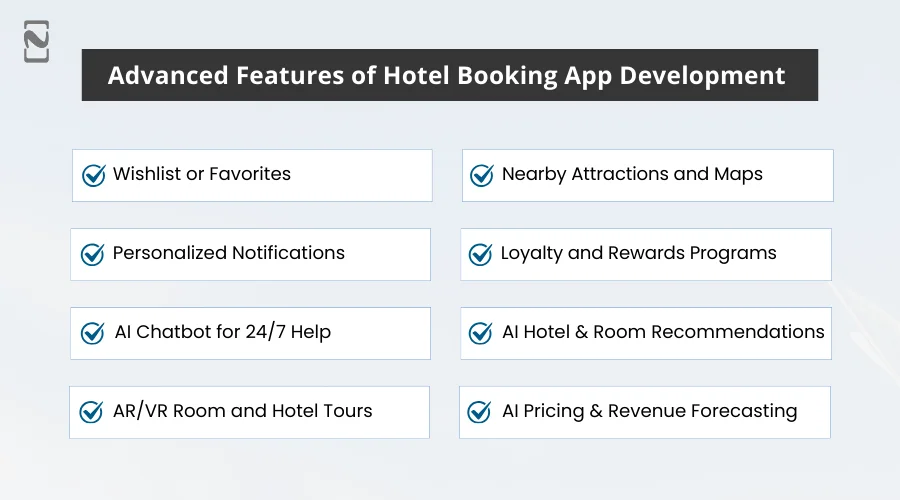
Advanced Features of Hotel Booking App Development
The core features are not enough to make your hotel booking app successful in the highly competitive market. You have to provide advanced features along with AI-integrated functionality in your app.
Below are the best advanced features for your hotel booking app development.
► Wishlist or Favorites
You can allow users to save their favorite hotels or rooms so they can come back and book later. This helps increase repeat bookings and keeps users engaged with your app.
► Nearby Attractions and Maps
You can show nearby restaurants, tourist spots, or transport options. Users can plan trips easily and choose hotels in convenient locations. This makes their experience smoother and more enjoyable.
► Personalized Notifications
You can send special deals or reminders based on what users like or have searched for. Push notification keeps them engaged and encourage more bookings from your app.
► Loyalty and Rewards Programs
Your app can offer points, discounts, or rewards for bookings, referrals, or reviews. This encourages users to return and builds loyalty that helps your hotel get repeat business.
► AI Chatbot for 24/7 Help
You can provide a chatbot to answer questions, help with bookings, or handle cancellations at any time. It reduces staff workload and keeps users happy with quick support.
► AI Hotel and Room Recommendations
With the integration of AI in the hospitality app, users can get suggestions for hotels or rooms based on past bookings, searches, or preferences. Users find what they like faster, and you can promote premium rooms or packages easily.
► AR/VR Room and Hotel Tours
Your app can offer 3D tours of rooms and hotel facilities so users can see exactly what they’re booking. It builds trust and helps reduce cancellations.
► AI Pricing and Revenue Forecasting
Users can adjust room rates automatically based on demand and trends. This helps fill more rooms, maximize revenue, and stay competitive without manual work.
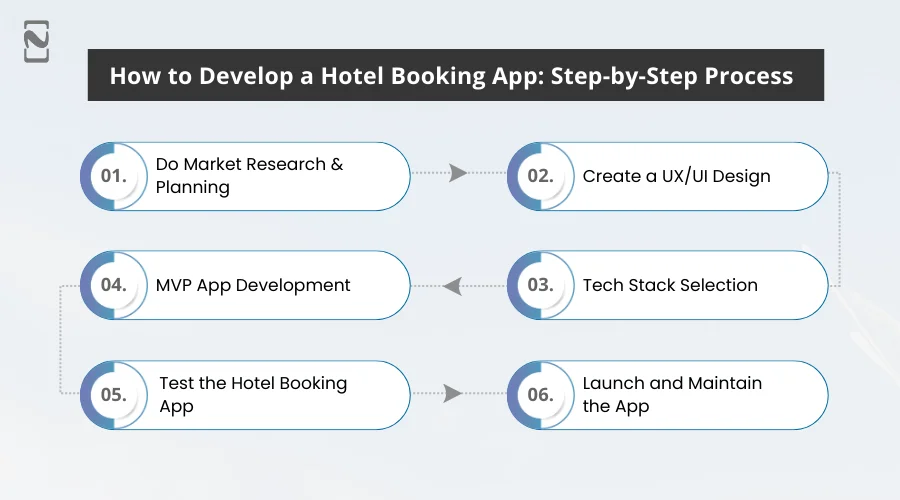
How to Develop a Hotel Booking App: Step-by-Step Process
To make a hotel booking app for your business, it is important to follow a roadmap for better guidance.
Here is the step-by-step process to develop a cutting-edge hotel booking application.
♦ Do Market Research & Planning
Before anything else, take a step back and think about your target audience. Who are they, what do they want, and how do they usually book? Doing proper market research will help you understand customers, competitors, and your market to make smart business decisions.
Now, check out your competitors too, like see what is working and where they fall short. Additionally, decide the type of hotel booking app you want, set clear goals, and outline the must-have features. This foundation will save you headaches later.
♦ Create a UX/UI Design
Once your market research is done, it is time to design a mobile app for your hotel booking business, like you were designing an experience for your guests. You can start with simple wireframes, then create prototypes so you can see how it feels to use.
Also, keep your hotel booking app mobile-friendly. It should be easy to navigate and visually appealing so that users keep coming back. If your target audience can search, book, and pay in a few clicks, they are more likely to complete their booking and come back.
♦ Tech Stack Selection
Now, choosing the right hotel booking mobile app tech stack is key. For example, Flutter or React Native works great for iOS and Android, while Node.js or Django can handle the backend smoothly.
Additionally, to develop a travel app, you have to design databases with PostgreSQL or MongoDB to store your data safely. You can plan ahead for payment gateways, hotel APIs, and maps. When you choose the right tech in advance, it makes everything faster, safer, and easier to scale.
♦ MVP App Development
This is where you develop a hotel booking app, but in an MVP version. MVP is just the basic version of your booking app that includes only must-have features and a simple design. Do not try to add all the features at the start; it is just to test your app idea in the market.
Once your MVP is tested successfully with the real audience, you can later add extras like wishlists, push notifications, or AI recommendations in a fully functional version. A solid MVP app development phase ensures the hotel booking app is smooth, secure, and reliable for your guests.
♦ Test the Hotel Booking App
Mobile app testing might not be the most glamorous part, but it is vital. You can check for bugs, slow screens, crashes, and payment errors. Just make sure your hotel booking app works on all devices and operating systems.
A perfectly-tested hotel booking mobile app feels polished, builds trust, and gives users a seamless experience, which means fewer complaints and more bookings.
♦ Launch and Maintain the App
Last but not least! Once your dream hotel booking app is tested, you can submit it to the App Store and Google Play, set up hosting, and make sure everything runs smoothly. Also, just keep an eye on how your target audience uses it in the first few days to catch any small issues.
A smooth launch creates a great first impression and encourages them to book immediately. But your work does not stop after launch. You have to update the app regularly. It includes fixing bugs, updating features, and improving AI recommendations etc.
Moreover, you should always listen to user feedback to make your hotel booking app better. A consistent update keeps your users happy, encourages repeat bookings, and makes sure your hotel stays ahead of competitors.
How Much Does it Cost to Develop a Hotel Booking App?
Let’s now estimate the budget you are required to build a hotel booking application. The actual cost of a hotel booking app can fluctuate based on different factors like app complexity, features, tech stack, team size, and so on.
All these factors affect both the timeline and the hotel booking app development cost. But we can provide you with a ballpark estimate to develop an app like Booking.com, Hopper, Agoda, or others. The development cost starts from $25,000 for an MVP version and goes beyond $200,000 for a fully-functional app.
The table below of the cost to develop a hotel booking app will help you better understand.
| App Complexity | Cost Breakdown |
| Basic MVP Version | $25,000 – $80,000 |
| Standard hotel booking app | $80,000 – $150,000 |
| Full-featured hotel booking app | $150,000 – $200,000+ |
However, if you want a more accurate cost estimate from a mobile app development company with experience in many projects, feel free to contact us. Just keep in mind that developing a hotel mobile app is not a one-time cost. Once the app is live, it will need regular updates and maintenance, which also require time and resources.
How to Monetize Your Hotel Booking Application?
Now that you know how to develop a hotel booking app, features, and budget required, it is time to determine the best suitable revenue model.
Below are some of the most effective and commonly used revenue models.
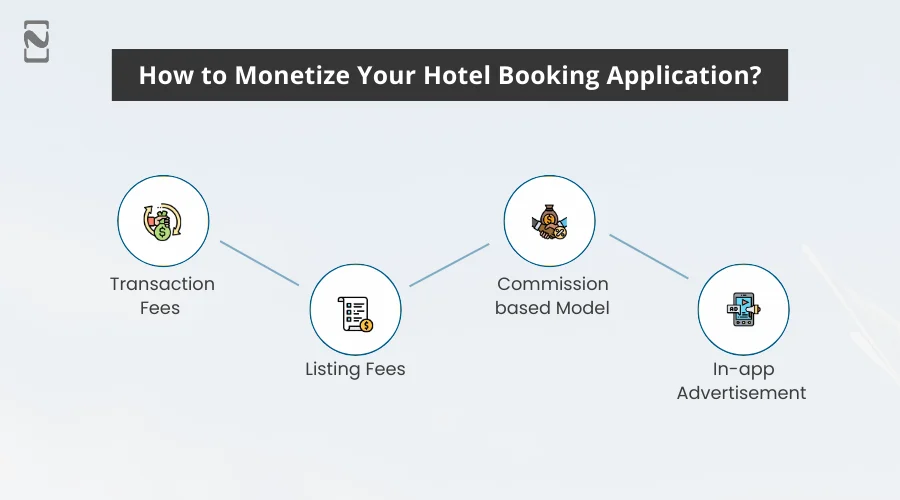
➤ Transaction Fees
You can charge a small fee each time a booking is completed through your hotel booking app. This app monetization model works best because revenue is directly tied to usage. Users usually accept this model when the app offers convenience, secure payments, and a smooth booking experience.
➤ Listing Fees
Hotels pay to appear on your hotel booking mobile application, either as a basic listing or with enhanced visibility. This monetization model gives you predictable income and works best when your mobile app attracts consistent traffic. Hotels benefit from exposure, while you earn regardless of booking volume.
➤ Commission-Based Model
One of the best ways you can earn huge revenue is through a commission-based model. In this setup, hotels share a percentage of their booking value with you. For example, it can be around 10-30% of the total bookings.
It’s widely used because it’s performance-based and low risk for hotel partners. This is also a common way travel apps make money, as it aligns your success directly with completed bookings.
➤ In-App Advertisement
Lastly, you can generate revenue by promoting hotels, travel services, or special deals within the hotel booking app. Your mobile application can show advertisements as banners, featured offers, or sponsored placements.
This mobile app monetization strategy is effective when your hotel booking app has great user engagement and regular activity.
How Can Nimble AppGenie Help Build an AI-Powered Hotel Booking App?
Nimble AppGenie, an experienced travel app development company, assists in building AI-powered hotel booking applications by providing end-to-end development services. Our AI integration enables personalized hotel recommendations, smart search and filters, and AI chatbots for 24/7 assistance.
We integrate your hotel booking platform with third-party systems to ensure real-time availability and reliable reviews. Beyond user-facing features, AI automates operations like booking management, notifications, and inventory synchronization.
We deliver a modern, smart, and future-ready AI-driven hotel booking app like TripAdvisor or others that boost user experience and drive bookings. So, if you have a similar idea in mind and want to build a robust hotel booking app, feel free to book a consultation call!
Student Castle: An Accommodation Booking App Case Study
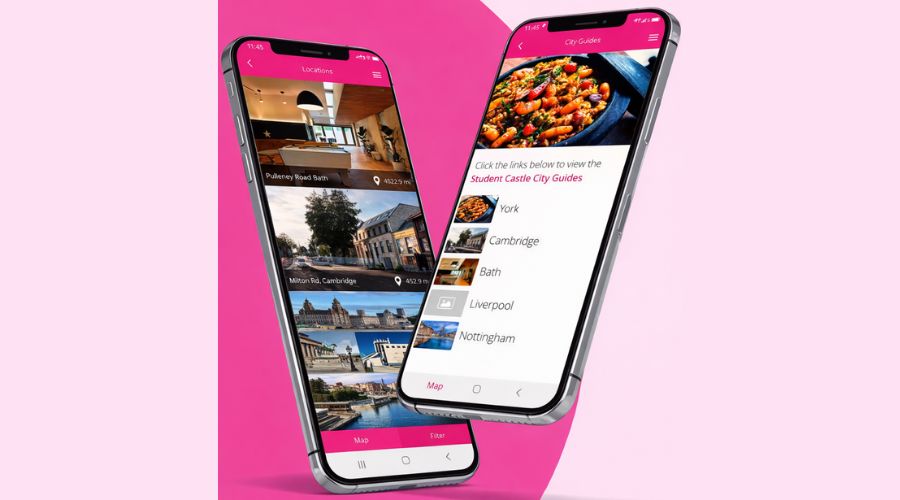
Client Profile—The client is a UK-based student accommodation provider that wanted to launch a dedicated mobile app, named Student Castle, for booking student housing. They aimed to make it easier for students to find, compare, and book accommodation near their universities using a single platform.
Challenges Faced:
- Students depend on various websites to search for housing, which makes the process confusing and time-consuming.
- There was no mobile-first solution to support students who prefer booking through apps.
- Property information was not presented clearly or consistently.
- The booking and payment process lacked convenience and speed.
- Managing student accounts securely was also a challenge.
Solutions We Offered:
We developed a user-friendly accommodation booking app, Student Castle, with advanced search and filtering options. The booking application showed detailed property details, real-time availability, and secure booking features. A bespoke backend system ensured smooth performance and safe payment handling.
Results Achieved:
- 40% faster accommodation search for students.
- 35% increase in mobile bookings within the first three months.
- 30% improvement in user engagement.
- 25% reduction in booking drop-offs.
- Higher student satisfaction and better platform adoption.
Conclusion
Creating an AI-powered hotel booking app allows you to give travelers exactly what they need: quick searches, smart suggestions, and easy bookings. With AI handling recommendations and automation, your solution feels personal and effortless.
For the best outcomes, it is vital to partner with a dedicated development team that makes it smooth and secure. Done right, your app can stand out in the crowded travel space and become one of the best travel apps, helping users plan trips faster, smarter, and more enjoyably.
FAQs
You can integrate hotel inventory using the APIs. Let’s have a look:
- Third-party hotel APIs
- Channel managers
- Direct contracts with hotels
- Property Management Systems
You might face many challenges while developing a hotel booking app. Take a look:
- Real-time data synchronization
- Handling cancellations & refunds
- High competition
- API reliability
- Scalability during peak traffic
Artificial Intelligence can be used in your hotel booking app in the following ways:
- Personalized recommendations
- Chatbots for customer support
- Demand forecasting
- Dynamic pricing strategies

Niketan Sharma, CTO, Nimble AppGenie, is a tech enthusiast with more than a decade of experience in delivering high-value solutions that allow a brand to penetrate the market easily. With a strong hold on mobile app development, he is actively working to help businesses identify the potential of digital transformation by sharing insightful statistics, guides & blogs.
Table of Contents
No Comments
Comments are closed.