







Key Takeaways:
- User-oriented design is the key to success for banking apps.
- Banking app design needs to be more and more minimal, decluttered, and secure.
- A solid banking app design can improve your app’s retention, efficiency, and accessibility.
- Super apps and AI-powered features are the latest banking app design trends to watch out for.
What is a Solid Banking App Design?
A solid banking app design focuses on all the design principles and gives its users convenience in the form of features and user experience. Several best practices can be used to improve the banking app design and experience for the user.
For any banking application to be successful in 2026, the banking app design needs to be more impactful than ever.
Gone are the days when offering simple features was enough to satisfy the user’s requirements. Today, your banking app design should be as convincing as the features, if not more.
Paying attention to mobile banking app design can be the best idea in today’s scenario, considering it is the only way you can make your solution stand out in this competitive market.
You see, features and functionalities can be replicated, but an experience is something that can never be recreated the same way.
And your banking app design defines the experience your solution has to offer.
Since the design is so important for the application, it automatically becomes a key factor to pay attention to. The key question that arises here is how to design a solid banking app. Or how to make your banking app design interactive.
If you are also looking for the best ways to design a banking app or want to know about the ultimate mobile banking app design principles, then your search ends here!
In this post, we will be looking at all the possible ways to improve your user experience, along with ways you can introduce better design elements to your existing app.
Without further ado, let’s get started!
What are the Best UX/UI Practices for Banking App Design?
The focus of banking apps has certainly shifted over the years. While earlier, the focus was always on practicality and functionality, today it has shifted to emotionality, support, and predictability.
Banking apps are highly optimized when it comes to offering features. However, it is the design where all the discussions are. It requires an additional layer of smart design that minimizes user effort and simplifies the experience for the user.
To achieve the best results and an optimized banking app, you need to integrate some important UX/UI design practices. We have listed them below for your reference:
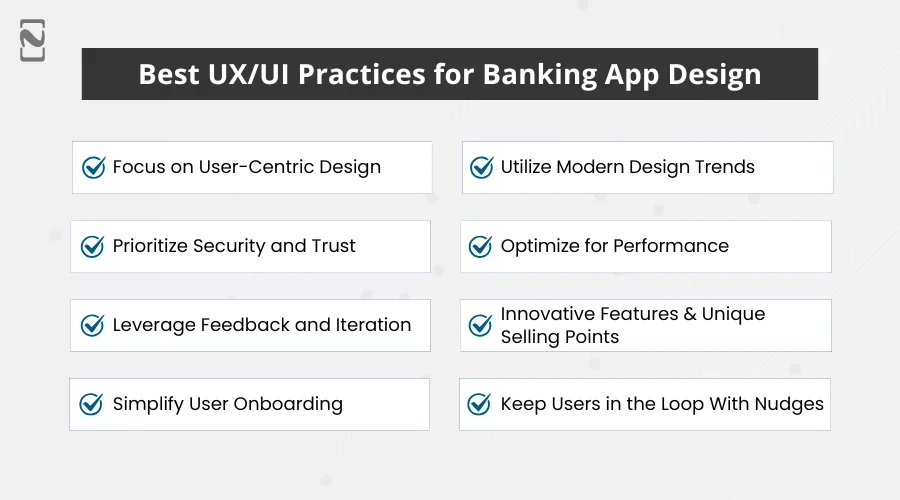
1] Focus on User-Centric Design
Put your users at the center of your design process.
Understand their needs, preferences, and behaviors through user research and create a design that meets these requirements.
Offer personalized experiences by adapting the interface based on user behavior, preferences, and past interactions. Ensure the design is simple and intuitive.
Avoid clutter and ensure that users can navigate the app effortlessly. Incorporate an accessibility feature set for the banking app to make the app usable for everyone, including those with disabilities. This includes screen reader support, high-contrast modes, and adjustable text sizes.
2] Utilize Modern Design Trends
Stay updated with the latest design trends and incorporate them into your app. This not only makes your app look contemporary but also improves the user experience.
Embrace minimalism by using clean layouts, ample white space, and a limited color palette. This helps in reducing cognitive load and improving focus.
Integrate microinteractions to provide feedback and make the app feel more interactive. These small animations or responses to user actions enhance the overall user experience.
Offer a dark mode option, which not only looks modern but also reduces eye strain for users, especially in low-light conditions.
3] Prioritize Security and Trust
Security is a critical concern for banking apps. Design your app to convey trust and reliability.
Implement secure and convenient login options like biometrics (fingerprint and facial recognition) and two-factor authentication.
Clearly communicate your security policies and data protection measures. Use straightforward language to explain how user data is protected.
Use visual cues like padlock icons, security badges, and secure color schemes (e.g., green for safe transactions) to reassure users.
4] Optimize for Performance
A beautifully designed app that performs poorly will quickly lose users.
Ensure your app is optimized for speed and efficiency.
Optimize images, reduce server requests, and use efficient coding practices to ensure quick load times.
Ensure that animations are smooth and do not hinder performance. Test on various devices to ensure consistency.
Design the app to provide essential functionalities even when offline, enhancing usability in areas with poor connectivity.
5] Leverage Feedback and Iteration
Continuously improve your app by leveraging user feedback and iterating on the design.
Implement in-app feedback mechanisms such as surveys and rating prompts to gather user opinions and suggestions.
Use A/B testing to compare different design elements and determine which performs better. This helps in making data-driven design decisions.
Regularly update the app to address user feedback, fix bugs, and introduce new features. This shows users that you are committed to improving their experience.
6] Innovative Features and Unique Selling Points
Introduce innovative features that set your app apart from competitors.
Implement voice-activated commands to allow users to perform tasks hands-free.
Use AI to provide users with personalized financial insights and advice, enhancing the app’s value proposition.
Incorporate gamification elements, such as rewards and challenges, to increase user engagement and make banking more enjoyable.
7] Simplify User Onboarding
One of the key aspects on which several modern banking apps must focus is on simplifying the onboarding process. You see, the attention span of an average customer has reduced significantly.
To ensure that your application stands out from the crowd, you need to design onboarding in such a way that it is seamless and doesn’t feel like a task to the user.
Avoid adding long information forms that a user may not be interested in filling out. Give them a direct way to sign up using their existing accounts or a simple One-Time Password via their contact information.
Leave the profile to be completed later and ensure that you add gamification to the same, giving percentages and points
8] Keep Users in the Loop With Nudges
Banking apps are a great way for users to stay on top of every transaction and account updates. There’s no point in having your app on the device if it doesn’t notify them about transactions in real-time.
Hence, make sure your banking app design includes convenient nudges that keep your users in the loop with every operation, every update that the user should be aware of.
These nudges and pop-up notifications ensure that the user is always returning to your app to get things done. However, balancing these notifications is the key, as you do not want to bother your user again and again with every minute update.
For this, you will need to implement personalization and understand user preferences on what they want to be notified about.
By focusing on these banking app design practices, you can ensure that your UI design stands out in the competitive market, providing a superior user experience and fostering user loyalty.
What are the 7 Must-Implement Mobile Banking App Design Principles?
Good design is the backbone of any successful mobile banking app. In order to achieve a decent design, the above practices can be a good way to start.
However, even when implementing these practices, you need to adhere to some design principles as they are fundamental to building a solid banking app. Check them out below to understand how to achieve the best results when designing a banking app.
-
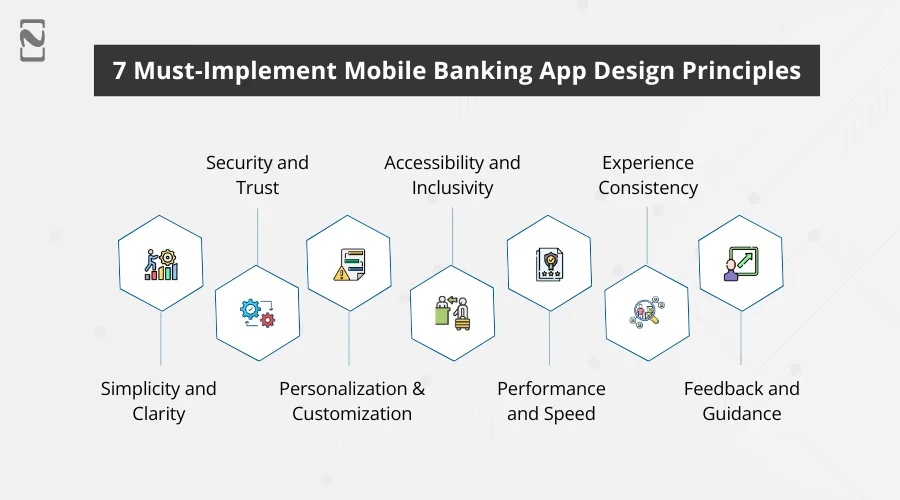
Simplicity and Clarity
The first thing is to pay attention to creating an experience that is simple to interact with and clear to understand. Banking is something that users of all age-groups interact with, hence you need to pay attention to simplicity and clarity when working on banking app design.
-
Security and Trust
Banking and fintech apps need to establish trust among users to have user-loyalty. With a lot of breaches and data theft cases, it is important that your banking app appears secure and teaches the user about the best practices of staying away from these security issues.
Hence, your banking app design must offer security features and more insights on how to stay safe, which creates a sense of trust.
-
Personalization & Customization
Every feature and every design element you plan to integrate into your banking app must offer personalization and customization features to the users. This helps the user feel in control and tweak the app as they see fit.
The more personalized an app appears to the user, the more they want to interact with it. Not to mention, when a user has spent time customizing their own experience, the chances of them moving to a different app become super thin.
-
Accessibility and Inclusivity
When we talk about accessibility, we are not simply talking about the additional features; we are talking about implementing features that help your app to accommodate all types of users.
Ensure that your app supports all the colors, text sizes, and screen resolutions to give the best user experience to different users. This gives you an upper-edge in the market as not only does this help you meet the legal accessibility requirements, but also makes it open to a wider range of users.
-
Performance and Speed
Banking app speed is nothing but the illusion that a user gets when they can get something done smoothly. Hence, focus on the performance of your app, and the speed will follow.
In order to ensure that the application feels fast and accurate, reduce the clutter and focus on adding more affirming screens that show something is being carried out.
-
Experience Consistency
One of the prime banking app design principles is to create a consistent user experience across devices and platforms. Maintaining experience consistency is a key factor in giving your users a reassuring experience that drives them back to the app.
Irrespective of the device or the choice of platform, the sync among the devices and the design language should be the same, making your user trust the application to a better level.
-
Feedback and Guidance
User feedback is nothing less than gold for any banking app, as it shows that a user cares enough to improve their experience rather than just going away from it. Create feedback loops and ensure that these are easily accessible for the user. The more feedback you can get from the user, the better. Also, make sure you iterate on the feedback, improving your user experience.
By focusing on these principles, you can create a banking app’s UI that not only meets but exceeds user expectations, leading to higher user retention and satisfaction.

What are Some Popular Banking App Designs?
Learning from the best can significantly improve your banking app UI design. Here are some top mobile banking apps known for their captivating and user-friendly designs:
1. Chase Mobile
The Chase Mobile app is renowned for its intuitive and clean interface. The app provides a seamless experience with easy navigation, quick access to essential features, and secure login options such as fingerprint and facial recognition.
- Personalized dashboards
- Quick access to account balances and transaction history
- Robust security measures
- Easy bill payments and money transfers
2. Bank of America Mobile Banking
Bank of America’s mobile app stands out for its comprehensive feature set and user-centric design. The app offers a streamlined experience with a focus on accessibility and ease of use.
- Virtual Financial Assistant (Erica)
- Customizable alerts and notifications
- Mobile Check Deposit
- Investment Management Tools
3. Revolut
Revolut’s app is designed with a modern and minimalistic aesthetic, appealing to a tech-savvy audience. It offers a range of features, from everyday banking to advanced financial tools, all within a sleek interface.
- Real-time spending notifications
- Budgeting and analytics tools
- Multi-currency accounts
- Cryptocurrency trading
4. N26
N26 combines simplicity with functionality in its app design. The app is known for its minimalist interface, making banking straightforward and stress-free for its users.
- Real-time transaction updates
- Spend insights and analytics
- Instant money transfers (MoneyBeam)
- Savings and investment tools
5. Monzo
Monzo’s app focuses on user engagement through its vibrant design and intuitive features. It is particularly popular among younger users due to its ease of use and transparency.
- Instant spending notifications
- Budgeting tools and spending summaries
- Bill splitting and shared tabs
- Overdraft and loan management
By analyzing these successful apps, you can gain valuable insights into effective mobile banking app UI design and apply these principles to your own app.
Why Invest in Banking App Design?
It is quite understandable that getting a custom banking app design takes both time and money. The question that bothers several business owners and app developers is why they should invest their resources in banking app design.
Well, if you are also someone who is second-guessing the decision to focus on your banking app design, here is a list of all the benefits a well-designed banking app can offer:
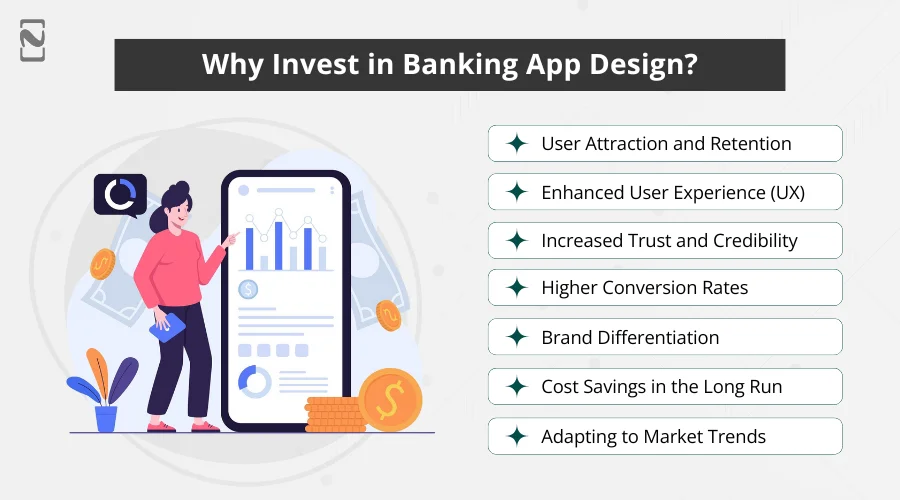
► User Attraction and Retention
A well-designed app attracts users and keeps them engaged. With the rise of digital banking, users have a plethora of options.
An intuitive and aesthetically pleasing design can set your app apart from the competition, ensuring users choose and stick with your app.
► Enhanced User Experience (UX)
The primary goal of good design is to provide a seamless and enjoyable user experience.
When users can navigate your app effortlessly, find information quickly, and complete transactions smoothly, they are more likely to have a positive perception of your brand and continue using your services.
This is particularly important in the banking app design landscape, where user experience can significantly impact user retention rates.
► Increased Trust and Credibility
A professional and polished mobile banking app UI design instills trust and confidence in your users.
Financial transactions involve sensitive data, and users need to feel secure while using your app.
A clean, well-organized design, combined with robust security features, can enhance credibility and reassure users that their information is safe.
► Higher Conversion Rates
Investing in design can directly impact your conversion rates.
Whether it’s onboarding new users, encouraging existing users to explore more features, or promoting premium services, a well-designed app can guide users through the process.
Thus, making it more likely they will complete the desired actions.
► Brand Differentiation
Do you want to become successful among people?
In a saturated market, branding is essential. Your app’s design is a critical component of your brand identity.
Consistent, high-quality design elements help build a strong brand image, making your app memorable and distinct from competitors.
► Cost Savings in the Long Run
Investing in good design upfront can save money in the long run. Poor design can lead to user frustration, increased churn rates, and higher customer support costs.
In addition, redesigning an app after launch can be more expensive than getting it right the first time.
Investing in quality design from the start ensures a smoother development process and better user satisfaction.
► Adapting to Market Trends
The fintech industry is dynamic, with user preferences and technological trends constantly evolving.
A focus on design allows you to stay ahead of these market trends.
Regular updates and design improvements keep your app relevant and competitive, meeting user expectations and incorporating new technologies.
In conclusion, a dedicated investment in banking app UX design is not just about making your app look good.
It’s about creating a functional, user-friendly, and secure platform that meets user needs and stands out in a competitive market. This investment is crucial for attracting and retaining users, building trust, enhancing brand identity, and ensuring long-term success.
Design Your Banking App with Nimble AppGenie
Creating an exceptional banking app requires expertise, creativity, and a deep understanding of user needs.
At Nimble AppGenie, a leading mobile banking app development company, we specialize in crafting top-notch mobile banking solutions tailored to your specific requirements.
Our team of experienced designers and developers works collaboratively to deliver intuitive, secure, and innovative banking apps that stand out in the competitive market.
We understand the importance of a well-designed banking app and its impact on user satisfaction and retention.
By leveraging the latest technologies and design trends, we ensure your app not only meets but exceeds user expectations. From initial research and analysis to post-launch monitoring and updates, we provide end-to-end solutions to bring your vision to life.
Conclusion
Investing in the design of your mobile banking app is crucial for attracting and retaining users in the competitive fintech market. A well-designed app not only enhances user experience but also builds trust and loyalty.
By following a structured banking app design process and focusing on user-centric principles, you can create a standout app that meets the needs of your customers.
Whether you are developing a new app or improving an existing one, prioritizing design is a step towards success.
FAQs

Niketan Sharma, CTO, Nimble AppGenie, is a tech enthusiast with more than a decade of experience in delivering high-value solutions that allow a brand to penetrate the market easily. With a strong hold on mobile app development, he is actively working to help businesses identify the potential of digital transformation by sharing insightful statistics, guides & blogs.
Table of Contents
No Comments
Comments are closed.