


In a Nutshell :
- AI in fintech is one of the fastest-growing markets and is projected to reach USD 41.16 billion by 2030.
- Integration of AI in fintech helps financial institutions to better understand the user requirements by analyzing patterns, predicting trends, and taking decisions based on data.
- Explainable AI (XAI), Generative AI, and Agentic AI are primary types of AI used in fintech and have different applications in the field.
- Adoption of AI helps in improved Fraud Detection, Personalized Recommendations, and Interactivity of the app.
AI in fintech is the integration of advanced machine learning (ML), Generative AI, and Agentic workflows into financial services to automate complex decision-making.
By 2026, the primary role of AI will have shifted from simple chatbots to autonomous financial agents that manage risk, detect fraud in real-time, and personalize wealth management with 99.9% accuracy.
What is AI in Fintech?
Artificial intelligence, as a technology, is one of the most advanced and helpful technologies that can be implemented in every walk of life.
In simple terms, AI is intelligence that is exhibited by machines and software, allowing these systems to interact with the user more convincingly.
How Does AI Work in Fintech?
Integration of AI in Fintech can help financial institutions analyze patterns, predict trends, and make data-driven decisions that are more accurate and beneficial for their organization.
It can easily streamline the entire process of data analysis and processing. AI also enables several features that support fraud detection, custom recommendations, and chatbots.
Hence, companies planning to penetrate the fintech market must use artificial intelligence to better manage and analyze the data to gain better insights.
Use of AI in fintech is one of the fastest-growing trends to have emerged in recent years. With the efficiency and promptness that AI brings to the complicated field of financial technology, it is completely understandable why people believe AI in fintech to be revolutionary in its own way.
But since curiosity is the fundamental fuel for the human brain, the core question that arises here is, HOW?
How has AI revolutionized the fintech sector? What benefits does it offer? What are the use cases for AI in fintech? More importantly, how can implementing AI in fintech be beneficial for your business?
If you want to understand the role of artificial intelligence in fintech, then you have reached just the right post.
In this one, we will be focusing on the use of AI in fintech and how it has enhanced the user experience. We will also look at some benefits of using AI in fintech and the challenges that you might face, along with core use cases.
So without further ado, let’s start with an overview of AI in fintech and what role it plays.
Overview of AI in Fintech
The digitization of financial services has brought advancements in the way people handle their finances. While it was a headache for many to visit a branch regularly for one thing or another, today, most financial services can be accessed through a smartphone.
However, the convenience is not limited to users, as the implementation of technology also brings a lot of benefits to the service providers, in this case, financial institutions.
AI in fintech is about leveraging advanced algorithms and machine learning to improve financial services. It’s essential for businesses looking to adopt these technologies to partner with AI consulting experts.
These experts can assess organizational needs, develop tailored strategies, and ensure effective integration into fintech solutions.
These insights can further help in addressing the current market challenges for AI consulting services, uplifting the experience for both users and financial institutions.
What are the Primary Types of AI Used in Fintech?
You might have already come across different AI-powered fintech apps that offer different but limited features. Since AI, in itself, is a widespread concept that has multiple applications and internal classifications.
When we talk about the role of AI in fintech, various types of AI can be deployed. Some apps use a specific type, while some use a more hybrid model, implementing different AI models to bring the features.
Ever wondered why two fintech apps that boast to be AI-powered offer different features and not the same ones?
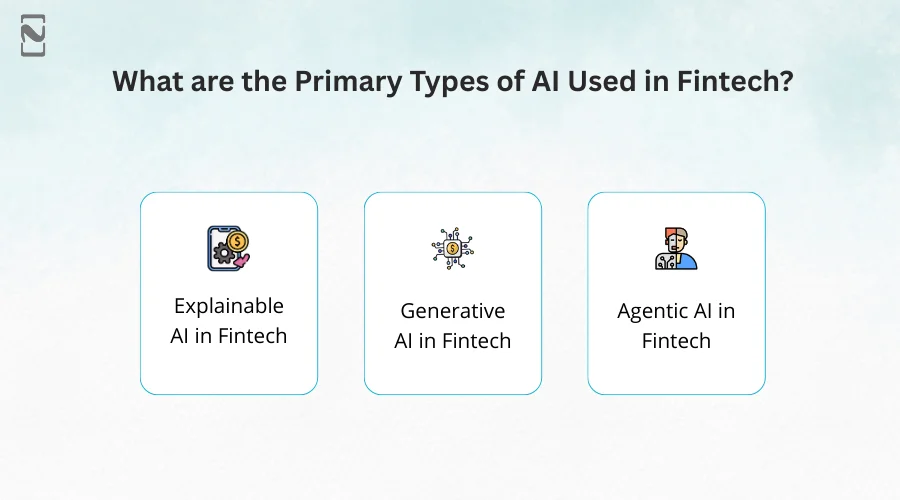
Well, the answer to that lies in the different types of AIs that are implemented to achieve various objectives in a fintech solution. Generally, 3 types of AIs are integrated in fintech. These are Explainable AI (XAI), Agentic AI, and Generative AI (Gen AI).
Let’s take a look at how they are used in fintech, one by one!
► Explainable AI in Fintech
Explainable AI, also known as XAI, focuses on creating transparency in the execution of AI in fintech. You see, when tasks are left to algorithms, the chances of confusion about why it did something are high.
That is because an AI does everything in the backend, giving a user simply an output. However, with XAI in fintech, you get transparency as to why and how an output was generated.
It simply breaks down AI decisions into human-understandable reasons, giving them clarity on things like why a loan request was declined, why a particular transaction was termed as fraud, or what led to a decline in the credit score of the consumer.
It works for all and creates a sense of clarity among regulators, consumers, and developers.
Applications of Explainable AI (XAI) in Fintech –
- Fraud Detection.
- Credit Scoring.
- Onboarding Eligibility Checking.
- Portfolio Suggestions.
- Regulatory Accountability.
► Generative AI in Fintech
Next up, we have Generative AI. While it is generally associated with content creation, Gen AI in fintech is being used to offer a lot of insights and help in financial planning.
Generative AI is commonly used to create personalized plans and recommendations based on user preferences.
For instance, if a user is looking for a tailored financial plan, budgeting tips, or guidance on whether they should take the risk and invest in a particular stock or not, GenAI can help them out.
Fintech apps and platforms integrate generative AI to ensure that the user gets an interactive experience. Gen AI-powered AI chatbots are another interesting use case, which allows the platform to be more user-oriented and create better communication.
Application of Generative AI in Fintech –
- Personalized Recommendations.
- Data Generation for AI Training.
- Advanced Chatbots.
- Operational Automation.
- Informed Financial Advice.
► Agentic AI in Fintech
Agentic AI is the driving force behind the automation of processes in fintech. It helps create autonomous systems that can perform complex tasks, make decisions while learning from the user patterns for better decision-making in the long run.
Unlike your traditional automation, Agentic AI goes a step further and identifies exactly what the user requires, making it more and more personalized for the user.
Agentic AI is capable of self-interpreting the user intent when completing a task, planning the flow of the task by breaking it down into a series of steps that allow the AI to achieve the desired outcome.
The best part is that while its primary focus is on automation and getting things done, it is continuously learning from the user interactions and adapting as per the changes in real-time.
Applications of Agentic AI in Fintech –
- Lending & Credit Underwriting.
- Regulatory Reporting.
- Wealth Management & Allocation.
- Advanced Customer Service.
- Autonomous Application Processing.
All these different AIs help in creating the desired working environment for a fintech app. The applications use an appropriate combination of AI models in fintech apps to achieve the objective.
Read Also – Generative AI, Conversational AI, and Chatbots
What are the Benefits of Implementing AI in Fintech?
Though the implementation of different AIs in fintech can get expensive and time-consuming, it offers a lot of benefits.
Wondering what type of benefits we’re talking about? Don’t worry, we have listed some of them below for your reference!
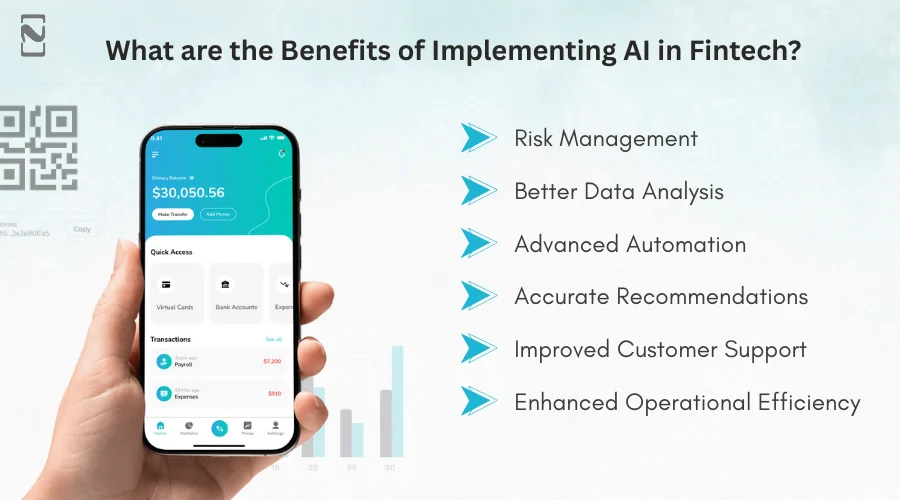
♦ Risk Management
Identifying and managing risks becomes super easy with the implementation of artificial intelligence. Risks in fintech mainly refer to the chances of a person defaulting on their payments and the poor assessment of an individual’s creditworthiness.
These defaults cost a lot of money for fintech companies. However, with AI algorithms combined with machine learning, you can create a solid risk management mechanism that helps you improve risk management on your FinTech platform.
♦ Better Data Analysis
The implementation of AI also helps in better data analysis. Usually, this data is generated by the user and is used to identify user requirements. However, with AI, this data can be used to analyze the entire trajectory of a user since they joined.
These patterns help in identifying the overall value of a customer for your company. Data analysis with AI often implements predictive analytics, allowing you to identify user patterns and make informed decisions.
♦ Advanced Automation
Artificial intelligence can be used to automate several operations that usually require a dedicated resource. This yields a lot of cost savings for a company and improves the efficiency of the processes by a significant margin.
This also means that with the help of advanced automation techniques deployed through AI & ML, you can easily automate some of the basic steps that a user or your company has to perform manually.
♦ Accurate Recommendations
Recommendations are one of the key players when it comes to pushing and converting your customers for additional services.
But in fintech, it is a service that helps users more than the business. Artificial Intelligence allows you to understand the patterns of a user so that you can identify what type of services they are interested in and recommend similar services.
This helps in converting more users into regular customers and cross-selling your services at the same time.
♦ Improved Customer Support
Another sector where the implementation of AI in financial services is beneficial is customer support. With AI-based chatbots and text support, you can easily enhance your turnaround time on any ticket raised by the customer.
It also helps in satisfying a user’s urgent requests, as finances are a delicate matter, and delaying in reverting to a grievance may result in the loss of a customer.
♦ Enhanced Operational Efficiency
With AI and machine learning, you can easily enhance operational efficiency. The implementation of AI can help streamline all the processes, making it operationally efficient and secure.
With the help of automation, operations become easier and easier to trace, which means fewer resources are invested in them, making it more operational than ever!
Other than this, AI in fintech can leverage all the user-generated content for better decision-making.

What are the Challenges in Implementing AI in Fintech?
When we talk about AI in fintech, the benefits do make a good case for implementation. However, keep in mind that there are significant challenges that you might face.
These challenges include –
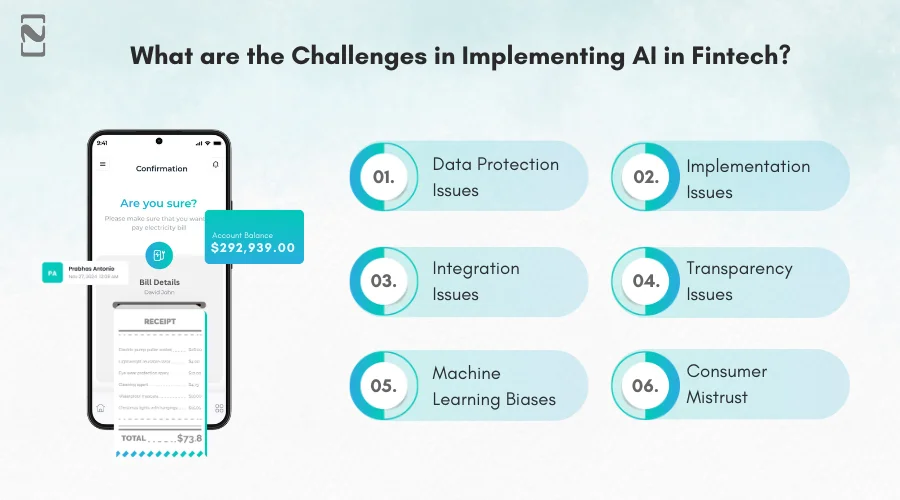
➤ Data Protection Issues
To make the most of artificial intelligence mechanisms that you deploy on your fintech platform, you need to store loads of data.
The real issue begins when you have to securely store this data. This data also holds especially sensitive information about a user and is always vulnerable to leaks and breaches.
➤ Implementation issues
The cost of implementation is one of the biggest challenges. Some fintech businesses are unable to identify the exact use case for which they want to implement AI, making it more complicated for them to rely on AI.
➤ Integration Issues
Not all technologies may be compatible with the legacy systems that are currently being used to power your platform. It is difficult to integrate AI in fintech, as you will also have to upgrade your legacy systems, as they may pose an issue in compatibility.
➤ Transparency Issues
While AI can help in generating decisions faster, sometimes it may lack transparency in the entire decision-making process.
While AI implementations can enhance operations, people often have concerns about the authenticity of those decisions, as they do not know how these were derived.
➤ Machine Learning Biases
This algorithmic bias can often prove to be a problem as AI is usually implemented to simplify the workflow, not to complicate it.
However, you have to run regular audits on implemented algorithms to find if they are getting affected by the ML bias, or if they are working fine or not.
➤ Consumer Mistrust
For common consumers, AI is yet to make a mark, as it has some serious glitches in the model.
Not to mention, when anything is related to finances, consumers prefer interacting with humans more than artificial intelligence. Mistrust is one of the key challenges in the implementation of AI in financial services.
The challenges may vary as per your domain in fintech, as insurtech has different issues than banking. Hence, you need to understand what issues can hamper your platform’s experience and work on them.
If you are unable to manage the implementation, you should ask the development team to guide you through it, as fintech development experts surely know how to implement things better.
What are Some Use-Cases of AI in Fintech?
Knowing about the benefits and challenges of implementing AI in fintech, you might have gotten confused about whether to use AI in fintech or not. Well, challenges are often seen with almost every other technology.
But that does not mean that you should avoid it, especially when something offers benefits that streamline operations to a whole new level. AI has proven to be highly effective in every industry where it has been implemented, and fintech is no exception.
Some of the key use cases of AI in fintech can give you a better understanding of how AI is reshaping the future of financial services!
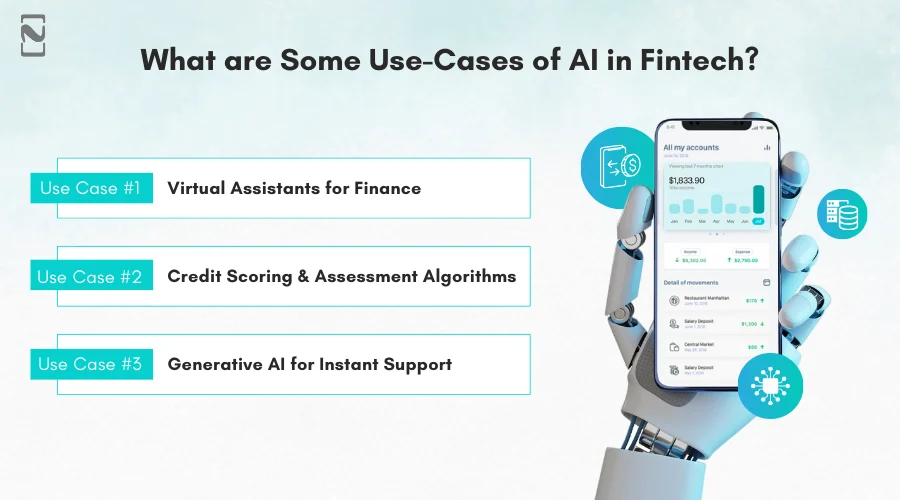
1. Virtual Assistants for Finance
One of the best use cases for implementing AI is in smart virtual assistants for financial services.
Any fintech service provider can create a virtual assistant that can be deployed on the platform to resolve basic user queries, such as helping them find a service, simplifying their experience, answering frequently asked questions, and sharing the status of their requests.
Think of these AI assistants as “Siri” for your fintech platform.
2. Credit Scoring & Assessment Algorithms
Another crucial AI use case is credit scoring and assessment. When dealing in fintech, you should be able to assess the consumer’s creditworthiness properly.
By combining the smartness of AI and the complexities of a machine learning algorithm, you can easily automate these tasks, making them more efficient, effective, and quick.
Resolving credit scoring and assessing creditworthiness correctly can help you tone down your default rate, which directly reflects in the overall financial performance.
3. Generative AI for Instant Support
Generative AI has become one of the most commonly used AI solutions, thanks to its ease of administration. AI often helps in generating texts, images, etc., for a prompt given by the user.
Now, by training your own generative AI model, you can directly deploy it as a quick support system. As soon as a user enters their query, this generative AI takes it as a prompt and generates an answer accordingly.
You can even leave suggestions for the users as to what they can ask or how they should structure their queries for the best results.
These are just 3 of hundreds of ways fintech companies are using AI to empower their businesses. Challenges do not stop them from making the most of available resources.
However, in order to implement these use cases, you have to be more and more diligent while implementing AI in fintech. Not to forget, implementing these AI use cases will affect the cost of developing a fintech app by a significant amount.
What are Some Trends Inspired by AI in Fintech?
While these use cases seem futuristic, we firmly believe that these are not the best solutions yet, as AI has a lot more potential.
With a team of out-of-the-box thinkers and development wizards, you can design unique use cases where AI in fintech can enable you to streamline the entire functionality in no time.
With every passing week, AI is advancing towards a better model of implementation, making it more and more intelligent.
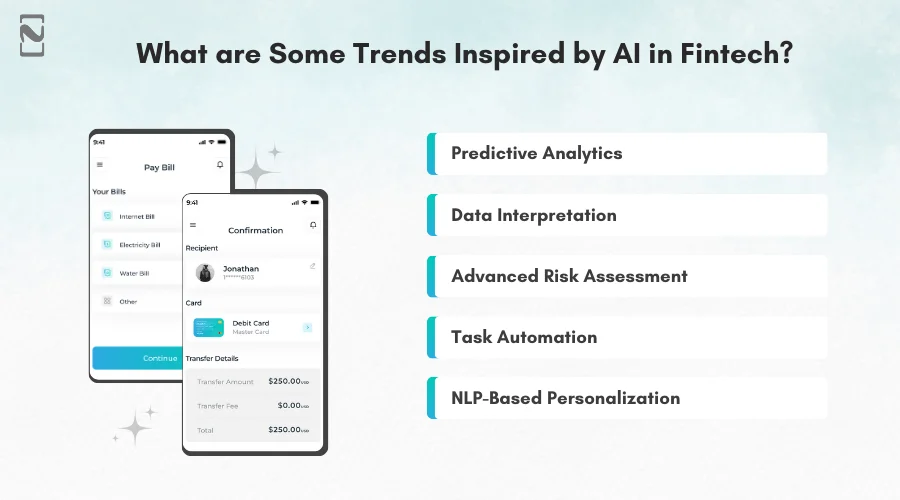
♦ Predictive Analytics
Predictive analytics is the advanced version of data analysis and offers insights into future trends.
With the help of an AI-powered machine-learning algorithm, you will be able to deliver deeper insights into user behavior and their usage patterns, allowing you to predict future trends.
With improvements in predictive analytics, it will be a lot easier to make decisions that can help maximize their profits while maintaining a quality experience.
♦ Data Interpretation
In the coming years, AI will find its way into data interpretation, helping financial institutions strengthen their strategic planning.
For any business to run successfully, it is crucial to keep updating yourself time-to-time. But how do you know if it is the correct time to make a move?
Well, you rely on data, and with the help of AI-based data interpretation, you will be able to interpret large amounts of data for your business quite easily.
♦ Advanced Risk Assessment
Financial risks are always a key challenge for both consumers and businesses in the field of finance.
The risk assessment will become more intelligent and accurate when it comes to making the right decisions, lending to the right people, and making things more efficient.
AI-powered credit scoring can help identify potential risks beforehand, reducing the chances of unintended consequences such as loan defaults.
♦ Task Automation
The future of financial services is moving towards task automation, which helps a fintech company to reduce human resource costs, improve efficiency, and make processes faster. Task automation can be easily implemented with the help of artificial intelligence.
The key is to develop an internal AI engine that allows the optimization of long tasks into steps that can be easily converted into tasks that can be automated easily through machine learning algorithms.
♦ NLP-Based Personalization
Personalization is another area of fintech that AI will revolutionize shortly. This is because implementing artificial intelligence can enable Natural Language Processing to interpret the queries of the users in their purest form, with the intent.
This helps in creating personalized recommendations based on a user’s usage patterns and requirements.
Implementing AI with fintech can be highly beneficial, especially for a small business, as it can help in automating processes like customer support, data processing, and more. Saving a lot of time, effort, and money in the long run.

Conclusion
Artificial intelligence offers some cutting-edge solutions and helps streamline several integral processes. There are several challenges that you might face while implementing AI in fintech.
However, the ease of access and benefits that AI offers overshadow these challenges completely and hence make it more desirable to integrate them.
To integrate AI in fintech, you will need two things: conviction and a team. The above information should be enough to bring conviction on how crucial using AI is for your business.
AI in fintech can prove to be highly beneficial, and hence, you must connect with a trusted fintech app development company. Hope all these insights help you understand the impact of AI.
FAQs
One of the key factors in any customer service is its turnaround time. While a human may be occupied with some other task and may delay in replying, an AI chatbot is always available and can manage multiple queries without any stress. When we talk about fintech, people are looking for solutions, and with an ever-ready AI Chatbot, they can instantly navigate to the solution by interacting with it.
AI systems can monitor transactions in real-time, identify complex patterns that indicate fraud, and predict potential fraudulent activities. This enhances security and reduces the number of false alerts, making financial transactions safer.
AI analyzes user data, such as spending habits and financial goals, to offer customized financial advice and recommendations. This helps users manage their finances more effectively with tailored budgeting, investment, and savings plans.
AI provides more accurate and inclusive credit assessments by analyzing a broad range of data sources. This improves the accuracy of credit risk evaluations, speeds up the lending process, and offers credit access to individuals with limited credit histories.
Challenges include data privacy and security, regulatory compliance, algorithmic bias, lack of transparency, high implementation costs, data quality, integration with legacy systems, skill shortages, and ethical concerns.
Fintech companies can optimize costs by leveraging open-source AI tools, partnering with AI service providers, and carefully budgeting for development, data management, infrastructure, and talent acquisition.
Key trends include hyper-personalization, frictionless user experiences, enhanced risk management, democratization of finance, and increased regulatory scrutiny and ethical considerations.

Niketan Sharma, CTO, Nimble AppGenie, is a tech enthusiast with more than a decade of experience in delivering high-value solutions that allow a brand to penetrate the market easily. With a strong hold on mobile app development, he is actively working to help businesses identify the potential of digital transformation by sharing insightful statistics, guides & blogs.
Table of Contents
No Comments
Comments are closed.