

 Free Consultation
 PCI-DSS Compliant
 GDPR Ready
 ISO 27001
 NDA Protected
 AI Services
 AI App Development
 Generative AI Development
 AI Chatbot Development
 AI Integration Services
 AI Consulting Services
 AI For Fintech
 AI Financial Assistant Solution
 AI Insurance Agent Development
 Tech Stack
 OpenAI / GPT-4
 Claude / Anthropic
 Gemini / Google AI
 Llama / Open Source
 LangChain / LlamaIndex
 Pinecone / Pgvector
 AWS / Azure AI


 Fintech Solution
 Core Fintech
 App Development
 Neobank Solutions
 eWallet Solutions
 Lending Software
 Banking Solutions
 BNPL Solutions
 BNPL Solutions
 Insurance App
 Wealth Management
 Crypto & DeFi
 Blockchain Development
  Payroll Software
 DeFi Solutions
 Crypto Wallet
 Crypto On/Off Ramp
 Crypto Exchange
 Trading Platform
 Payments
 Compliance
 Regulations & Compliance
 Fraud Detection
 Lending Ecosystem
 P2P Lending Platform
 Mortgage Software
 Engagement
 Fintech Outsourcing

 Mobile Development
 Mobile App Dev
 iOS App Development
 Android App Development
 React Native
 Flutter Development
 Web Solution
 Node.js Development
 React.js Development
 Angular Development
 App Services
 UI/UX Design
 App Maintenance
 By Stage
 MVP Development
 Industry Solutions
 Healthcare App Dev
 Education App Dev
 Travel App Dev
 Real Estate App Dev
 Logistics Software
 Social Media App

 Hire Mobile Developers
 Hire iPhone Developers
 Hire Android Developers
 Hire React Native Devs
 Hire Flutter Developers
 Hire Web Developers
 Hire Node.js Developers
 Hire Angular Developers
 Hire PHP Developers
 Hire Laravel Developers
 How It Works
 Pre-Vetted Developers
 Ready In 48 Hours
 NDA From Day One
 Replace Guarantee
 Company
 About Us
 Our Work Process
 Portfolio
 Case Studies
 Blog / Insights
 Careers
 Contact Us
 Awards
 Recognition


 Offices



TL;DR
- Freelancers are best for small, short-term, well-defined tasks with a limited budget.
- Agencies offer a full team, structured processes, and accountability for complex, full-product builds.
- Freelancers cost less per hour but often cost more in total when you factor in management time, rework, and risk.
- Agencies reduce your risk significantly if one person leaves, the project doesn’t stop.
- The bigger and more business-critical your project, the stronger the case for an agency.
- Nimble AppGenie gives you the best of both worlds – agency-grade quality, dedicated teams, transparent pricing, and full IP ownership from day one.
You have a mobile app idea, and you are ready to build it. Here comes the first real confusion: “Should I hire a freelancer or agency?”
Most founders hit the same wall when it comes to hiring freelancers vs agencies for their next app or digital project, as both look reasonable on paper, have strong supporters, and carry potential risks.
The decision between hiring a freelancer vs a development agency is one of the most significant choices for any business owner or startup.
Get it wrong, and you will meet poor-quality code, missed deadlines, and a project that costs you twice the expected range. Get it right, and you will witness a product that ships on time, works as anticipated, and scales with your growth.
This complete guide on hiring freelancers vs agencies breaks down quality, cost, reliability, scalability, and risk so you can make an informed decision, with confidence for your specific project.
Whether you are a startup founder, business owner, or product manager, by the end of this article, you will know exactly which option is right for you.
⚡ Quick Answer:
Choose a freelancer for small, well-defined, short-term tasks. Choose a development agency when you need a complete product, accountability, and a team that can scale with you.
What Is a Freelancer?
A freelancer is a self-employed individual who offers their skills on a contract or project basis. In the tech world, freelancers can be designers, developers, QA testers, or project managers – each working independently, usually juggling multiple clients at a time.
You will typically find freelancers on leading job portals like Toptal, Upwork, and Freelancer.com. They set their rates, their working hours, and decide which projects to take.
The global freelance platforms market will be valued at $14.39 billion by 2030, up from $5.58 billion in 2024. [PR Newswire]
It clearly shows how independent hiring has become mainstream.
What a freelancer is NOT: a full team. They are just one person who brings their particular expertise, but rarely owns the whole product lifecycle from strategy to deployment.
What Is a Development Agency?
A development agency is an organization made up of a structured team of specialists who can be UI/UX designers, developers, QA engineers, project managers, and sometimes business analysts.
Unlike freelancers, agencies take ownership of the complete project lifecycle: from scoping and wireframing to development, QA testing, and post-launch support.
Agencies are responsible as a business entity. If one developer is unavailable, another joins. If a bug arises three months after launch, there’s a team accountable for fixing it. They follow procedures, sign NDAs, and typically provide formal contracts and milestone-based deliverables.
At Nimble AppGenie, for example, each project involves regular updates, sprint reviews, and comprehensive visibility into progress – no guesswork, no silence.
Freelancer vs Agency for App Development – Side-by-Side Comparison
| Factor | Freelancer | Agency |
| Cost | $25–$150/hr (varies widely) | $75–$250+/hr (structured pricing) |
| Team Size | One person | Multi-specialist team |
| Accountability | Limited – personal reputation | High – business contract & SLAs |
| Availability | May juggle multiple clients | Dedicated project team |
| Scalability | Limited bandwidth | Can scale resources as needed |
| Quality Control | Self-managed | Peer review + QA process |
| Communication | Direct but informal | Structured – PMs & reports |
| Risk | Higher (single point of failure) | Lower (redundancy built in) |
| Best For | Simple, defined tasks | Complex, full-product builds |
| IP Ownership | Must be confirmed in the contract | Typically transferred formally |
| Post-Launch Support | Rarely guaranteed | Usually included or retainer-based |
Pros and Cons of Hiring a Freelancer
When you hire mobile app developers on a freelance basis, it comes with benefits. Besides, you should also know the risks of hiring freelancers for software development.
Let’s look at some direct pros and cons of hiring a freelancer:
Advantages of Hiring a Freelancer
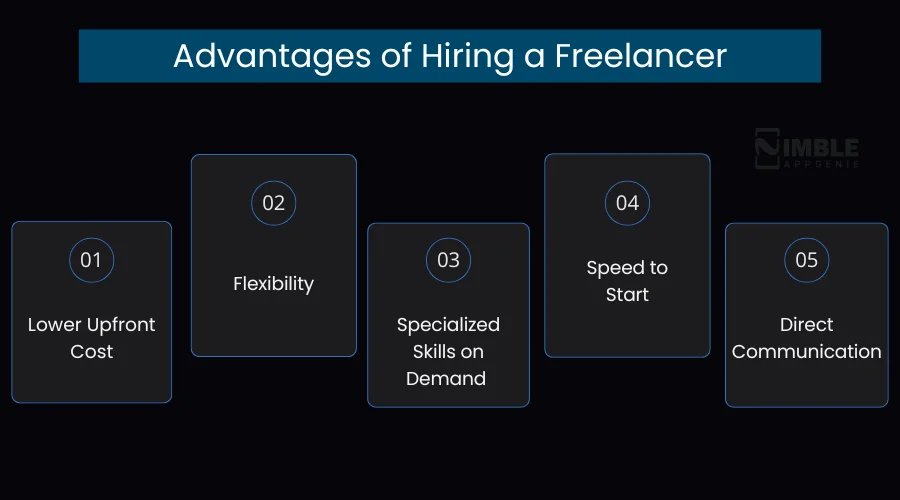
1. Lower Upfront Cost
Freelancers don’t bear the overhead of an agency – no management layers, no office rent. They can be significantly more affordable for a small, defined task.
2. Flexibility
Freelancers can work across time zones, adjust hours, and adapt to your particular communication preferences without bureaucratic delay.
3. Specialized Skills on Demand
If you need a specific react native developer for a 3-week module, a freelancer with exactly that expertise is one search away.
4. Speed to Start
A freelancer onboarding can be done in days, not weeks.
5. Direct Communication
You interact with the person who is actually doing your work. There are no layers of account managers between you and the developer.
Disadvantages of Hiring a Freelancer
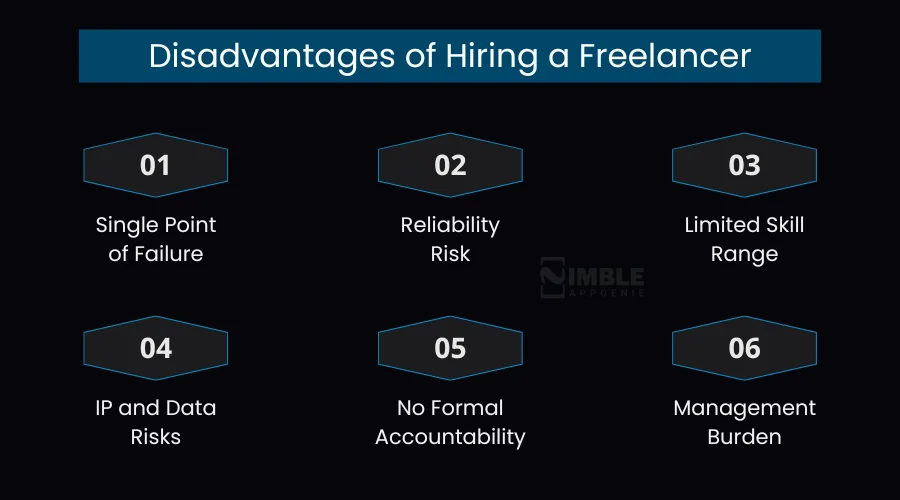
1. Single Point of Failure
If they get sick, disappear, or quit mid-project, you are back to square one; also, your codebase may be poorly documented.
2. Reliability Risk
57%+ freelancers work with more than one client simultaneously. So, your project may not always be their priority.
3. Limited Skill Range
A proficient frontend developer may struggle with QA and backend architecture. You usually need to hire multiple freelance mobile app developers, which adds coordination overhead.
4. IP and Data Risks
Freelancers don’t use secure environments every time. You should include data protection and code ownership clauses explicitly in the contract.
5. No Formal Accountability
There’s no manager to escalate issues in your app development project. It may be challenging for you to resolve disputes and missed deadlines.
6. Management Burden
You become the project manager, which demands your expertise and time that you may not have.
Real Scenario:
A US-based startup hires a freelancer at $20/hr for app development. After accounting for 15–20 hours of their own time spent managing the relationship, reviewing code, and handling knowledge transfer, the effective cost often reaches agency rates, with none of the structural protection.
Pros and Cons of Hiring a Development Agency
Let’s now learn the drawbacks and benefits of hiring a development agency.
Advantages of Hiring a Development Agency
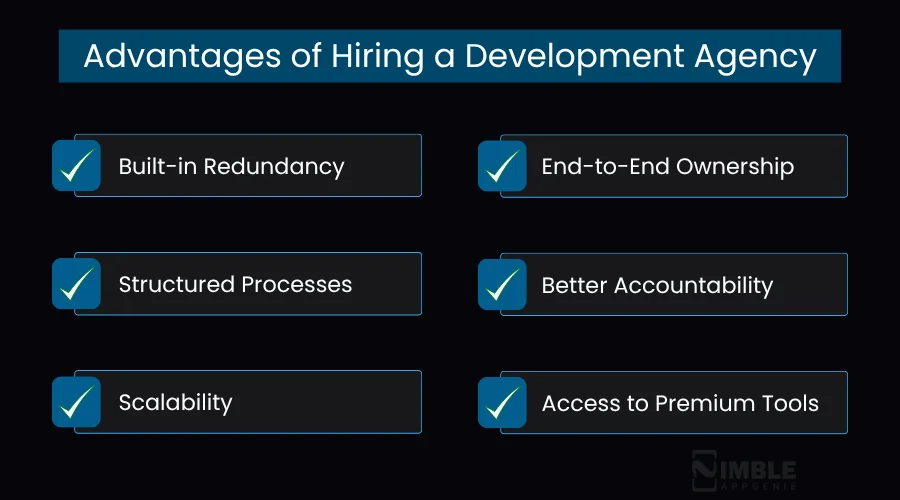
1. Built-in Redundancy
Even if a developer is unavailable or sick, the agency assigns another developer, ensuring your project moves per schedule.
2. End-to-End Ownership
From discovery and design to development, QA, and launch, agencies handle the comprehensive product lifecycle so you don’t have to.
3. Structured Processes
Agencies use milestone reviews, sprint planning, and QA processes that identify issues before they become costly.
4. Better Accountability
Agencies have SLAs, contracts, and reputation to safeguard. They are far less likely to leave a project mid-way.
5. Scalability
If you want to double the speed in Q2, a mobile app development agency can allocate more resources with no need to hunt for new hires.
6. Access to Premium Tools
Top agencies utilize enterprise-grade tools for testing, project management, and security that solo freelancers rarely afford.
An agency’s biggest strength is its structure. If you want to understand what a professional mobile app development team looks like from the inside, who does what, and why it matters, this guide covers it end-to-end.
Disadvantages of Hiring a Development Agency
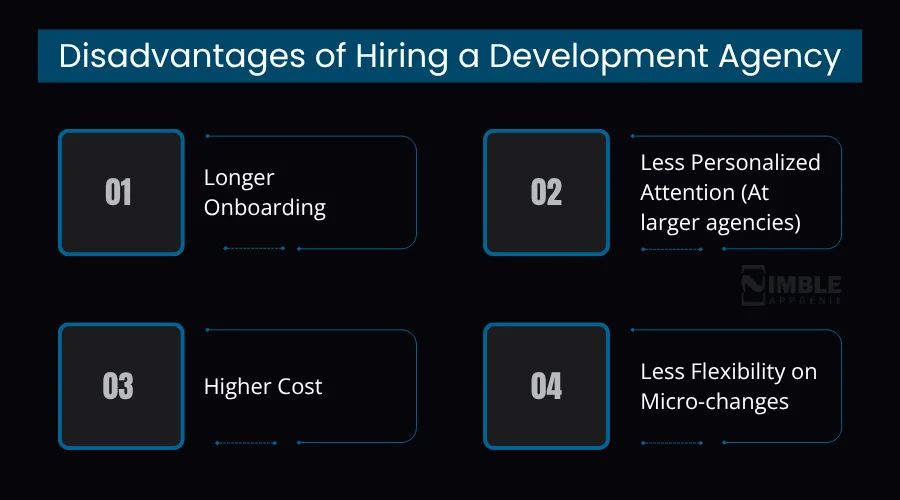
1. Longer Onboarding
Discovery phases and formal contracts take more time upfront than hiring a freelancer.
2. Less Personalized Attention (At larger agencies)
Big agencies may cycle your project through multiple team members, diminishing continuity.
3. Higher Cost
Agency pricing is non-negotiable and structured. This may feel heavy for very small and experimental tasks.
4. Less Flexibility on Micro-changes
In an agency engagement, scope changes may need formal change requests and incur additional cost.
Pro Tip:
The right agency is not always the biggest one. A mid-sized, specialized agency, like Nimble AppGenie, often delivers better communication, continuity, and accountability than a large agency while remaining competitive on price.
5 Factors That Should Drive Your Decision
Now, when you know every aspect relevant to hiring freelancers vs agencies, move forward and run your project through the five questions below:
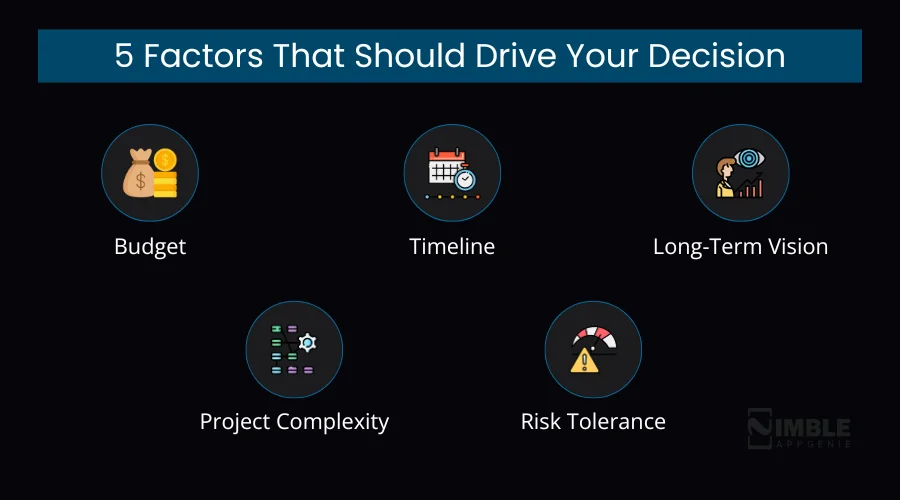
1. Budget
If you have a limited budget of under $5,000 and your scope is tightly defined, choosing a freelancer can be effective.
For complete app development, $30,000–$150,000+, and in that range, if you hire an agency, its structured delivery usually prevents expensive work that takes upfront savings.
2. Timeline
Freelancers can be swift at the start, but slow in the end, especially with the emergence of competing priorities. Agencies have sprint structures, a vested interest in on-time delivery, and dedicated timelines.
3. Long-Term Vision
You can hire mobile developers on a freelance basis for your one-time experiment. But for projects that demand iterations, ongoing support, and new features, an agency is the best option to hire as a lasting technology partner, rather than just a vendor.
If scalability and continuity are priorities for your project, a dedicated development team model might be exactly what you need – combining agency-level accountability with the flexibility of an extended in-house team.
4. Project Complexity
For a simple project, a freelancer will work better. But the more complex your project is, the more you need a coordinated team setup, regardless of whether you are a solo operator.
5. Risk Tolerance
Can you manage a 3-month delay when your freelancer disappears? Can your company bear the cost of a security vulnerability if an independent contractor didn’t follow the best practices? If your answer is no, risk mitigation justifies an agency alone.

Cost of Hiring a Freelancer vs. an Agency
The first thing people look at while considering freelancer vs agency, which is better for a small business, is budget, and here most comparisons stop early.
Is it cheaper to hire a freelancer or an agency for app development? Well, the hourly rate is the surface figure; the real cost goes deeper. This section will help you understand better.
What Freelancers Actually Cost?
Freelancers typically charge between $15 and $150/hr, depending on their location, skill level, and platform. A developer from South Asia may quote $20/hr, while someone from the US or Western Europe may charge $80–$150/hr for the same role.
Sounds affordable until you add:
- Cost of rework when quality doesn’t meet expectations
- Your own time spent managing them (5–15 hrs/week easily)
- Hiring a second freelancer when the first one disappears
- Delays from miscommunication or competing client priorities
- No post-launch support unless renegotiated separately
What Agencies Actually Cost?
Agencies charge $75-$250+/hr or work on fixed-price project models. A full mobile app build typically ranges from $30,000 to $150,000+, depending on complexity.
What that price includes:
- A complete team – developer, designer, QA, and project manager.
- Structured sprints, milestone reviews, and delivery timelines
- NDA, IP transfer, and formal contracts
- Zero management burden on your end
- Post-launch support and maintenance
The Real Cost Comparison
| Cost Factor | Freelancer | Agency |
| Hourly Rate | $15–$150/hr | $75–$250/hr |
| Management Time | High (you manage) | None (PM handles it) |
| Rework Risk | High | Low |
| Post-Launch Support | Rarely included | Typically included |
| Total Cost (Full App) | Unpredictable | Predictable, fixed-scope |
Before you finalize your budget, understand what individual developer hiring actually looks like in numbers. Check out our detailed breakdown of the cost to hire an app developer by tech stack, region, and experience level.
Bottom Line: A freelancer at $30/hr who requires 3x the hours, 2x the revisions, and handover an undocumented codebase will cost you more in stress and money than an agency that quoted $80/hr from the beginning.
When to Choose a Freelancer?
Now, you would like to ask: How do I choose between a freelancer and an agency?
Here, we will explore when freelancers are an ideal choice:
- Your budget is actually limited, and the task doesn’t need cross-functional expertise.
- Your project is clearly defined with a small scope (for example, you want to fix a specific bug, design a logo, and build one feature)
- You have the internal caliber to manage the freelancer, handle knowledge transfer, and review their work.
- You need a very particular skill that’s challenging to find when you hire mobile app development company.
- You are running an MVP test or short-term experiment before moving ahead with full-fledged app development.
If you’re still weighing individual talent over team structure, here’s everything you need to know before you Hire App Developers, from vetting portfolios to structuring contracts.
When to Choose a Development Agency?
A freelance developer reliability issues are a big concern. You can opt for an app development agency. When? Let’s figure this out:
An agency is the right choice when:
- Your project has various technical components and demands coordinated specialists.
- You are developing a complete product – web platform, mobile app, SaaS, and others that need design, development, testing, and launch support.
- You don’t have the proficiency and time to manage an external developer regularly.
- You are in a regulated industry, such as Fintech and Healthcare, and compliance is non-negotiable.
- You need NDA protection, formal IP ownership, and legal accountability.
- Post-launch maintenance and iterative feature development are included in your roadmap.
Once you have decided an agency is the right fit, the next step is knowing exactly what to look for. Read our complete guide on how to hire app developers to avoid the most common hiring mistakes founders make.
Common Mistakes Businesses Make When Choosing
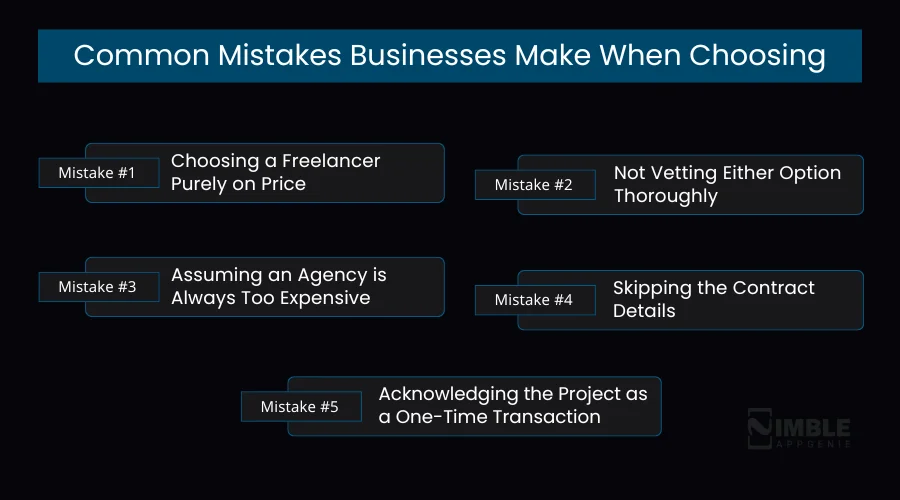
When considering freelancers vs agencies, businesses often make mistakes that lead to missed deadlines, have poor quality code, and experience an unexpected cost increase.
Mistake #1: Choosing a Freelancer Purely on Price
What is the true cost of freelancing? No, not their hourly rate, it’s your time you spend managing them, rework because of poor quality, potential rebuild from scratch if they leave, and the cost of delays. What seems $20/hr to you can easily cost more than an agency at $150/hr.
Many businesses discover too late that hiring cheap locally costs more than choosing the right talent globally. Learn how to hire remote software developers without sacrificing quality, communication, or security.
Mistake #2: Not Vetting Either Option Thoroughly
The difference between a perfect freelancer and a bad one, or between a trustworthy agency and an average one, is huge.
You should always check references, portfolios, and reviews on top platforms like GoodFirms or Clutch, and ask detailed questions about communication and process.
Mistake #3: Assuming an Agency is Always Too Expensive
Various businesses put aside agencies before comparing the complete cost of ownership. An agency with clear milestones and a fixed-price model can be more predictable and cheaper in the long term than a freelancer engagement that becomes unpredictable.
Mistake #4: Skipping the Contract Details
Whether you are hiring a freelancer or an agency, the contract is your safety net. Define revision policies, IP ownership, confidentiality terms, milestone payments, and what happens if either party ends the agreement.
Mistake #5: Acknowledging the Project as a One-Time Transaction
Your mobile app will need updates, the market will shift, and user behavior will change. Treating development as a one-time job leads to technical debt and expensive rebuilds. A good agency relationship is a continuous partnership.
How Nimble AppGenie Gives You Agency Quality at Transparent Pricing
At Nimble AppGenie, a leading mobile app development company, we have developed 350+ digital products for startups, enterprises, and scaleups across Healthcare, Fintech, eCommerce, and Education.
We know what it feels like to get an incomplete project from a freelancer who left it mid-way, and we know what it means to deliver something clients are really proud of.
Here’s what working with us looks like:
- Full IP ownership transferred to you on delivery.
- A dedicated team of developers, designers, QA engineers, and a project manager, all focused on your product.
- NDA signed before any discussion begins.
- Post-launch maintenance, updates, and support included.
- AI integrated into your app’s core – not as an afterthought.
We are not the cheapest option; we are the right option when you need a product that ships on time, works, and grows with your business.
Conclusion
In the freelancer vs agency for app development, there’s no universal winner. There is only the right choice for your specific budget, project, and risk appetite.
Whether your project is a mobile app, a web platform, or both, the principles in this guide apply equally. If your focus is on the web side, our guide on how to hire web developers walks you through every step of finding and onboarding the right talent.
If your task is defined, small, and you are equipped to handle it, a freelancer can efficiently get it done. But if you are creating something that matters, like a platform your customers will utilize every day or a product your business depends on, an agency brings the accountability, structure, and team depth that a freelancer simply can’t.
The smartest businesses we work with don’t ask ‘freelancer or agency?’ They ask: ‘What does this project need to succeed?’ And then they choose accordingly.
If your project needs a team you can trust, one that shows up, communicates clearly, and delivers what it promises – Nimble AppGenie is ready to talk.
FAQs

Richard Thomas is the Lead Architect at Nimble AppGenie, where he oversees the design and development of scalable, secure, and high-performance digital solutions. With deep expertise in software architecture, cloud infrastructure, and system integration, he plays a key role in transforming complex business requirements into robust technical frameworks. When he’s not architecting systems, he enjoys exploring emerging technologies and staying ahead of industry trends.
Table of Contents




No Comments
Comments are closed.