

 Free Consultation
 PCI-DSS Compliant
 GDPR Ready
 ISO 27001
 NDA Protected
 AI Services
 AI App Development
 Generative AI Development
 AI Chatbot Development
 AI Integration Services
 AI Consulting Services
 AI For Fintech
 AI Financial Assistant Solution
 AI Insurance Agent Development
 Tech Stack
 OpenAI / GPT-4
 Claude / Anthropic
 Gemini / Google AI
 Llama / Open Source
 LangChain / LlamaIndex
 Pinecone / Pgvector
 AWS / Azure AI


 Fintech Solution
 Core Fintech
 App Development
 Neobank Solutions
 eWallet Solutions
 Lending Software
 Banking Solutions
 BNPL Solutions
 BNPL Solutions
 Insurance App
 Wealth Management
 Crypto & DeFi
 Blockchain Development
  Payroll Software
 DeFi Solutions
 Crypto Wallet
 Crypto On/Off Ramp
 Crypto Exchange
 Trading Platform
 Payments
 Compliance
 Regulations & Compliance
 Fraud Detection
 Lending Ecosystem
 P2P Lending Platform
 Mortgage Software
 Engagement
 Fintech Outsourcing

 Mobile Development
 Mobile App Dev
 iOS App Development
 Android App Development
 React Native
 Flutter Development
 Web Solution
 Node.js Development
 React.js Development
 Angular Development
 App Services
 UI/UX Design
 App Maintenance
 By Stage
 MVP Development
 Industry Solutions
 Healthcare App Dev
 Education App Dev
 Travel App Dev
 Real Estate App Dev
 Logistics Software
 Social Media App

 Hire Mobile Developers
 Hire iPhone Developers
 Hire Android Developers
 Hire React Native Devs
 Hire Flutter Developers
 Hire Web Developers
 Hire Node.js Developers
 Hire Angular Developers
 Hire PHP Developers
 Hire Laravel Developers
 How It Works
 Pre-Vetted Developers
 Ready In 48 Hours
 NDA From Day One
 Replace Guarantee
 Company
 About Us
 Our Work Process
 Portfolio
 Case Studies
 Blog / Insights
 Careers
 Contact Us
 Awards
 Recognition


 Offices


In a Nutshell:
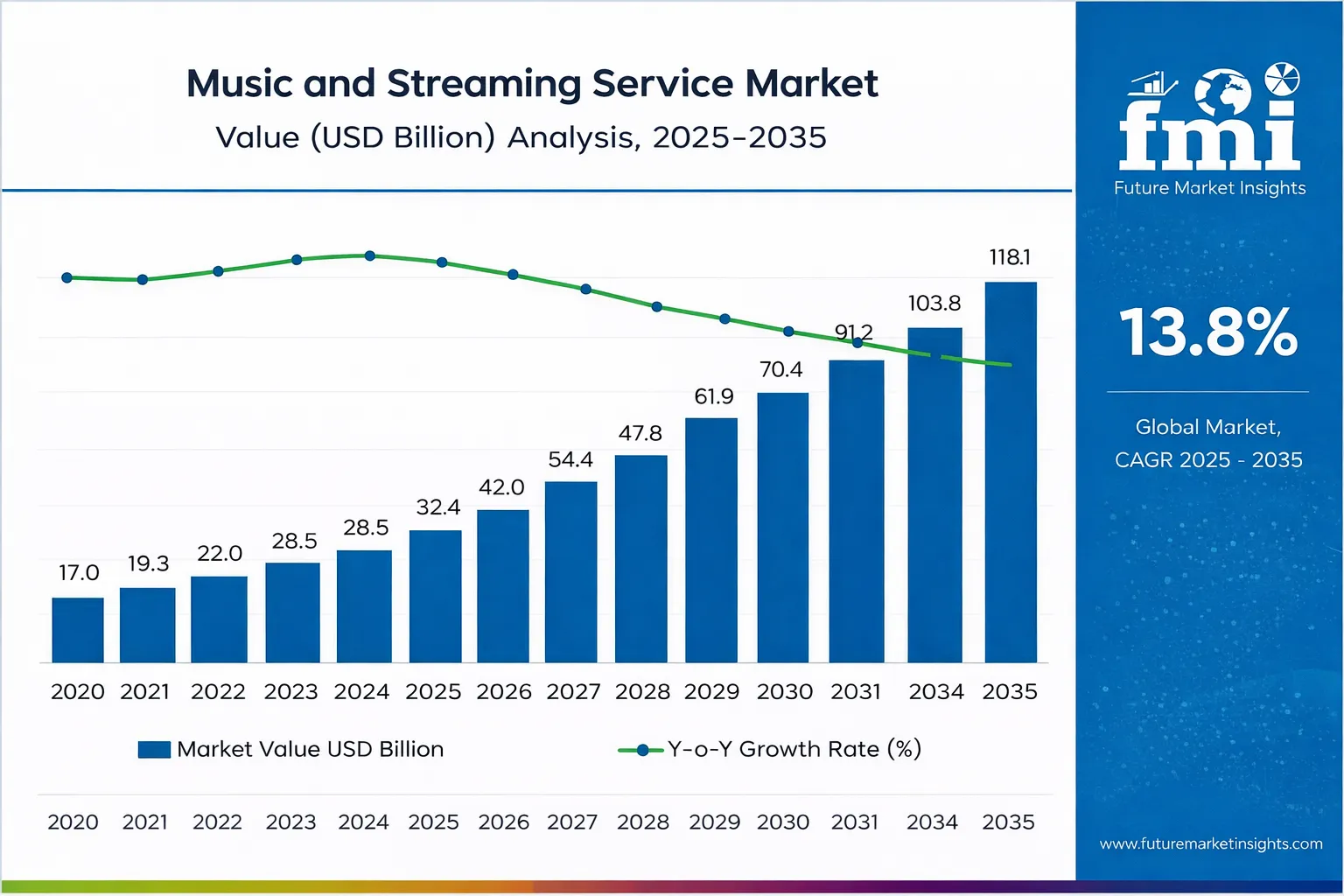
- The demand for AI-powered music streaming apps is growing fast, with the global music streaming market expected to reach $118.1 billion by 2035.
- Developing an app like Spotify focuses on combining smart AI recommendations with seamless audio playback, personalized playlists, and context-aware music suggestions.
- Businesses that create an app like Spotify can benefit from subscription models, in-app ads, and partnerships, unlocking recurring revenue while keeping listeners highly engaged.
- The estimated cost to build an app like Spotify ranges from $25,000 for basic features to over $250,000 for advanced AI-driven platforms with podcasts and cross-device functionality.
- A successful Spotify-like app requires smooth UX, high-quality streaming, and AI music features for personalized recommendations, playlist curation, and user engagement analytics.
- The future of AI-powered music app development will emphasize smart discovery, real-time personalization, predictive playlists, and scalable solutions with expert partners like Nimble AppGenie.
To create a music streaming app like Spotify, all you need to do is include the right features and adopt for the prompt process. This all begins with evaluating the scope of your app, performing a market study, designing the app, selecting a tech stack, testing, and then deployment.
Spotify is one of the leading music streaming apps. The platform currently offers over 100 million tracks, 7 million podcasts, and 350,000 audiobooks.
Well, for developing a platform like Spotify, it’s not essential that you need to offer this many songs and such a large number of tracks. You can be the next Daniel and Martin by identifying a niche and a problem, then filling it with your app.
If you are an investor or an entrepreneur, looking to create a Spotify-like platform, then it’s the right place. We have all discussed it in this guide.
Let’s move ahead together.
What is Spotify?
Spotify is the world’s leading audio streaming service, which offers free ad-supported listening and even paid premium subscription for offline, high-quality audio.
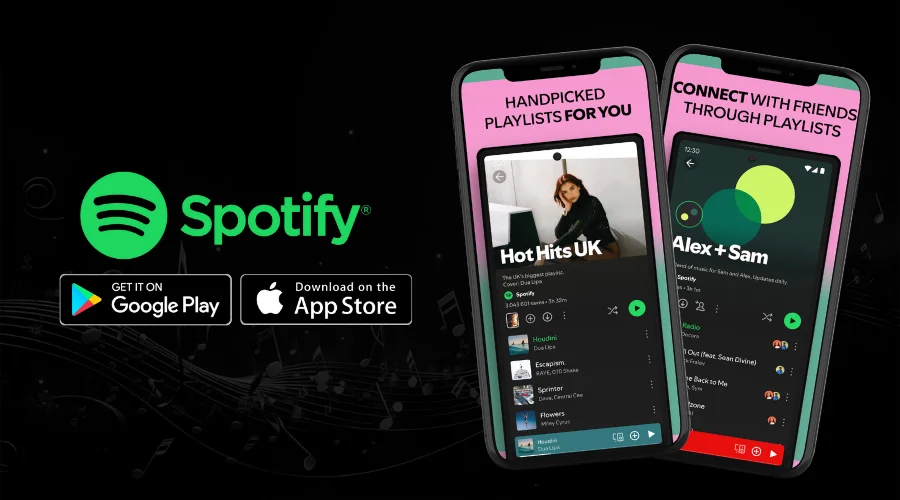
The key features of the Spotify app are that it has streaming options, a large content library, is available on iOS and Android, and can be integrated into different smart speakers and car systems.
The app operates on a freemium model, offering ad-supported free listening or a premium subscription for online and high-quality audio.
Let’s check out some of the related music streaming app market stats:
- The music streaming service market is estimated to be valued at USD 32.4 billion in 2025 and is projected to reach USD 118.1 billion by 2035.
- When it comes to Spotify, the platform is the world’s most popular audio streaming subscription service with 751 million users, which comprises 290 million subscribers, in 184 markets.
- As per the results of the fourth quarter 2025, the premium subscribers grew by 10% to 290 million, and the total revenue increased by 13% to €4.5 billion.
Well, if you are not yet convinced to build an app like Spotify, then let’s quickly cover the reasons to proceed.
| App | Availability | Total Downloads | Rating |
| Spotify | iOS & Android | 1B + | 4.8/5 |
Why Build an App Like Spotify in 2026?
You should create an app like Spotify because people are comfortable paying for subscriptions, it can help you earn a high revenue, and it is effective for audio engagement.
Let’s learn them all in detail:
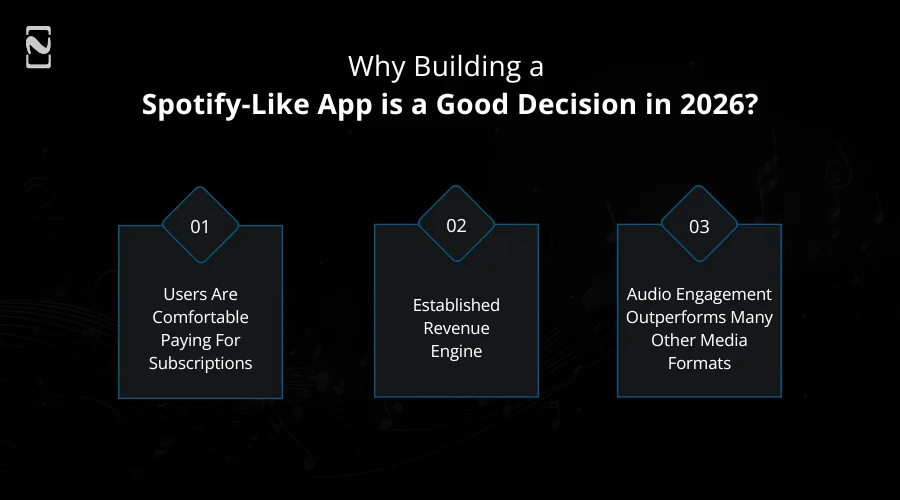
► Users Are Comfortable Paying For Subscriptions
Subscription services are no longer a niche product. By 2025, the best music streaming apps had more than 750 million paying subscribers worldwide. These users have already demonstrated a willingness to pay for better digital experiences.
Something your app can tap into if it delivers real value. This is crucial: you do not need to convince the market that subscriptions work; the market already accepts them.
► Established Revenue Engine
Unlike emerging tech categories that are still unproven, music streaming already generates significant global income. In 2025, streaming revenue reached approximately $60.5 billion, and analysts project it will grow to about $73.7 billion in 2026.
This growth is not slowing down; it is fueled not just by more users, but by more users who are willing to pay. For you, this means the market demand is real, not speculative, and the best time to develop an app like Spotify.
► Audio Engagement Outperforms Many Other Media Formats
People integrate audio into daily life more naturally than many other digital formats. Whether it’s during a commute, a workout, or while working, audio fits into routines without demanding full visual attention.
This makes user engagement more consistent and measurable, a big plus for retention and lifetime value. So, if you are planning to start an online music streaming business, this is the perfect time to earn huge revenue.
What are the Core Features Required to Build an App Like Spotify?
The key features that you can include in an app like Spotify are user authentication, search functionality, playlist creation, lyrics display, offline listening, and high-quality audio streaming.
Let’s evaluate the complete list of music streaming app features below:
| Category | Feature | Description (Short) |
| Core | User Authentication | Secure login/signup via email, phone, or social accounts. |
| Core | High-Quality Audio Streaming | Smooth, buffer-free music playback. |
| Core | Search Functionality | Quickly find songs, artists, and podcasts. This will enhance user retention. |
| Core | Playlist Creation | Create, edit, and manage personal playlists. |
| Core | Push Notifications | Alerts for new music, updates, and offers. |
| Core | Offline Listening | Download and play music without the internet. |
| Core | Lyrics Display | View synced lyrics while listening. |
| Smart / AI | AI Music Recommendations | Suggest songs based on user listening habits. AI in music streaming is doing wonders. |
| Smart / AI | Mood-Based Playlists | Auto playlists for moods like chill, workout, focus. |
| Smart / AI | Context-Aware Suggestions | Music based on time, location, or activity. |
| Social | Collaborative Playlists | Create and edit playlists with friends to make music discovery easy. |
| Experience | Cross-Platform Playback | Seamless listening across devices. |
| Content | Podcasts & Exclusive Content | Access podcasts, interviews, and unique releases. |
| Creator Tools | Artist Analytics | Insights on listeners, trends, and engagement. |
Now, after evaluating the features, let’s get ahead with a complete working process to develop an app like Spotify in the following section.
How to Develop an App Like Spotify: Step-by-Step Process
You can create an app like Spotify by following the given steps:
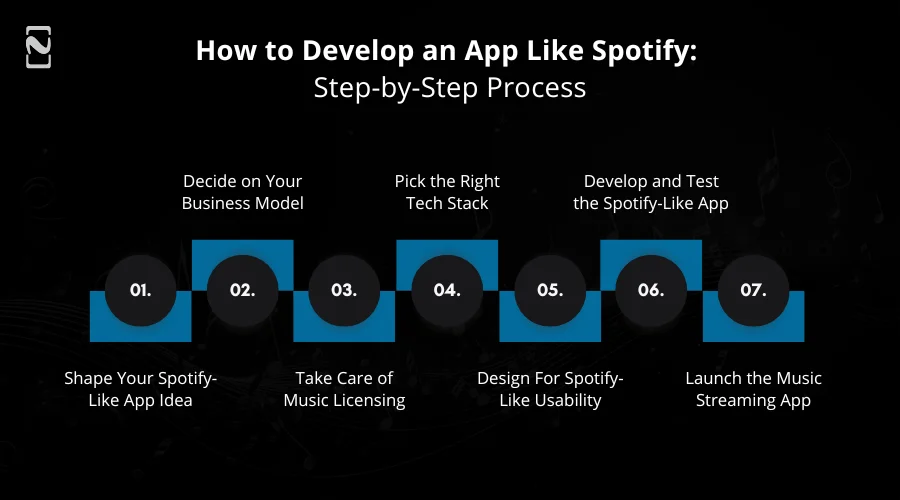
- Performing Market Research
- Decide on Your Business Model
- Take Care of Music Licensing
- Pick the Right Tech Stack
- Design like Spotify
- Develop and Test
- Launch and Maintain
Now, let’s get ahead to the details:
Step 1: Shape Your Spotify-Like App Idea
You should define the scope of your Spotify-like app idea. This should cover what your app would look like and how it can reach the target audience. Here, you should define the market, how you will connect the artist, and all other related things.
Understanding your target audience is the key to a successful app. Therefore, you need to opt for proper mobile app market research and need to identify your audience.
Before you develop a music streaming app, just imagine your app as a Spotify alternative. You can think about how users will discover songs, create playlists, and follow artists.
Step 2: Decide on Your Business Model
A Spotify replica cannot survive without a proper business and revenue plan. You have to decide whether you will offer free listening with ads, premium subscriptions, or a mix. Maybe you can offer tiered plans, exclusive content, or artist partnerships?
Your business model is primarily responsible for design and feature decisions. For example, premium users may get offline downloads or higher-quality audio.
Therefore, if you plan this, it will make sure your music streaming app balances user value and revenue potential, just like Spotify. However, it also gives you flexibility to grow and experiment with monetization.
Step 3: Take Care of Music Licensing
Spotify succeeds because it has millions of licensed tracks. Your app requires similar legal licensing. Before you can develop an app like Spotify, you will need to deal with record labels, independent artists, and performing rights organizations.
This ensures your users can listen without interruptions and protects you legally. Besides just licenses, you also have to think about exclusive tracks, curated playlists, or indie artist partnerships. It will help in making your app unique.
It is advisable not to skip this stage. Getting licensing right is both a legal necessity and an opportunity to differentiate your Spotify-like app from competitors.
Step 4: Pick the Right Tech Stack
In this stage, you have to carefully choose the tech stack for your music streaming app development. Spotify works smoothly because of a solid tech foundation, and your app needs the same.
You can use backend frameworks like Node.js or Python, databases like PostgreSQL or MongoDB, and cloud services. Besides, you can add streaming protocols, CDNs for instant song delivery, and frontend frameworks for mobile apps.
This mobile app tech stack ensures your Spotify-like app handles millions of streams, scales as your audience grows, and delivers smooth playback on every device.
| Layer | Technologies (Examples) | Purpose |
| Frontend | React Native, Flutter, Swift, Kotlin | Build mobile/web user interface |
| Backend | Node.js, Django, Spring Boot | Handle logic, APIs, and user requests |
| Database | PostgreSQL, MongoDB | Store users, playlists, metadata |
| Audio Streaming | WebRTC, HLS (HTTP Live Streaming) | Deliver smooth music playback |
| Cloud & Hosting | AWS, Google Cloud, Azure | Storage, servers, scalability |
| CDN | Cloudflare, AWS CloudFront | Fast audio/content delivery globally |
| Authentication | Firebase Auth, OAuth 2.0 | Secure login and user management |
| AI/ML | Python, TensorFlow | Recommendations and personalization |
| Notifications | Firebase Cloud Messaging (FCM) | Push alerts and updates |
| Analytics | Google Analytics, Mixpanel | Track user behavior and engagement |
| Payments | Stripe, Razorpay | Subscriptions and transactions |
Step 5: Design For Spotify-Like Usability
Spotify’s mobile app design is simple yet addictive, and your app should also feel similar. Your target audience should effortlessly browse playlists, follow artists, and discover new music. Additionally, you can make a smooth onboarding, so new listeners can start exploring immediately.
Moreover, keep in mind that the visuals, colors, and animations should reflect your brand while keeping navigation intuitive. You should focus on pleasure and convenience.
Each swipe or tap should feel natural. A visually appealing music streaming app design helps users spend more time in your music streaming app, discover more music, and feel connected to your Spotify-like experience.
Step 6: Develop and Test the Spotify-Like App
Once the music streaming app design is complete, development begins. This is where your Spotify-like app idea starts to take real shape. The dedicated development team turns mockups and prototypes into functioning code.
This carefully builds the music app’s framework while making adjustments along the way. After development, mobile app testing takes over. The app is tried in real-world conditions, errors are spotted, and improvements are made.
This two-stage process ensures your Spotify-like app is stable, smooth, and ready to handle users confidently from day one.
Step 7: Launch the Music Streaming App
Releasing your Spotify-like app is just the beginning. You have to watch how users interact with playlists, recommendations, and search. It is vital to collect user feedback and analytics to improve features, fix bugs, and add content users love.
Additionally, for further updates, you should connect with the leading mobile app maintenance services, which know well when it’s the right time to maintain and update your music streaming app.
How Much Does it Cost to Develop an App Like Spotify?
The cost to build a music streaming app like Spotify can range from $25,000 to $250,000 or more, based on your project requirements.
To correctly estimate the cost to develop an app like Spotify, you have to thoroughly analyze different variables like app complexity, features, platform choice, etc.
Let’s say you want to build a simple music streaming app with only core features; the cost can start from $25,000 to $100,000.
However, this music streaming app development cost can be between $100,000 – $200,000 for a complex Spotify-like app with advanced features.
But above all, if your budget is quite good and you want to create a podcast app with a music streaming service, the cost can go beyond $250,000.
In simple terms, the cost to create an app like Spotify is based on the complexity of your app.
Let’s understand the Spotify app development cost with the table given below :
| Factor | Impact on Cost | Estimated Cost Range Contribution |
| App Complexity | Basic vs advanced features (AI, offline, podcasts) | $5,000 – $80,000 |
| Platform (iOS/Android/Web) | Single vs multiple platforms | $5,000 – $40,000 |
| UI/UX Design | Simple vs custom, interactive design | $3,000 – $25,000 |
| Backend Development | Server, APIs, database setup | $7,000 – $50,000 |
| Audio Streaming Setup | High-quality streaming & CDN integration | $5,000 – $30,000 |
| AI & Recommendations | Personalization and smart suggestions | $5,000 – $35,000 |
| Third-Party Integrations | Payments, analytics, authentication | $2,000 – $15,000 |
| Team & Location | Developer rates (local vs offshore) | $5,000 – $50,000 |
| Maintenance & Updates | Ongoing support and improvements | $3,000 – $25,000/year |
How to Monetize Your App Like Spotify?
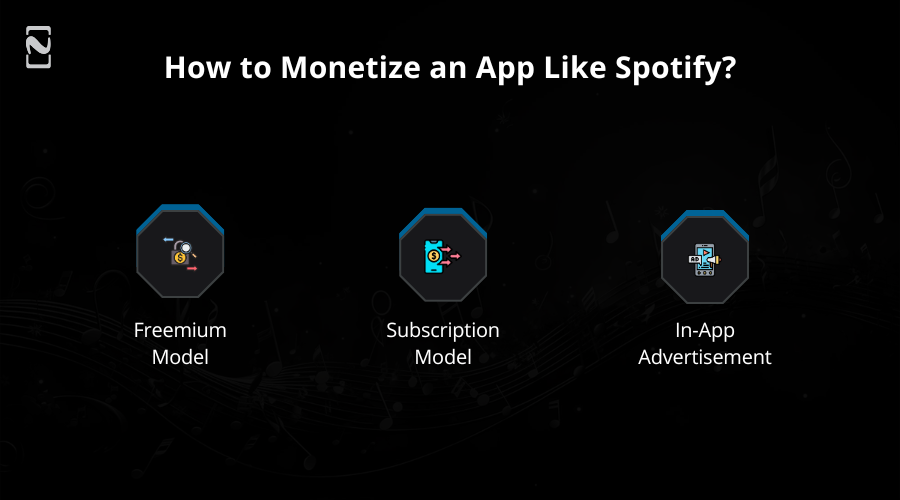
You can monetize your app like Spotify through a freemium model, paid subscriptions with premium benefits, and in-app advertisements, attracting free users, and generating steady revenue through ads and tiered plans.
Let’s deeply understand these common monetization strategies that you can take into consideration.
► Freemium Model
Spotify’s freemium model allows users to access the app for free and gives them a taste of the experience before asking for payment. Free users can listen to music with ads or limited features. However, premium users get benefits like offline mode and personalised recommendations.
| Spotify has over 60% Premium subscribers who were once free users. |
The Freemium model is an effective app monetization strategy that allows you to engage users through providing limited services for free. Once they are convinced, they can opt for a subscription model.
► Subscription Model
One of the most used music app monetization strategies is the subscription model. This is one of the important and significant strategies that replaces volatile one-time purchases and offers high-lifetime value (LTV) subscribers.
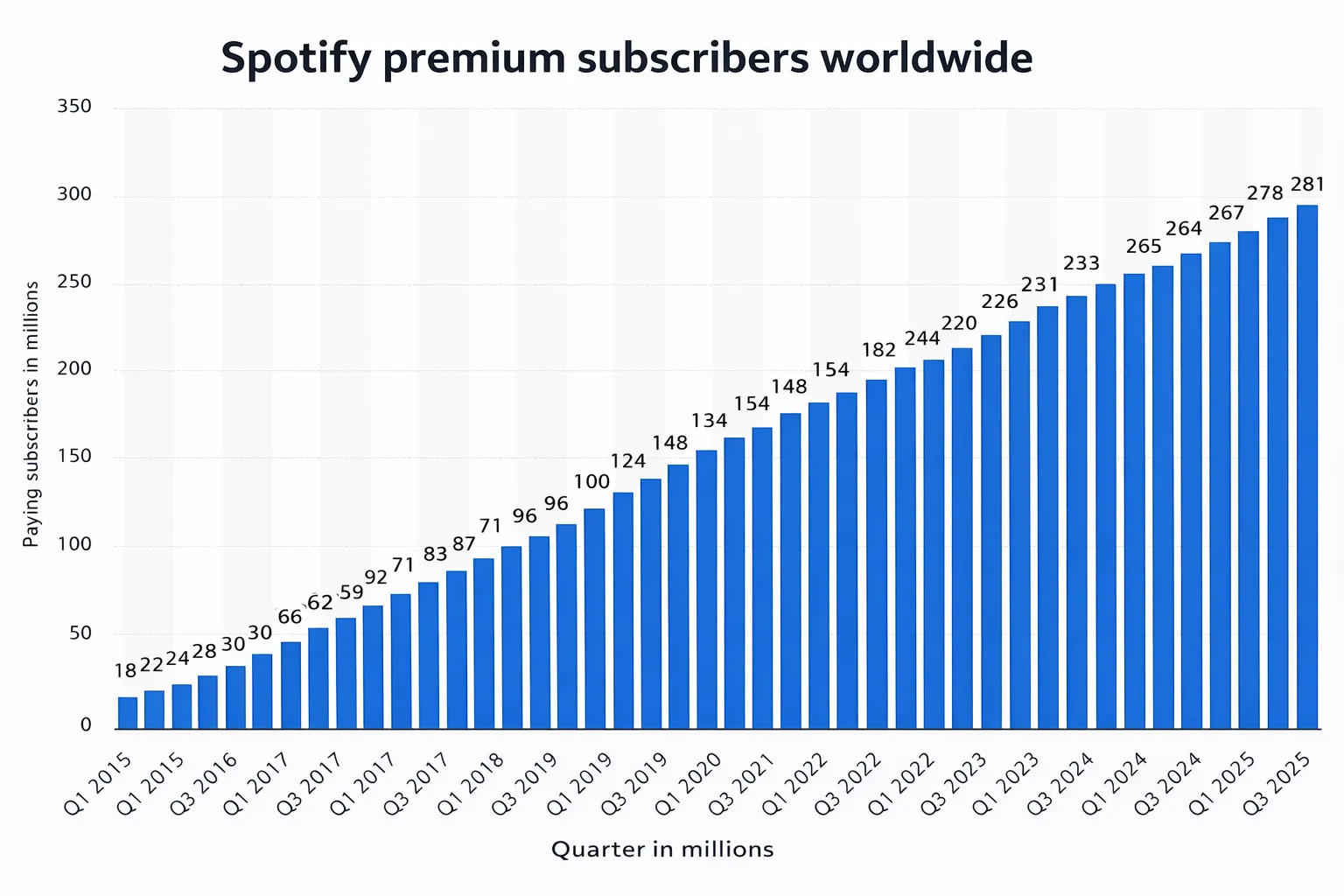
| As per Statista, Spotify had 281 million paid subscribers globally in 2025. |
You can provide tiered plans as Spotify does. A student plan, an individual, and a family plan. The goal is to make the upgrade feel worthwhile. This gives listeners features they can’t get for free, while ensuring predictable, recurring revenue that grows as the user base expands.
► In-App Advertisement
Spotify’s free tier runs audio and shows ads between songs. This allows anyone to listen without paying. Similarly, your music streaming app can generate revenue by partnering with brands for ads or sponsored playlists. It is vital to carefully time ads so they do not frustrate listeners.
| In 2022, Spotify’s ad profit accounted for $1.56 billion. By 2027, ad revenue is projected to hit $2.2 billion. |
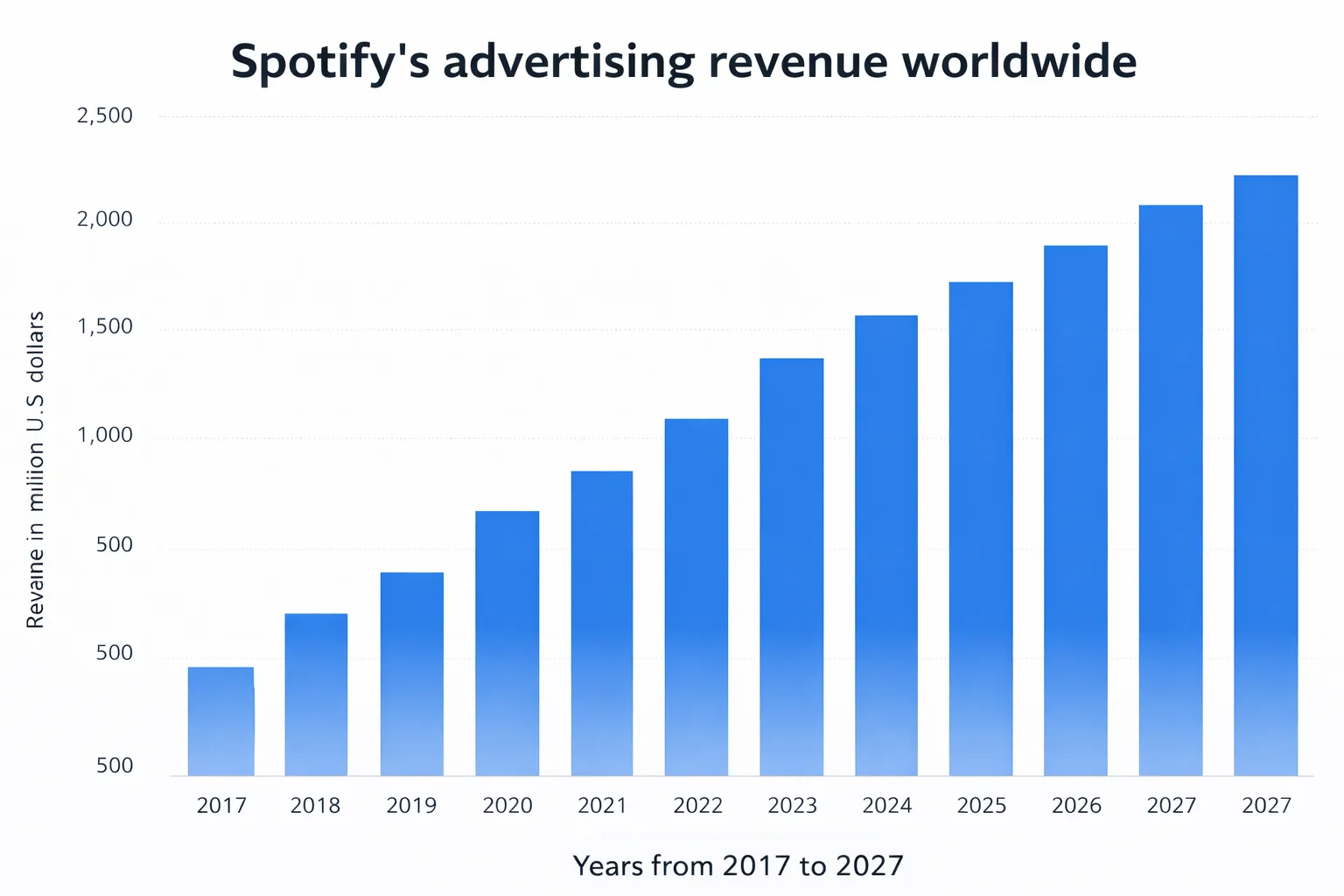
For example, short breaks or banners while browsing. The more active listeners you have, the more impressions you deliver, and the higher your earnings. If you run the correct ads, it allows you to keep the app free while still generating a huge profit.
What are the Challenges to Developing a Music App Like Spotify and How to Solve Them?
Creating a music app like Spotify comes with several technical, legal, and business challenges, such as licensing, scalability, user engagement, and performance. Understanding these challenges in advance will help you in planning effective solutions and building a successful streaming platform.
We will discuss the music app development challenges and their potential solution in this section:
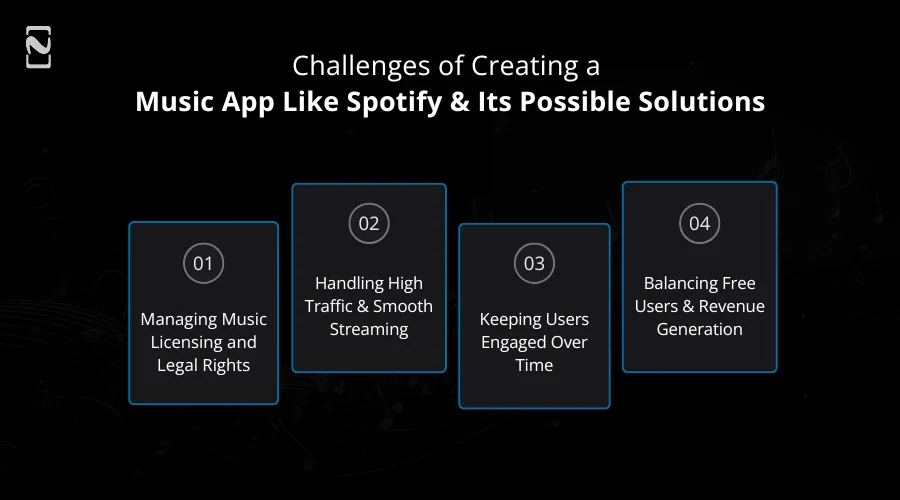
➤ Managing Music Licensing and Legal Rights
One of the biggest challenges in creating a Spotify-like app is managing music licensing. You can’t just stream songs without proper permissions, and licensing rules vary from country to country. This can feel overwhelming at first.
Solution :
You can plan licensing and work with music rights firms, record labels, or independent artists. Besides, you can start small by focusing on specific regions or indie creators. This approach reduces legal risk and allows you to grow your music library gradually and safely.
| License Type | Purpose (Why It’s Needed) |
| Music Streaming License | Allows streaming songs legally to users |
| Mechanical License | Covers reproduction of music (downloads/offline listening) |
| Public Performance License | Permits playing music publicly via the app |
| Synchronization License | Needed if music is used with video content |
| Publishing Rights License | Pays songwriters/composers for their work |
| Master Rights License | Grants rights to use the original recording (owned by labels) |
| Podcast License | Rights to stream and distribute podcast content |
| DRM License | Protects content from piracy and unauthorized use |
➤ Handling High Traffic and Smooth Streaming
Apps like Soundcloud and Spotify manage millions of users listening at the same time, and matching that level of performance is not really easy. Poor audio quality, buffering, or a music streaming app crashes can quickly drive users away.
Solution :
You should develop a strong technical foundation with cloud infrastructure and content delivery networks. These systems distribute audio efficiently, so songs load quickly. It is best to start with scalable technology like ML to make sure your app performs well today and can grow smoothly as your audience increases.
➤ Keeping Users Engaged Over Time
Getting users to download your music listening app is only half the battle. The real challenge is keeping them coming back. Music apps compete for attention, and users can easily switch platforms.
Solution :
You can focus on user behavior and listening habits. By analyzing how people interact with the app, you can improve recommendations, refresh playlists, and personalize the experience. When users feel the app understands their taste, they’re more likely to stay loyal and use it daily.
➤ Balancing Free Users and Revenue Generation
Spotify’s success comes from balancing free listeners and paid subscribers, and this balance is hard to achieve. Too many advertisements frustrate users, while too few hurt revenue.
Solution :
Mobile app developers can design a thoughtful freemium model. Free users should enjoy enough value to stay engaged, while premium users clearly see the benefits of upgrading. Limited restrictions and meaningful premium benefits help convert free listeners into paying customers without harming the experience.
How AI is Transforming Music Streaming Apps Like Spotify?
AI is making music apps smarter. Apps like Spotify can now suggest songs users will love, create playlists for their mood, and help them find new music easily. It keeps listening fun, easy, and more enjoyable for everyone.
Let’s see how AI is impacting music streaming applications like Spotify:
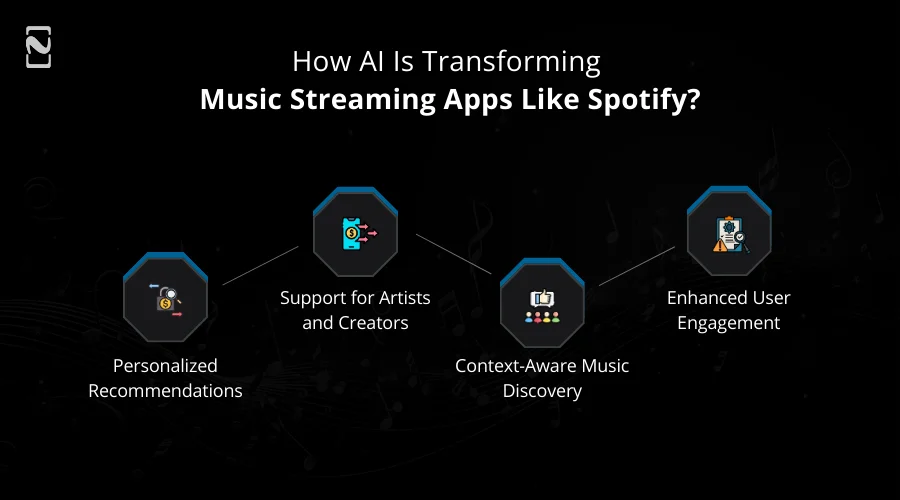
♦ Personalized Recommendations
AI makes music discovery feel personal and easy for every listener. On applications like Spotify, AI‑powered recommendation systems drive about 60% of all song streams by suggesting music.
It is based on listening history, favorite genres, and skipping behavior. This means users spend less time searching and more time enjoying music they love without effort.
♦ Support for Artists and Creators
AI in music streaming apps also supports fairness and quality by helping platforms manage music content better. Some services use automated tagging and content recognition to distinguish real artist uploads from AI‑generated tracks.
This protects creators while keeping recommendations accurate. This helps maintain trust in the app and ensures users hear relevant, high‑quality music that fits their tastes.
♦ Context-Aware Music Discovery
AI helps to customise the music suggestions based on real‑world context like mood, time, and activity.
For example, AI can suggest calm music in the evening or energetic tracks during workouts by learning the user’s listening habits. This makes your music app feel smarter and more helpful throughout users’ daily routines.
♦ Enhanced User Engagement
AI boosts user engagement and better user retention for your app. It is because recommendations match what users enjoy most that people spend more time listening, exploring, and discovering.
It is the tendency of the users that when they feel understood, they are more likely to stay active, come back often, and even use features such as playlist, which fosters trust.
Also Read: “Best Music APIs”
Why Custom Development Wins Over Spotify Clone?
The reason why custom development wins over Spotify clone is that it can provide niche services and cater to a diversified audience as per their demands.
Furthermore, through custom development, you can identify what gap exists in the market and then cater to the diversified needs accordingly.
Well, we understand that you want to develop a Spotify clone; however, it’s essential to look for custom solutions because a clone can be a replica, but an innovative app can deliver prompt and effective solutions.
Let’s understand why a custom development is best through a given table:
| Aspect | Custom Development | Spotify Clone |
| Flexibility | Fully customizable features & design | Limited to pre-built features |
| Scalability | Easily scales with user growth | May face performance limitations |
| Unique Branding | Strong, original brand identity | Looks similar to existing apps |
| Advanced Features | Can integrate AI, personalization, and innovation | Restricted feature expansion |
| Performance | Optimized for specific business needs | Generic performance |
| Security | Tailored security measures | Standard/basic security |
| Long-Term Value | Sustainable and future-proof | Short-term solution |
Why Partner With Nimble AppGenie to Develop an App Like Spotify?
When you build an app like Spotify, having the right partner makes a big difference. Nimble AppGenie is a trusted music streaming app development company that works closely with clients to understand what they want to build, not just what features to add.
Our expert team explains technical choices in simple terms and helps you make practical decisions. Having more than 8+ years of experience, our focus is on performance, scalability, and real user behavior.
Instead of rushing development, our approach is thoughtful and structured to assist you in avoiding costly rework. Also, launching a music streaming app feels stable, usable, and ready to grow over time.
Real-Time Case Study of Nujaxx – Music Streaming Platform
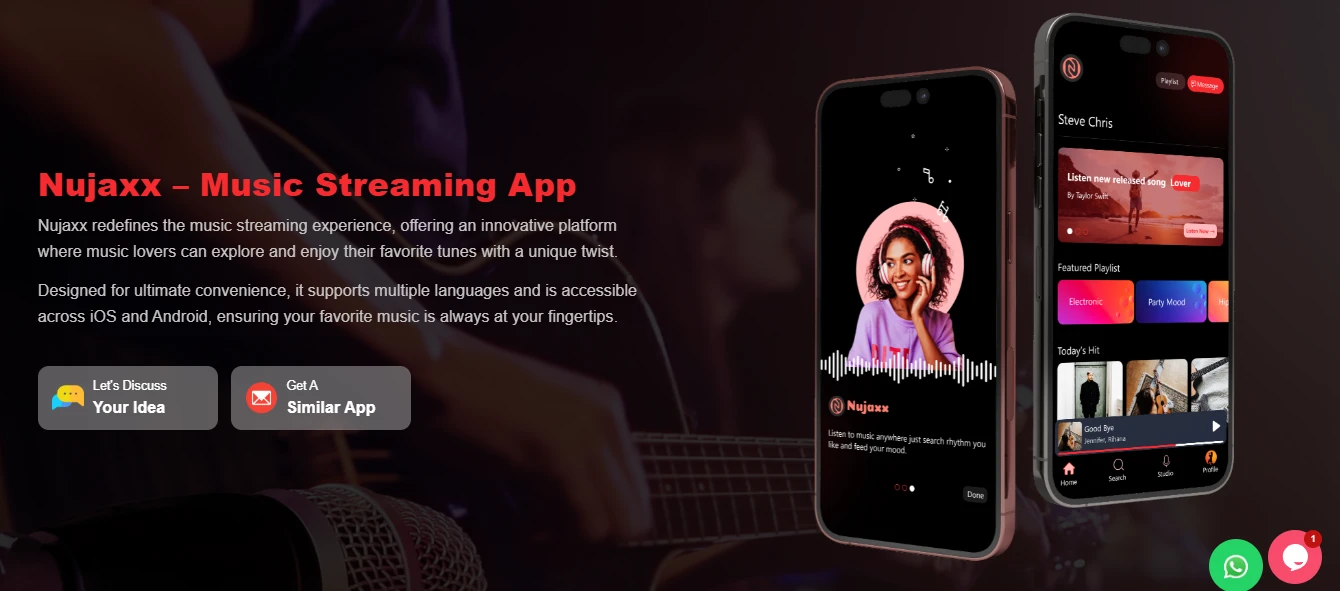
Client Type: A music streaming platform called Nujaxx, targeting music lovers of all ages on iOS and Android.
Challenge: The goal was to build a platform that offered more than just music playback. The client wanted a community-focused app where listeners could engage with artists, explore music easily, and enjoy a seamless experience on multiple devices. Integrating a voucher system to reward both users and artists added a layer of complexity.
Solutions Implemented :
- Developed a native app for iOS and Android with smooth performance.
- Designed a clean, user-friendly interface for easy navigation.
- Integrated a voucher system to engage users and reward artists.
- Focused on real-time streaming and multi-language support for accessibility.
Business Results :
- Delivered a stable and responsive music streaming experience.
- Increased user engagement through the voucher and community features.
- Built a scalable platform ready to grow with the audience.
Key Takeaway :
Nujaxx combines innovative features and the best user experience to create a music streaming app that connects fans and artists. Also, it provides a reliable platform for discovering and sharing music.
Conclusion
Developing a music streaming app like Spotify is a long journey, not a shortcut. You have to carefully consider music rights, user habits, performance, and how the app will actually grow over time. You can choose to integrate the best music APIs like Spotify instead of reinventing everything.
This can help in managing music data and streaming more smoothly. What really matters is execution. Thus, with the right planning and technical support, your Spotify-like idea can turn into a robust solution people genuinely enjoy using every day.
FAQs

Niketan Sharma, CTO, Nimble AppGenie, is a tech enthusiast with more than a decade of experience in delivering high-value solutions that allow a brand to penetrate the market easily. With a strong hold on mobile app development, he is actively working to help businesses identify the potential of digital transformation by sharing insightful statistics, guides & blogs.
Table of Contents




No Comments
Comments are closed.