

 Free Consultation
 PCI-DSS Compliant
 GDPR Ready
 ISO 27001
 NDA Protected
 AI Services
 AI App Development
 Generative AI Development
 AI Chatbot Development
 AI Integration Services
 AI Consulting Services
 AI For Fintech
 AI Financial Assistant Solution
 AI Insurance Agent Development
 Tech Stack
 OpenAI / GPT-4
 Claude / Anthropic
 Gemini / Google AI
 Llama / Open Source
 LangChain / LlamaIndex
 Pinecone / Pgvector
 AWS / Azure AI


 Fintech Solution
 Core Fintech
 App Development
 Neobank Solutions
 eWallet Solutions
 Lending Software
 Banking Solutions
 BNPL Solutions
 BNPL Solutions
 Insurance App
 Wealth Management
 Crypto & DeFi
 Blockchain Development
  Payroll Software
 DeFi Solutions
 Crypto Wallet
 Crypto On/Off Ramp
 Crypto Exchange
 Trading Platform
 Payments
 Compliance
 Regulations & Compliance
 Fraud Detection
 Lending Ecosystem
 P2P Lending Platform
 Mortgage Software
 Engagement
 Fintech Outsourcing

 Mobile Development
 Mobile App Dev
 iOS App Development
 Android App Development
 React Native
 Flutter Development
 Web Solution
 Node.js Development
 React.js Development
 Angular Development
 App Services
 UI/UX Design
 App Maintenance
 By Stage
 MVP Development
 Industry Solutions
 Healthcare App Dev
 Education App Dev
 Travel App Dev
 Real Estate App Dev
 Logistics Software
 Social Media App

 Hire Mobile Developers
 Hire iPhone Developers
 Hire Android Developers
 Hire React Native Devs
 Hire Flutter Developers
 Hire Web Developers
 Hire Node.js Developers
 Hire Angular Developers
 Hire PHP Developers
 Hire Laravel Developers
 How It Works
 Pre-Vetted Developers
 Ready In 48 Hours
 NDA From Day One
 Replace Guarantee
 Company
 About Us
 Our Work Process
 Portfolio
 Case Studies
 Blog / Insights
 Careers
 Contact Us
 Awards
 Recognition


 Offices



| Quick Answer: A custodial wallet lets a third party hold your private keys for you, and a non-custodial wallet puts you in complete, sole control of your own keys – the core tradeoff is convenience and recovery options versus full control and privacy. |
TL;DR
- Custodial wallets trade control for convenience: a third party manages your private key, handles recovery, and generally needs KYC.
- Non-custodial wallets trade convenience for control: you alone hold the private keys, with no recovery option if it’s lost, and no KYC required.
- As of June 2026, global cryptocurrency ownership reached approximately 774 million people. Among surveyed Bitcoin holders, 53.6% primarily used self-custody hot or cold wallets, compared with 41.2% who kept most of their holdings on centralized exchanges.
- Multi-party computation (MPC) is a secure technique used across custodial and non-custodial setups to split key control, not something unique to custodial wallets.
- Nimble AppGenie builds custodial and non-custodial crypto wallet infrastructure for fintech businesses entering the crypto market.
Crypto wallets are generally thought of as an e-wallet that stores cryptocurrency. However, it is not that simple – these wallets work with the blockchain directly to keep your digital assets secure.
If you think your crypto wallet stores your crypto assets directly, that’s a common misconception: the wallet holds a public key that allows you to set up a transaction and a private key to authorize it.
As keys enable transactions, the market offers two basic, distinct approaches to manage them: Custodial Wallets and Non-Custodial Wallets. This guide covers how each works, verified market data, and a clear way to decide between them.
What is a Custodial Wallet?
A custodial wallet is one in which a third party is responsible for managing the private keys of crypto assets for a user.
These third parties are crypto exchange platforms and companies that can manage your private keys. Users usually prefer opting for custodial wallets, as it is typically difficult to manage their private keys.
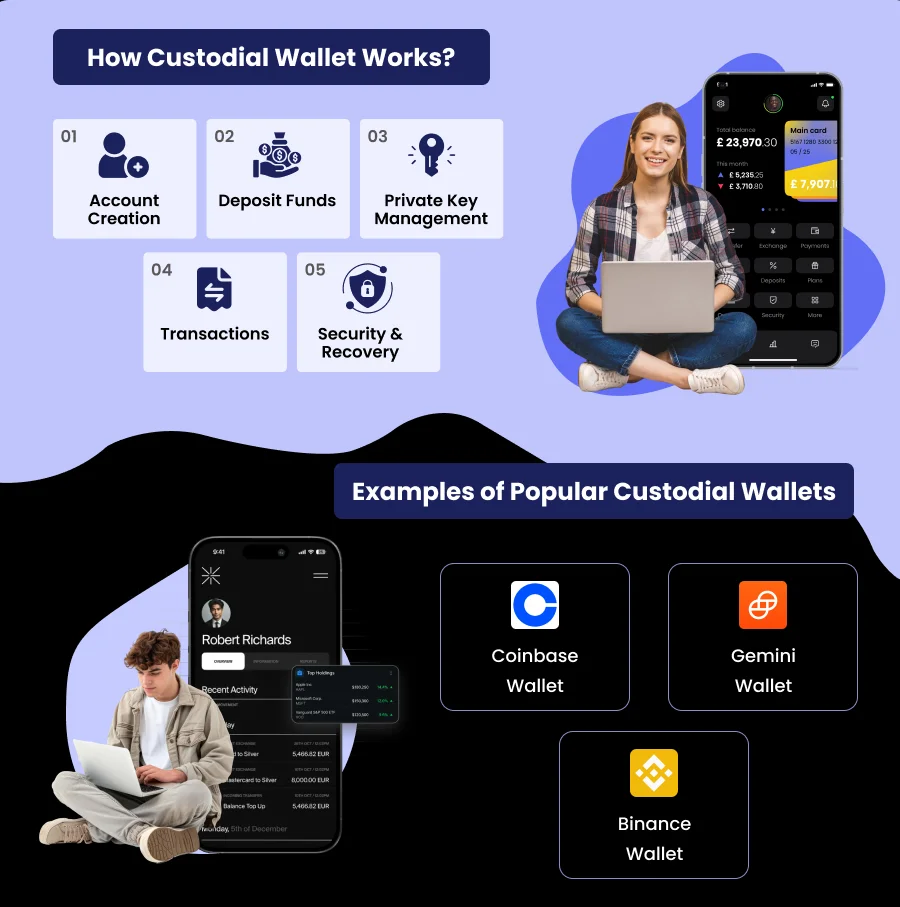
These keys are the fundamental requirements to access your funds, and in case these are lost, all your crypto funds can no longer be accessed.
Allowing a third party to manage these keys helps a user stay stress-free while using the crypto assets at their disposal. Custodial wallets operate much like traditional eWallets. If you need context on how these work, here is what a digital wallet is and the different types that exist.
What Is a Non-Custodial Wallet?
A non-custodial wallet is one where no third party manages a user’s private keys.
The user manages all public and private keys, making the whole system dependent on that individual. Users with a non-custodial wallet get round-the-clock access to their funds, working as their own bank.
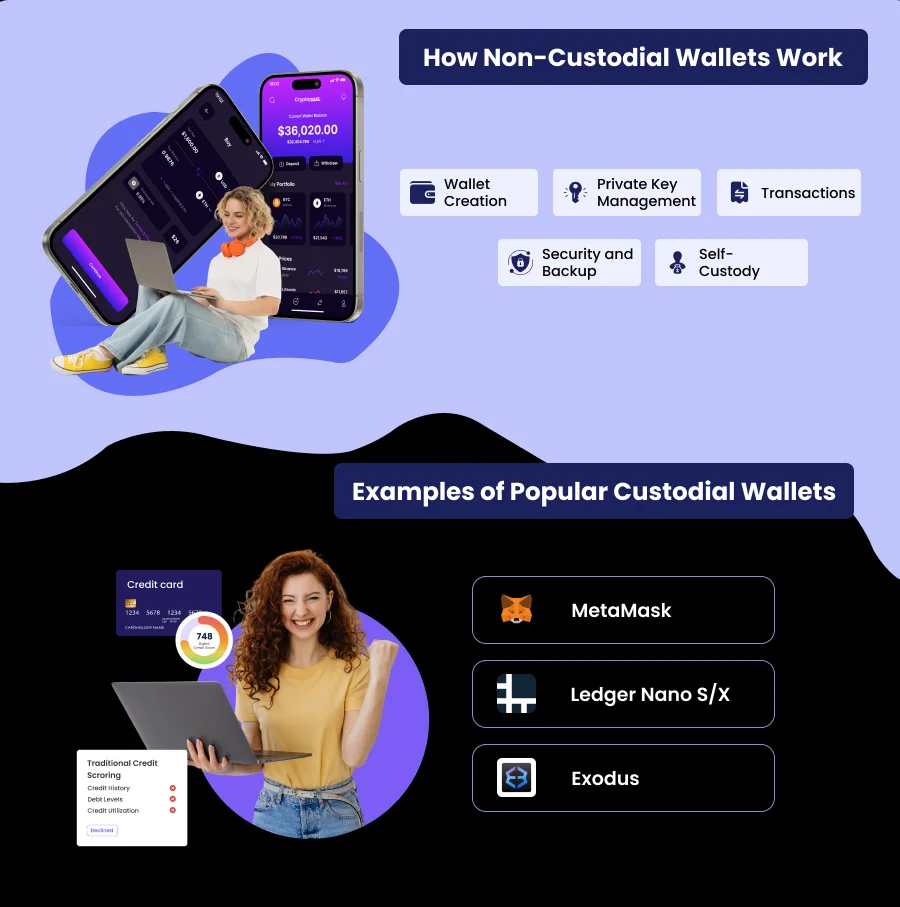
Experienced traders usually choose non-custodial wallets as funds are always accessible. The trade-off is real risk: misplacing, losing, or forgetting a private key means losing access to funds permanently, since there’s no central party to appeal to for recovery.
On the upside, because keys are not exposed to any other party, the chance of a data breach exposing those funds is significantly reduced.
Key Terms
- Private key: A secret code that authorizes transactions and proves ownership of crypto assets; whoever holds it controls the funds.
- Public key: A shareable address used to receive funds, derived from the private key but safe to disclose.
- Seed phrase: A 12-24 word backup phrase that can regenerate a private key if a device is lost, used in non-custodial wallets.
- MPC (Multi-Party Computation): A cryptographic technique that splits control of a key across multiple parties, reducing single-point-of-failure risk – used in both custodial and non-custodial wallet designs, not exclusive to either.
How Big Is the Non-Custodial Wallet Market?
This is the category where market-size estimates vary dramatically depending on the research firm and its methodology – worth knowing before citing any single number as definitive:
- One estimate puts the non-custodial wallets market at $6.43 billion in 2025, reaching $45 billion by 2035 at a 21.5% CAGR. (Source: Wise Guy Reports.)

- A separate report covering the same category puts 2025 at just $1.38 billion, reaching $11.92 billion by 2035 at a 24% CAGR – around 5x smaller than the figure above for the same year. (Source: Global Growth Insights.)

- A broader crypto wallet market (custodial and non-custodial combined) was valued at about $15.54 billion in 2025 predicted to reach $100.77 billion by 2033, a 26.6% CAGR. (Source: Grand View Research).
The user-preference stat is more useful than any single market-size figure here, since it shows actual behavior rather than a modeled projection that varies by 5x across firms.

What Are the Key Differences Between Custodial and Non-Custodial Wallets?
The key difference between these two wallet types comes down to access to the private key – the “custody” of the key itself.
Custodial wallets have a third party managing the key, allowing users to send or receive funds through requests tied to their public key. Non-custodial wallets put the user in sole control, with complete access to crypto assets at any time.
This architecture decision directly impacts the cost of building an eWallet app, since non-custodial builds need more complex key-management infrastructure than custodial ones.
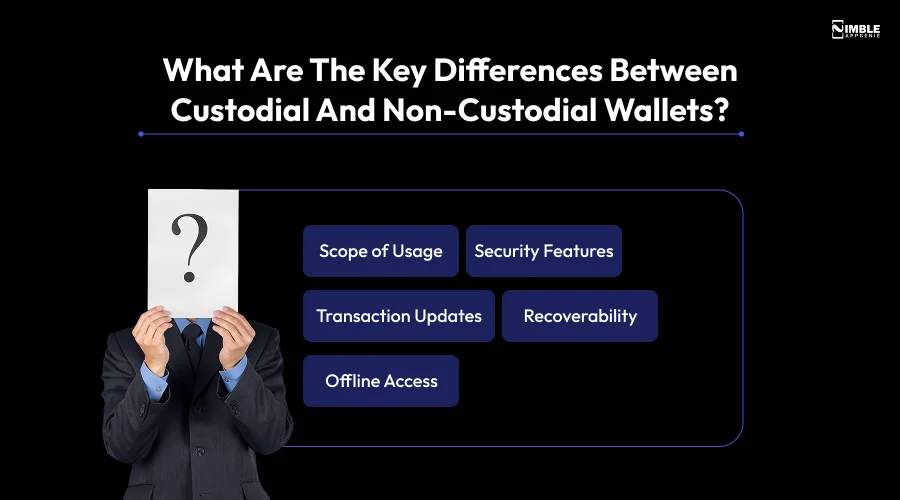
1. Scope of Usage
Custodial wallets generally have a restricted scope: initiating a transaction to send or receive payments. Non-custodial wallets open up everything else, from DeFi interactions to full asset control, which matters for anyone choosing between trading-focused use versus long-term saving, or for startups deciding which model to build into their app.
2. Security Features
Security in a custodial wallet relies entirely on the hardware and software the third party offers; see our broader eWallet security guide for what that should include. Since custodians manage many users’ keys, they maintain dedicated, highly secure data infrastructure, but the private keys are still held by someone else, exposing them to potential data-breach risk.
Non-custodial wallet security is usually considered stronger against external breaches, as keys are never shared, though the user bears complete responsibility for staying alert about their key security.
3. Transaction Updates
Transaction updates in a custodial wallet depend on the third party’s infrastructure and processing time. Non-custodial wallets update in real time as there’s no mediator between the parties involved – a meaningful advantage for traders who need up-to-the-second balance information.
4. Recoverability
Recovery and backup are considerably better with custodial wallets, as the third party manages the key and can restore access after identity verification. Non-custodial wallet recovery is far more limited: as only the user holds the private key, losing it can make assets permanently unrecoverable.
5. Offline Access
Custodial wallets need an internet connection to reach the third party. Non-custodial wallets can be accessed entirely offline.
Apart from these five, factors like support availability, user experience, privacy, and cost also shape the comparison. Here’s the complete picture at a glance:
| Parameter | Custodial Wallet | Non-Custodial Wallet |
| Control | Third party controls private keys and assets | User has full control over keys and assets |
| Security | Dependent on the service provider’s measures | Dependent on how well the user manages their key |
| User Experience | Generally more beginner-friendly | Requires more technical knowledge |
| Recovery Options | Provider can help recover lost access | No recovery if the key or seed phrase is lost |
| Privacy | Requires KYC and regulatory compliance | Greater privacy, often no KYC required |
| Support | Customer support available | No customer support; self-managed |
| Cost | May include service or custodial fees | Typically lower, with no custodial fees |
| Accessibility | Web platforms and mobile apps | Apps, hardware wallets, or browser extensions |
| Trust Model | Requires trusting the service provider | Trustless: self-managed security |
| Transaction Speed | Dependent on provider processing time | Usually faster, directly on the blockchain |
What Are the Pros and Cons of Custodial Wallets?
Based on the differences mentioned, there are various pros and cons of using a custodial wallet. Let’s take a look at them to get a better understanding of why you should or should not choose custodial wallets over non-custodial wallets.
Pros
- A custodial wallet is highly user-friendly, which means even a beginner can easily use it.
- A custodial wallet implies no additional transaction fees, making it pocket-friendly for a user.
- A custodial wallet has less of a risk of losing a key, as the third party can easily help in gaining access.
- Restoring previous versions and undoing a transaction is a possibility that makes it easier and more adaptive to use it.
- Offers dedicated customer care support that gives a user the ability to stay on top of everything, even if something goes wrong.
Cons
- A custodial wallet gives major control of your crypto assets to a third party that is managing your private key.
- When using a custodial wallet, you have to verify your identity to gain access to your crypto assets. This defeats the purpose of using cryptocurrency, as the whole principle is based on anonymity in making transactions.
- A custodial wallet requires you to follow a timeline for accessing your crypto assets. These are not instantly available funds, as you are reliant on a service provider to access them.
What Are the Pros and Cons of Non-Custodial Wallets?
Non-custodial wallets are highly helpful for businesses and can be extremely beneficial to users looking for an autonomous platform to save their crypto assets. However, these are also not bulletproof as they do have some pros and cons. Check them out below –
Pros
- Instant availability of your assets, as you are the authority that manages the private key for access.
- Since you are the only one with access to the private key, the chances of data breaches are significantly reduced. This makes it more secure.
- With a non-custodial wallet, you are not reliant on any third party to gain access, reducing the time taken to liquidate your funds or make any transactions.
- Non-custodial wallets offer real-time updates of transactions, allowing traders to be prompt while trading.
- Allows easy offline access as you do not need to interact with a third party, which usually requires an internet connection.
Cons
- No recovery/backup solution in case you lose access to your private keys.
- The advanced user interface is tough for a user to navigate.
- No customer support is available in case you get stuck, leading to higher chances of losing money if you are a novice.
How Do You Choose Between a Custodial and Non-Custodial Wallet?
This decision isn’t limited to individual users – businesses building a crypto platform, Neobank, or DEX face the same dilemma. Here’s how to work through it:
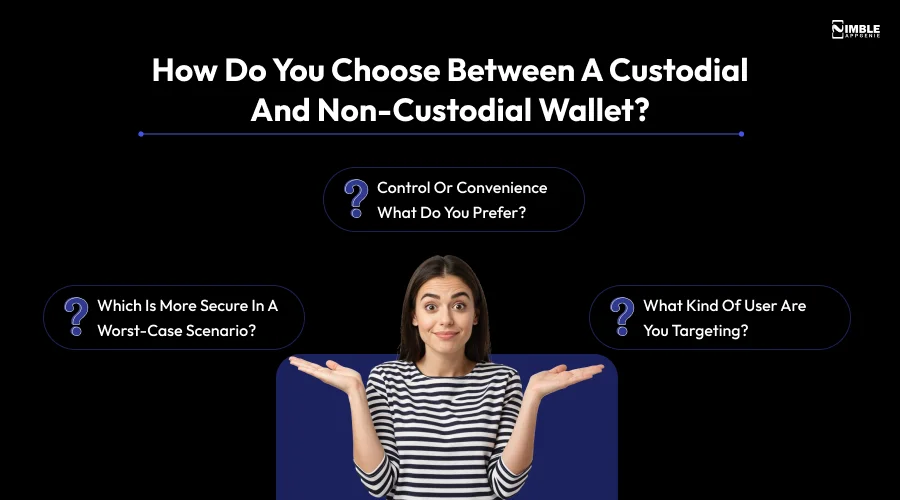
1. Which Is More Secure in a Worst-Case Scenario?
If the wallet provider goes bankrupt, custodial assets may be treated as the company’s assets during liquidation – a real risk of losing funds. Non-custodial assets live on the blockchain itself, independent of any single provider, so a user can just access them through a different provider if one fails.
2. Control or Convenience: What Do You Prefer?
A custodial wallet offers convenience but also gives the provider power to freeze funds during fraud investigations or under government directive. A non-custodial wallet gives complete control over transactions and assets – at the cost of being personally responsible for a 12- 24-word seed phrase, with no safety net if it’s lost.
3. What Kind of User Are You Targeting?
Custodial wallets generally use an internal ledger, making transactions near-instantaneous and sometimes free for high-frequency trading. This makes them suitable for active trading use cases.
Non-custodial wallets involve per-transaction fees and blockchain processing time, making them better for long-term holding than frequent trading. For businesses, a wallet built around trading and rapid transactions generally favors a custodial model.
Answering these three questions should clarify which model fits – whether you are an individual choosing a wallet or a business deciding which model to build.
Nimble AppGenie: Building Crypto Wallets
Choosing the right wallet type for crypto enthusiasts is crucial, and the same decision directly applies to any business building a crypto wallet product, which also needs to identify the features that resonate with their specific users.
Nimble AppGenie helps businesses pinpoint opportunities in the custodial-versus-non-custodial market, also providing complete eWallet app development services customized to each client’s requirements.
Businesses ready to move forward can connect with Nimble AppGenie’s team to build a robust cryptocurrency wallet suiting their target users.
Conclusion
Knowing what you are looking for is the best thing that can happen to you in this uncertain market of cryptocurrency.
Choosing the right wallet as per your requirements and experience in dealing with crypto can be highly beneficial.
Both custodial and non-custodial crypto wallets have their pros and cons. Based on those, you can simply decide on which is the best type of wallet for cryptocurrencies.
If you want the benefits of both without building the full infrastructure yourself, Wallet-as-a-Service is worth exploring as a middle ground.

FAQs
A custodial wallet is a type of crypto wallet that gives access to or custody of a user’s private key to a third party, enabling them to manage the user’s assets.
A non-custodial wallet is one where the user is entirely responsible for all transactions and manages their own private key, acting as their own bank for authorizing payments.
The core difference is how they handle the private key. A custodial wallet gives a third party control over the user’s assets, while a non-custodial wallet puts the user fully in charge.
Yes. This requires manually withdrawing crypto assets from the custodial wallet and depositing them into a non-custodial wallet, which may involve transaction fees and other charges.
If the recovery phrase or private key is lost and not recovered, the wallet and its funds become permanently inaccessible, since there is no third party to restore access.
Yes. Custodial wallets are typically built to comply with required regulations, since they involve a third-party company subject to transaction and data-privacy requirements.

Niketan Sharma, CTO, Nimble AppGenie, is a tech enthusiast with more than a decade of experience in delivering high-value solutions that allow a brand to penetrate the market easily. With a strong hold on mobile app development, he is actively working to help businesses identify the potential of digital transformation by sharing insightful statistics, guides & blogs.
Table of Contents




No Comments
Comments are closed.