

 Free Consultation
 PCI-DSS Compliant
 GDPR Ready
 ISO 27001
 NDA Protected
 AI Services
 AI App Development
 Generative AI Development
 AI Chatbot Development
 AI Integration Services
 AI Consulting Services
 AI For Fintech
 AI Financial Assistant Solution
 AI Insurance Agent Development
 Tech Stack
 OpenAI / GPT-4
 Claude / Anthropic
 Gemini / Google AI
 Llama / Open Source
 LangChain / LlamaIndex
 Pinecone / Pgvector
 AWS / Azure AI


 Fintech Solution
 Core Fintech
 App Development
 Neobank Solutions
 eWallet Solutions
 Lending Software
 Banking Solutions
 BNPL Solutions
 BNPL Solutions
 Insurance App
 Wealth Management
 Crypto & DeFi
 Blockchain Development
  Payroll Software
 DeFi Solutions
 Crypto Wallet
 Crypto On/Off Ramp
 Crypto Exchange
 Trading Platform
 Payments
 Compliance
 Regulations & Compliance
 Fraud Detection
 Lending Ecosystem
 P2P Lending Platform
 Mortgage Software
 Engagement
 Fintech Outsourcing

 Mobile Development
 Mobile App Dev
 iOS App Development
 Android App Development
 React Native
 Flutter Development
 Web Solution
 Node.js Development
 React.js Development
 Angular Development
 App Services
 UI/UX Design
 App Maintenance
 By Stage
 MVP Development
 Industry Solutions
 Healthcare App Dev
 Education App Dev
 Travel App Dev
 Real Estate App Dev
 Logistics Software
 Social Media App

 Hire Mobile Developers
 Hire iPhone Developers
 Hire Android Developers
 Hire React Native Devs
 Hire Flutter Developers
 Hire Web Developers
 Hire Node.js Developers
 Hire Angular Developers
 Hire PHP Developers
 Hire Laravel Developers
 How It Works
 Pre-Vetted Developers
 Ready In 48 Hours
 NDA From Day One
 Replace Guarantee
 Company
 About Us
 Our Work Process
 Portfolio
 Case Studies
 Blog / Insights
 Careers
 Contact Us
 Awards
 Recognition


 Offices


Quick Answer –
Digital transformation in financial services is the integration of technologies like AI, blockchain, cloud computing, and open banking APIs into banking and fintech operations to improve security, efficiency, and customer experience. It powers solutions such as mobile banking, robo-advisors, real-time fraud detection, and digital wallets, and by 2026, an estimated 90% of finance functions are expected to use at least one AI-powered tool.
In a Nutshell:
- Core technologies: AI, blockchain, cloud computing, big data analytics, and open banking APIs.
- Common solutions: mobile banking apps, robo-advisors, AI fraud detection, and digital wallets.
- Global fintech transaction value is projected to reach $36.75 trillion by 2029.
- Main barriers: legacy system integration, regulatory compliance, and cybersecurity risk.
Digital transformation in financial services is swiftly transforming how banks, fintech startups, and financial institutions deliver services to customers. By seamlessly integrating technologies like artificial intelligence, cloud computing, blockchain, and advanced data analytics, institutions can modernize traditional financial systems and boost operational efficiency.
With the shifting customer expectations towards mobile banking, instant payments, and personalized financial experiences, financial organizations are increasingly investing in digital infrastructure.
From AI-powered fraud detection to automated financial workflows and digital wallets, digital transformation enables companies to deliver more secure, faster, and scalable financial services.
According to industry reports, global spending on digital transformation is expected to reach $3.9 trillion by 2027, highlighting the growing importance of technology adoption in the financial sector.
In this guide, we will explore digital transformation in financial services, including its benefits, technologies, implementation process, challenges, and real-world fintech applications.
What is Digital Transformation in Financial Services?
Digital transformation in financial services refers to the integration of advanced digital technologies into insurance, payments, banking, and other financial operations to boost security, efficiency, and customer experience.
It includes modernizing legacy financial systems by adopting technologies, like artificial intelligence (AI), cloud computing, blockchain, big data analytics, and automation.
Digital transformation in financial institutions can automate internal processes, diminish operational costs, and deliver rapid financial services.
Also, it enables organizations to roll out innovative digital solutions, like digital wallets, banking platforms, AI-powered fraud detection systems, and robo-advisors.
By utilizing modern technology infrastructure and data-driven insights, fintech companies and banks can offer personalized financial products, real-time transactions, and effortless digital experiences for customers.
With the expanding financial industry, digital transformation has become important for organizations looking to stay scalable, competitive, and secure in the modern fintech ecosystem.
Digital Transformation by the Numbers
The increasing usage of digital technologies in the financial industry is modernizing institutions’ infrastructure and services.
Here are key statistics highlighting the growth and impact of digital transformation in fintech:
| Metric | Figure | Source & Date |
| Global fintech transaction value | $36.75 trillion by 2029 (15.9% CAGR) | Statista, 2026 |
| Finance functions using AI tools | 90% by 2026 | Gartner, September 2024 |
| Fintechs expecting increased AI/ML scrutiny | 89.2% | Zip, 2026 |
| Global digital transformation spend | $3.9 trillion by 2027 | Statista, 2026 |
| Weekly time saved per finance team via AI | 10+ hours/week | Zip, 2026 |
Why Do Businesses Need Digital Transformation in Finance?
Businesses need digital transformation in finance to automate manual processes, reduce errors, improve compliance, and make faster, data-driven decisions. It also helps lower costs, increase efficiency, and adapt quickly to changing customer and regulatory demands.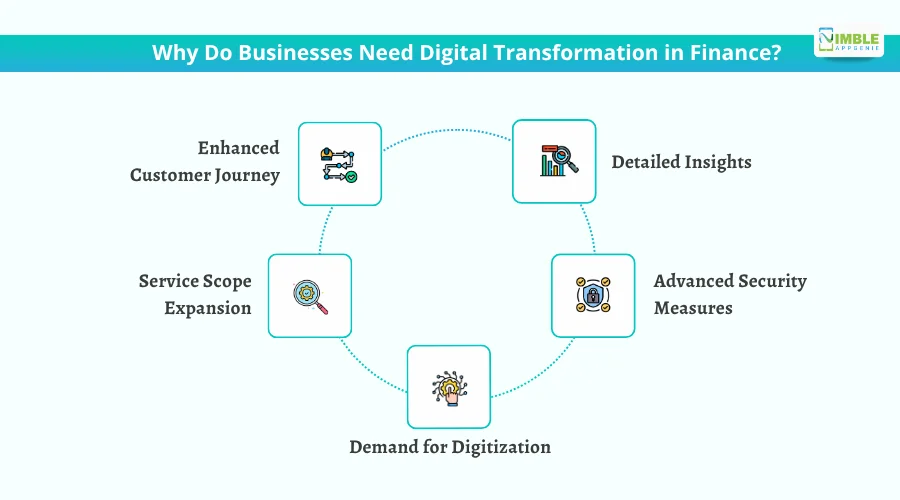
Several factors are leading to the adoption of digital transformation in the finance sector, these include –
♦ Enhanced Customer Journey
By deploying digital solutions, the journey of an individual client can be improved to a greater extent. That is because, in a digital solution, the customer has the flexibility to access from anywhere.
The implementation of new technology allows businesses to take a customer-centric approach.
♦ Detailed Insights
With the use of digital technologies, data analytics can be improved. These analytics can be interpreted concerning the business, leading to better decision-making and insightful planning.
This also allows for better risk mitigation in fintech businesses.
♦ Service Scope Expansion
Digital transformation helps a business expand its scope of services. A traditional business has its geographical limitations; however, digital platforms know no limits.
♦ Advanced Security Measures
With technologically advanced security, customers’ sensitive data can be kept secure without any hassle. It’s digitization that helps in detecting fraud and reduces the risk of data leaks.
♦ Demand for Digitization
One of the key factors that has driven digital transformation is the rising demand for digitization across the globe. With smartphones taking over, every business and service provider has started going digital, leading to the rise of fintech.
Examples of Digital Transformation in Finance
Let’s unveil multiple innovations showcasing how digital transformation is modernizing traditional financial services.
-
- Mobile Banking: It permits customers to manage accounts, monitor transactions, and transfer money using their smartphone apps.
- Digital Wallets: It helps with contactless transactions and instant payments.
- Robo-Advisors: Such AI-driven platforms offer automated investment advice.
- Blockchain Payments: These allow secure and transparent cross-border financial transactions.
- AI Fraud Detection: Leveraging machine learning, organizations detect suspicious financial activities in real-time.
How to Implement Digital Transformation in Finance?
Implementing digital transformation in finance starts with setting clear business goals, identifying gaps in your existing systems, understanding customer needs, choosing the right technology partner, and rolling out the solution in phases.
Instead of trying to digitize everything at once, a structured approach helps reduce risks, improve efficiency, and achieve better business results. You should follow the steps mentioned below to successfully implement digital transformation in finance.
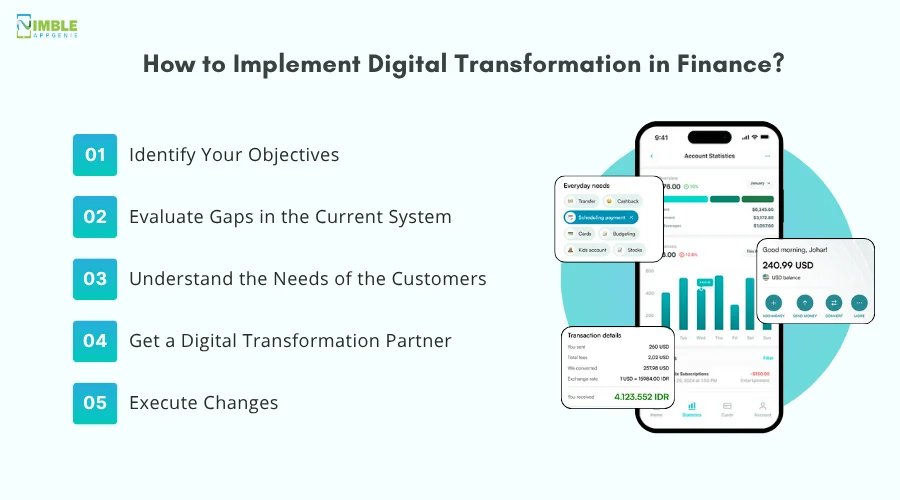
There’s a series of steps that you must follow. The steps include:
Step 1: Identify Your Objectives
The first step is to identify the objective of your digital transformation.
Why do you want to go digital? To expand your reach or to simplify your internal operations?
Do you want to create another revenue stream? The sooner you identify your goals, the better the strategy can be developed.
We recommend you create a list of your primary objectives beforehand, as it will help you choose the right solution.
Step 2: Evaluate Gaps in the Current System
After identifying the objectives, you have a set of functions that you want to make digital (to start with). Analyze the current system in place and find out what the current gaps are that you want to fulfill.
Where does the current system fall short? What are the issues that you plan to resolve with digital systems? After evaluating the gaps, you will get an idea of the features to make your digital transformation in finance a success.
Step 3: Understand the Needs of the Customers
Once you are through with analyzing your current system and the gaps in it, it is time to take a closer look at the market to understand what exactly a customer needs.
This way, you will be able to create a balance between simplifying your operating model and enticing new customers with digital transformation.
Take note of every digital trend related to finance and banking, and try aligning your services with it to get an idea of whether it works for you or not.
Step 4: Get a Digital Transformation Partner
Now, with all the research, you may have a solid list of objectives that combine both your internal and external operations.
Now what you need is a digital transformation partner who not only guides you through the process but also helps you implement technologically advanced solutions.
Consulting a fintech solution provider partner can be a great first step if you have decided to go the digital route, as it will help you understand the solutions properly.
Step 5: Execute Changes
After aligning your vision with a fintech digital transformation expert, it is time to execute your changes. This will take time, considering you will have to implement custom fintech solutions for your services.
After the entire process is over, you will have a digitally transformed solution for your existing services.
Keep in mind that you don’t need to build an entire team in-house, as there are several experts, consultants, and development companies available to help you through.
Digital Transformation Architecture in Financial Services
A digital transformation architecture in financial services illustrates the technology framework that empowers fintech companies, banks, and financial institutions to deliver efficient digital services.
This architecture integrates various technology layers that support payment systems, banking applications, security infrastructure, and data processing.
A typical fintech digital transformation architecture includes the following layers:
| Layer | Components |
| User Interface Layer | Mobile banking apps, web portals, and customer dashboards are used for interacting with financial services |
| Application Layer | Core banking systems, payment processing platforms, lending systems, and financial management tools |
| Data Layer | Financial databases, big data platforms, analytics tools, and data warehouses for managing financial information |
| Integration Layer | APIs and middleware connecting payment gateways, fintech platforms, and third-party financial services |
| Security Layer | Encryption protocols, identity verification systems, fraud detection tools, and cybersecurity frameworks |
| Cloud Infrastructure Layer | Cloud storage, scalable computing resources, containerization, and microservices architecture |
This layered architecture enables financial institutions to develop fintech platforms, integrate them with third-party services through APIs, and maintain top-level security and regulatory compliance.
Compliance & Regulations for Fintech Digital Transformation
When implementing digital transformation in financial services, institutions should comply with numerous financial regulations and data protection standards.
Such regulations ensure the financial transactions’ security, safeguard sensitive customer data, and maintain transparency in financial operations.
Since fintech platforms manage large amounts of financial and personal data, it’s crucial to maintain regulatory compliance for creating secure and reliable digital financial solutions.
Some of the key fintech compliance standards include:
| Regulation | Description |
| PCI DSS (Payment Card Industry Data Security Standard) | Ensures secure processing, storage, and transmission of cardholder data |
| SOX (Sarbanes-Oxley Act) | Protects investors by improving corporate financial reporting and internal controls |
| ISO 27001 | Global standard for managing information security systems |
| AML (Anti-Money Laundering) | Prevents illegal financial activities such as money laundering and fraud |
| SOC 2 | Ensures organizations securely manage customer data in cloud environments |
| NYDFS Cybersecurity Regulation | Establishes cybersecurity requirements for financial institutions in New York |
| Dodd-Frank Act | Promotes financial stability and transparency in the financial system |
| CCPA (California Consumer Privacy Act) | Protects consumer data privacy rights in California |
| GDPR (General Data Protection Regulation) | Protects personal data and the privacy of users in the European Union |
| PSD2 (Payment Services Directive 2) | Enables secure open banking and third-party financial service integrations in Europe |
Fintech companies should implement regulatory frameworks as mentioned above to create secure digital platforms, protect customer data, and ensure compliance with global financial standards.
You may find regulatory compliance complex, but working with experienced compliance experts and fintech developers makes it simpler to implement secure and compliant digital financial solutions.
What are the Benefits of Digital Transformation in Financial Services?
Digital transformation offers multiple benefits for financial institutions and customers by improving efficiency, enhancing security, and enabling faster financial services.
While traditional practices, where you had to visit physical branches for even the most basic tasks, were something that drove people away, digital transformation consulting in the fintech space, in particular, has changed the way people interact with financial services.
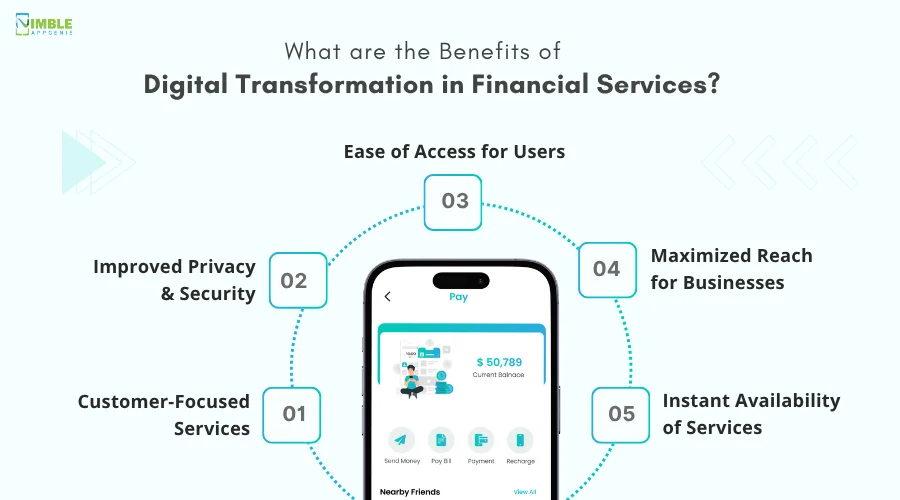
Some of the key benefits of digital transformation in finance include –
• Customer-Focused Services
When you have a digital outlet for your customers, it tends to offer more control to them, making them the center of every service.
And since these services generate a lot of user data, you can easily use digital solutions like AI to understand user behavior and provide better customer service using automated systems.
• Improved Privacy & Security
With technologies like encryption and blockchain supporting your services, the security of user information can be easily enhanced and made more reliable.
The issue of privacy and security has always been a pressing one for finance-related businesses. Thanks to the digital transformation of finance, issues like data theft can be minimized.
• Ease of Access for Users
One of the biggest challenges for a finance company is to provide easy access to its services.
People have to visit branches, connect with customer care on the phone, and wait for days for a process to be over in traditional services.
However, with digital transformation, users can easily access the services through their smartphones or desktops.
The convenience that digital transformation brings to your business can be remarkable.
• Maximizing Reach for Businesses
Another benefit of digital transformation is that it amplifies your presence in the market exponentially.
While traditional businesses are limited to a particular region, digital services can reach any corner of the world, opening a completely new market for your fintech business.
• Instant Availability of Services
Banking and financial services are the lifeblood of the economy. And rightly so, they should not be limited to working hours.
With digital transformation, your services become available to your customers 24/7 with instant access.
Further advantages of digital transformation can be explored in specific areas of the fintech industry.
• Faster Financial Transactions
Digital infrastructure allows real-time payment processing and quicker settlement systems, boosting customer satisfaction and operational efficiency.
• Personalized Financial Services
AI and advanced data analytics help financial institutions thoroughly analyze customer behavior and deliver investment recommendations, customized financial products, and tailored banking experiences.
All in all, the benefits sweeten the pot for users to migrate to a digital platform. Needless to say, the digital benefits make the investment worthwhile.
Key Technologies Driving Digital Transformation in Financial Services
By adopting modern technologies such as artificial intelligence, cloud computing, blockchain, and data analytics, financial institutions can modernize legacy systems and deliver faster, more secure financial services.
To introduce digital transformation in financial services, you need technology that is both advanced and futuristic.
There are a bunch of technologies that you will have to implement to create a truly digital transformation for your finance business.
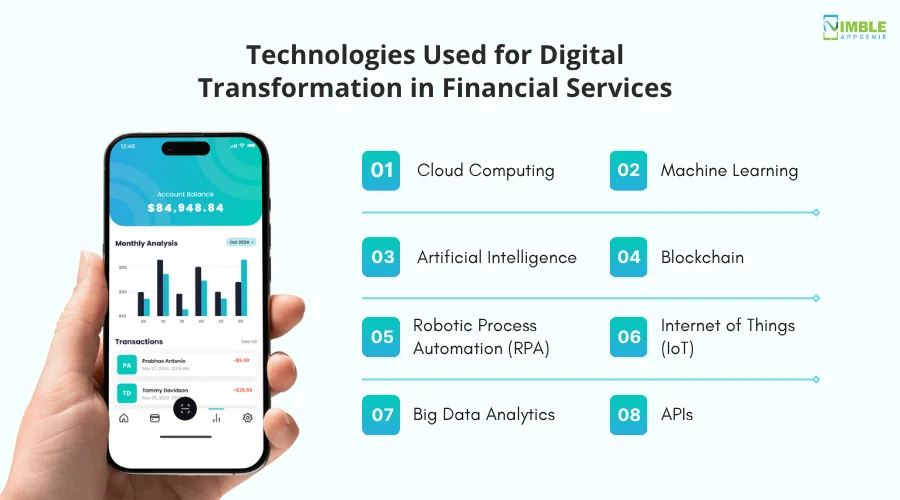
The technologies that are at the core of driving fintech and digital transformation of finance are as follows:
► Cloud Computing
Cloud computing is the modern way of keeping computing resources without having to maintain them physically.
It allows a business to manage data and deploy newer features easily. A business can simplify its operations and minimize its cost of resources by using cloud computing for fintech.
► Machine Learning
Machine learning algorithms help in analyzing the usage patterns of users to generate insights for businesses and provide smart recommendations to the users.
Machine learning is also helpful in keeping your platform secure, as ML algorithms can help with fraud detection, too.
► Artificial Intelligence
Artificial Intelligence in fintech, in conjunction with machine learning, is used to enhance the user’s experience.
It can help in automating a few processes and personalizing the recommendations as well as services for the users.
You can even deploy a digital assistant for your customers with the help of AI.
► Blockchain
For any finance-based business, security and transparency are really important.
Blockchain offers both of these advantages as it serves as a decentralized ledger that records transactions and keeps them distributed across multiple computers. So it stays safe from any breach.
► Robotic Process Automation (RPA)
When going digital, you have to be ready for large volumes of users coming to you for services, even at odd times.
Robotic Process Automation in fintech helps you deal with all of these incoming queries. How?
Well, by automating the customer interaction with your services with the help of chatbots and bots to automate usually manual processes.
► Internet of Things (IoT)
With IoT in fintech and digital transformation in finance, you can manage physical assets virtually, helping your fintech business to stay afloat through digital transformation.
IoT, as a concept, enables a business to create an ecosystem of devices that interact with each other to simplify a task for you.
Some of the core applications of IoT in fintech businesses include contactless payments, mobile banking, etc.
► Big Data Analytics
If you are part of fintech services, you have user-generated data coming your way.
While it may not seem useful to you, insights can be fetched through the analysis of this data. Big Data Analytics is a technology that helps you do exactly that.
It can help you break down large data into insightful information that can be used to improve your decision-making and operations.
► APIs
Fintech application programming interfaces (APIs) play a crucial role in data sharing between two or more software systems.
This means that if there’s already an application available for the functionality you want in your application, the API for the same can be integrated with your system instead of building the functionality from scratch.
It speeds up the process of digital transformation for different fields, including fintech.
► Generative AI
Generative AI streamlines tasks such as customer support, financial report generation, and fraud detection. Financial institutions leverage generative AI to analyze huge datasets, generate insights, and provide personalized financial recommendations to customers.
► Open Banking APIs
Open banking APIs secure data sharing between financial institutions and third-party providers. This technology empowers fintech companies to build innovative financial products such as payment services, budgeting apps, and embedded finance platforms while maintaining secure, compliant access to data.
By utilizing these technologies, fintech firms can build expandable digital platforms, boost security, and deliver innovative financial services that meet dynamic customer expectations.
Challenges in Digital Transformation in Finance With Solutions
Digital transformation in financial services comes with challenges such as legacy systems, regulatory compliance, cybersecurity risks, high implementation costs, and skill gaps.
With the right technology, planning, and security strategies, financial institutions can overcome these challenges and build secure, scalable, and efficient digital platforms.
Challenge #1: Legacy System Integration
Solution: Organizations can adopt a phased modernization strategy, leveraging APIs and middleware to connect legacy infrastructure with modern fintech platforms. Incremental system upgrades assist in reducing operational disruptions while enabling smooth digital transformation.
Challenge #2: Regulatory Compliance
Solution: Implementing regulatory technology (RegTech) solutions can help fintech firms automate compliance monitoring, reporting, and risk assessment. Financial institutions should collaborate with compliance experts to ensure their digital platforms meet global regulatory standards.
Challenge #3: Cybersecurity Risks
Solution: Financial institutions should implement advanced cybersecurity frameworks, embracing multi-factor authentication, encryption protocols, continuous security monitoring, and AI-powered fraud detection to protect digital financial systems.
Challenge #4: High Implementation Costs
Solution: Adopting cloud-based infrastructure and scalable fintech solutions lets organizations reduce upfront costs and expand their digital platforms gradually. Strategic technology partnerships can also decrease development and implementation expenses.
Challenge #5: Talent and Skill Gaps
Solution: Financial organizations can invest in fintech partnerships, employee training programs, and technology consulting services to bridge skill gaps and accelerate digital innovation.
By successfully overcoming such challenges, fintech institutions can unlock the complete potential of digital transformation, improve operational efficiency, deliver innovative financial services, and stay competitive in the swiftly evolving fintech landscape.

If you get the right guidance and a digital transformation partner, these should not be a problem. However, finding the right fintech app development company in itself can be challenging.
If you are facing a similar issue, then make sure you do not skip the next section at any cost!
Future Trends in Digital Transformation in Financial Services
The future of digital transformation in financial services will be shaped by technologies that make banking faster, more secure, and more personalized.
Trends like AI, blockchain, embedded finance, biometric authentication, and real-time payments are helping financial institutions improve customer experiences and operate more efficiently.
1. AI-Powered Financial Services
Artificial intelligence will play a larger role in financial decision-making, enabling predictive analytics, automated financial planning, and advanced fraud detection.
2. Blockchain-Based Financial Infrastructure
Blockchain technology will improve cross-border payments constantly, boost transaction transparency, and reduce settlement times for financial institutions.
3. Embedded Finance
Embedded finance allows financial services such as payments, lending, and insurance to integrate directly into non-financial platforms like e-commerce apps and digital marketplaces.
4. Biometric Authentication
Biometric technologies like facial recognition and fingerprint authentication are enhancing security and easing user authentication in digital banking.
5. Real-Time Payment Systems
Financial institutions are increasingly adopting real-time payment infrastructure to enable instant money transfers and faster transaction processing.
These trends will continue to drive innovation in fintech and encourage financial institutions to invest in scalable digital transformation strategies.
How Nimble AppGenie Can Help in Digital Transformation
If you have decided to take your fintech business to the next level, then going the digital route can be a good choice.
But to implement digital transformation, you will need a partner who can help you achieve the best results.
We at Nimble AppGenie can help you carry out digital transformation in fintech.
With cutting-edge technology and experience in developing high-tech solutions, such as a multi-currency wallet, integration of payment gateways, etc.
We will guide you through every step smoothly, making the transformation process sustainable for your business.
Conclusion
Digital transformation in financial services means integrating AI, blockchain, cloud computing, and open banking APIs to modernize legacy systems, cut operational costs, and meet customer demand for mobile-first, real-time services.
Institutions that pair the right technology stack with a clear compliance strategy, addressing PCI DSS, GDPR, AML, and regional regulations, are best positioned to stay competitive as the fintech sector grows toward a projected $36.75 trillion in transaction value by 2029.
FAQs

Niketan Sharma, CTO, Nimble AppGenie, is a tech enthusiast with more than a decade of experience in delivering high-value solutions that allow a brand to penetrate the market easily. With a strong hold on mobile app development, he is actively working to help businesses identify the potential of digital transformation by sharing insightful statistics, guides & blogs.
Table of Contents




No Comments
Comments are closed.