


If we are being honest, the way elections are managed today has not changed much in decades. However, everything else around us has evolved.
We order food online. We transfer money in seconds. But when it comes to voting?
Many places still depend on paper lists, physical ballots, and long manual processes. Due to that, elections struggle with the same recurring issues—for example, lost or duplicate voter records, slow verification, long queues, etc.
| A 2024 survey by the Pew Research Center found that only 59% of people globally trust their election processes. That means 4 out of 10 voters are unsure whether the result truly reflects the votes. That’s huge! |
But here’s an interesting change happening quietly. Governments and organizations are now exploring digital and automated online election management software, not as a futuristic idea but as a practical solution. And the numbers prove it.
| According to Digital Journal, the worldwide online election voting software market was worth around $329.87 million in 2022 and is forecasted to reach $516.52 million by 2028. |
Different reports give different exact figures, but they all agree on one thing. Election technology is a growing market, not a fading trend. As soon as decision-makers see the benefits, they do not want to go back.
Thus, if you are a startup founder or entrepreneur, there is a massive opportunity to build election management software. It is not just about building a profitable product, but something that really matters.
So, in this guide, we will discuss how you can build election management software, along with features and other aspects.
What is Election Management Software?
Most people think election software is just an app that helps cast votes electronically, but the reality is much bigger. Election management software is not just a voting tool; it is a full ecosystem. It manages everything before, during, and after the election.
You can just think about how a traditional election works :
- Voters’ lists are prepared
- Poll stations are set
- Ballots are printed
- People arrive, verify identity
- Cast their votes
- Votes are stored and counted
- Results are announced
- Audits translation began
The open source election management software takes this entire workflow and digitizes it very securely, transparently, and efficiently.
In simple words, Election management software is a secure technology platform that automates the end-to-end election process, from registration to result reporting. This ensures accuracy, transparency, accessibility, and fraud prevention.
Where is Election Management Software Used Today?
If you are planning to build election management software, it is vital to understand who will use it.
Let’s take a quick look at the breakdown of real categories of your target audience :
| Sector | Examples |
| Government Elections | National, state, municipal |
| Educational Institutions | Colleges, universities |
| Corporates | Board voting, annual elections |
| Associations and Unions | Labor unions, trade bodies |
| Housing and Community | Resident associations, cooperatives |
| Online Communities and DAOs | Web3 governance |
A lot of these audiences don’t have a solution yet. This is exactly where software development companies can help develop election management software with the latest technologies.
Why the Future of Voting Depends on Technology?
Around the world, the conversation about voting is moving towards keywords like digital governance, transparency, cybersecurity, blockchain verification, etc. Why? Because technology solves problems that the traditional system cannot.
Here is what is driving the change :
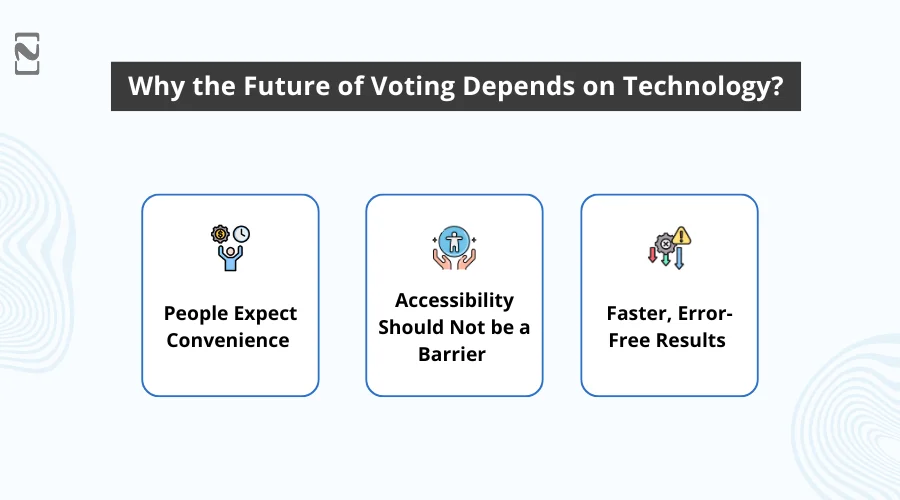
► People Expect Convenience
We live in a world where banking happens digitally, identity verification happens remotely, and documents are signed electronically. So naturally, voters ask if I can pay taxes or renew my password online. Why can’t I vote securely online?
► Accessibility Should Not be a Barrier
Millions of people skip voting because they live abroad, travel for work, have mobility or health challenges, or polling centers are far away. Digital voting increases participation by removing physical limitations.
► Faster, Error-Free Results
Manual counting is slow and prone to mistakes. Technology can process results in minutes, not days, with an audit trail for every vote. Countries like Brazil, where more than 150 million voters use electronic machines, now publish national results within hours.
Major Problems Election Management Software Must Solve
Before you build election management software, it is vital to answer: what real problems are we solving? Because the success of this system does not depend on features. It depends on eliminating pain points.
Let’s take a look at the core problems election technology must solve :
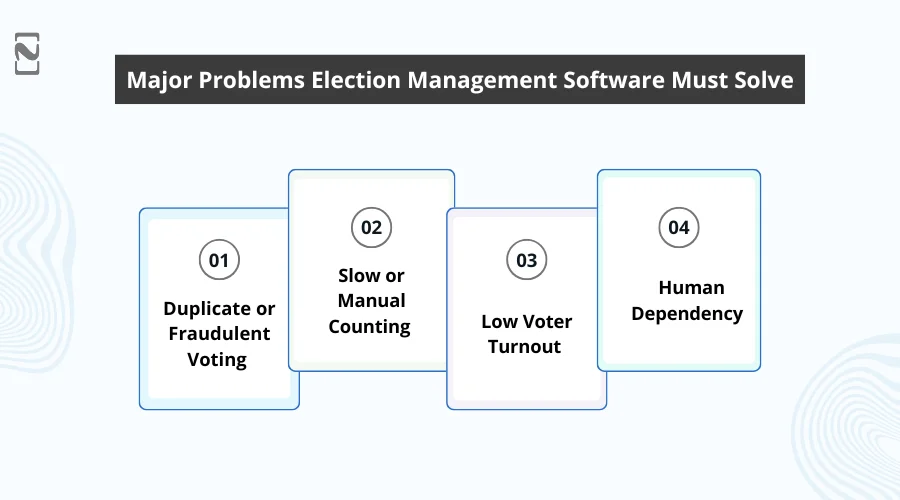
♦ Duplicate or Fraudulent Voting
Fake registrations, repeat votes, and identity manipulation are long-standing issues. A modern system requires identity verification, blockchain-based record integrity, device authentication, and fraud detection alerts. So, if you develop a blockchain-based electronic voting system, it can reduce fraudulent voting issues.
♦ Slow or Manual Counting
As you know, counting votes manually takes days or sometimes weeks. But automated tabulation enables instant counting, real-time dashboards, error-free reporting, and clear breakdowns.
♦ Low Voter Turnout
People skip voting because it is inconvenient for them. Digital access increases participation, especially among remote, young, or busy voters. Estonia is the best example. In the 2023 parliamentary elections, 51% of all votes were cast online.
♦ Human Dependency
Traditional elections require huge manpower. For example, polling staff, supervisors, counting teams, and verification officers. But election manager software reduces dependency and human chaos, especially in large organizations.
Must-Have Features of Election Management Software
So now the foundation is clear, the next big step is to understand what your product actually needs to include. Anyone can build a voting interface. Very few can build a secure and trustworthy election ecosystem. And the difference is in the features.
Let’s break down the must-have features your election management software should have:
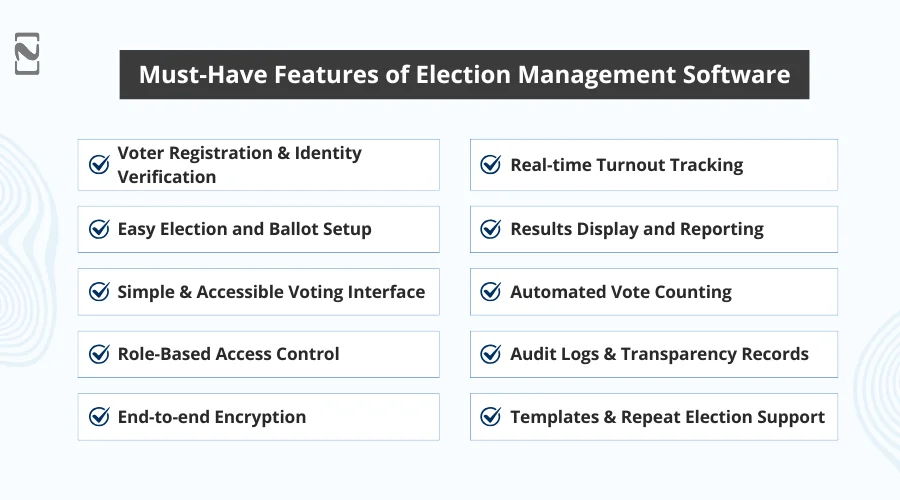
➤ Voter Registration and Identity Verification
The election experience starts before anyone casts a vote. So your election campaign management software needs a smooth yet secure onboarding layer.
You can include digital voter profile creation, integration with government ID systems, KYC verification, duplicate election, and age/eligibility screening in it.
➤ Easy Election and Ballot Setup
A drag-and-drop interface allows organizers to create ballots, add candidates, define rules, and configure election settings without technical support. This should support single-choice voting, professional voting, party-based ballots, etc. The more flexible this module is, the more markets your product can serve.
➤ Simple and Accessible Voting Interface
You should add a clean, user-friendly voting screen that works across web, mobile, and kiosks. It should be accessible for all voters, including those with disabilities or limited technical skills.
Always remember, if a person can use UPI, WhatsApp, or any other everyday app, they should be able to vote confidently.
➤ Role-Based Access Control
Admins, observers, candidates, auditors, and voters all need different access levels. Your software should support permission layers like super admins, election authority, counting supervisors, polling observers, etc.
So, you can provide biometric authentication that ensures transparency without exposing sensitive processes.
➤ End-To-End Encryption
This feature is not just technical but emotional. People must trust the system. So, votes must be encrypted during submission and storage. Your system should not allow anyone to see individual selection that ensures secrecy and trust.
➤ Real-Time Turnout Tracking
When you build election management software, add a dashboard showing the number of people who voted, regions performing strongly, and participation spikes. But it should be without revealing individual choices or patterns.
➤ Results Display and Reporting
Once polls close, publishing results should not take days. Your system should generate summary dashboards, detailed constituency breakdowns, candidate-wise insights, exported legal reports, etc. You can think of it as the press conference button inside the election booth management software.
➤ Automated Vote Counting
Today, the use of AI in political apps, software, and platforms is increasing. In this context, software should function as a secure counting engine that eliminates manual errors, processes results instantly. But still allows full auditing and recount validation when needed.
➤ Audit Logs and Transparency Records
This may be the most under-discussed feature. But for governments and institutions, it is crucial.
The system must record every login, vote timestamp, configuration change, permission assignment, and rule updates. All this should be without compromising voter secrecy. Transparency is not just a feature; it is proof.
➤ Templates and Repeat Election Support
Organizations run elections repeatedly. You should add a template feature that allows easy reuse, faster setup, and consistent election workflows. But without developing everything from scratch.
How to Develop Election Management Software?
Election management software development works best when planned in phases. Each step plays a role in security, usability, and compliance.
Here is a simple breakdown of the process so you can approach development confidently and strategically.
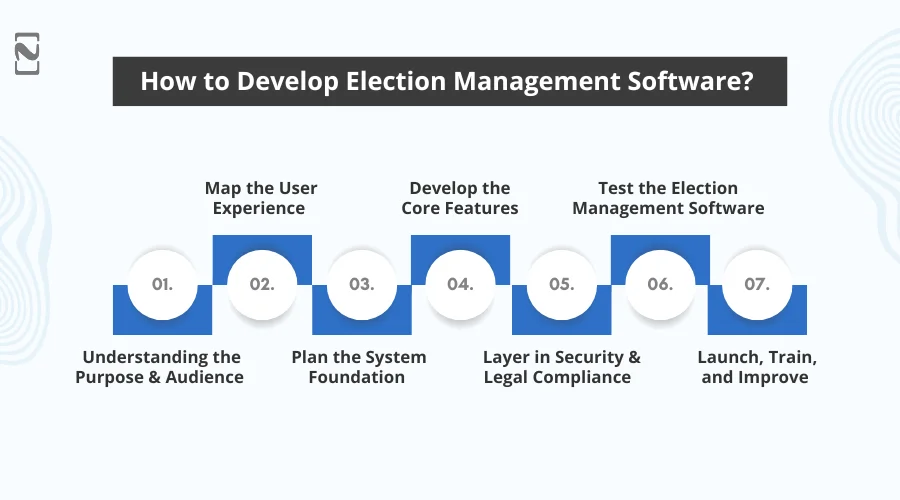
► Understanding the Purpose and Audience
Before you develop election management software, you need clarity. Who will use this system, like governments, universities, corporations, or small associations? Each group has different expectations, legal requirements, and scale.
For example, a national election demands stronger security and GDPR compliance than a college council vote. Besides, you can think about voting modes like assisted kiosks, online, mobile, and hybrid.
When you clearly understand the purpose, audience, and legal boundaries in advance, your software vision becomes sharper, and the elections management software roadmap becomes far easier to execute.
► Map the User Experience
Elections involve many different users and not just voters. These are admins, observers, auditors, and sometimes candidates. So it is best to start mapping what each user should see and do. The voting experience, especially, should feel effortless.
It should have clear instructions, a clean interface, and no confusing steps. Many voters may not be technically savvy, so the design should feel familiar. It should be more like using a banking app than a complex system.
A seamless and smooth user journey builds confidence, reduces mistakes, and increases turnout because people feel comfortable using the election task management software.
► Plan the System Foundation
The next step to build election management software is to decide how the system will work behind the scenes. Will it work on a secure cloud, government servers, or a hybrid setup? How will it handle thousands or millions of votes arriving at the same time?
This is where you decide how data flows, how votes are encrypted, and how failures are prevented. You can just think of this like designing the building structure before adding doors and furniture.
You can choose the best software development methodologies to make election management software. A strong architecture makes sure the election task management software remains secure, scalable, and reliable even during peak usage.
► Develop the Core Features
Once the foundation is ready, you can start developing the core modules. For example, registration, authentication, ballot creation, the voting interface, counting logic, and reporting.
It is vital to focus on building an MVP first, not a perfect final version. That way, you can test real behaviour in advance instead of assuming how users will interact. Do not forget to prioritise clarity, speed, and privacy in every feature.
The goal is to create election management software where voting feels seamless, and administration feels effortless. All should be without compromising on election integrity.
► Layer in Security and Legal Compliance
Election software must be secure from day one, not an afterthought. This is where you integrate encryption, secure login, fraud prevention, device checks, and audit logs. The election booth management software should not reveal how anyone voted, but it must prove that every vote is legitimate.
Depending on the region, there may also be legal frameworks, certification requirements, and legal compliance, like SOC 2 compliance. Always ensure compliance in advance to prevent delays later when clients request proof and documentation. It is especially important for governments.
► Test the Election Management Software
Testing is not just about fixing bugs; it is about making sure everything works under real conditions. Simulate slow internet users, older voters, multilingual ballots, accessibility needs, and high traffic spikes. You can run mocks with actual people and gather feedback.
Besides, you can ask, “Was anything confusing? Did something feel slow or unclear?” Elections have one shot, and there is no room for errors on voting day. The more real your software testing feels, the safer and smoother the final launch will be.
► Launch, Train, and Improve
Once everything is tested and approved, it is time to launch. But launch does not mean walking away. You should provide training, live support, onboarding help, and clear guidance materials.
After the election, review what worked, what didn’t, and what people struggled with. The best election software improves over time, not overnight. Every election becomes practice for a better version.
The real win is when users trust the election project management software, and that comes through reliability, clarity, and continuous improvements.

Required Tech Stack For Election Management Software
When you build election management software, your tech stack should focus on three things: security, scalability, and reliability. You do not need the fanciest tools; you need the best software development tools that are stable, well-supported, and trusted.
Here is a tech stack table you can consider for developing EMS software:
| Module | Recommended Technologies |
| Frontend (Web Admin / Portal) | React, Angular, Vue.js, TypeScript, HTML5, CSS3 |
| Backend (Application Layer) | Node.js (Express/NestJS), Java (Spring Boot), .NET Core, Python (Django/FastAPI), Go |
| Database (Transactional) | PostgreSQL, MySQL, MS SQL Server |
| Database (Analytics / Reporting) | PostgreSQL, BigQuery, Snowflake, AWS Redshift |
| Caching Layer | Redis, Memcached |
| Message Queue / Event Bus | RabbitMQ, Kafka, AWS SQS, Google Pub/Sub |
| Authentication & Authorization | OAuth2, Keycloak, Auth0, Azure AD, JWT, MFA |
| Security Frameworks & Tools | OWASP, TLS 1.2+, HashiCorp Vault, HSM, SIEM (Splunk/ELK) |
| Blockchain / Audit Trail (Optional) | Hyperledger, Private Ethereum |
| GIS / Maps | Leaflet, Mapbox, ArcGIS |
| Infrastructure / Cloud | AWS, Azure, GCP, On-Premise Servers |
| Containerization | Docker |
| Orchestration | Kubernetes (EKS/AKS/GKE), Docker Swarm |
| DevOps / CI/CD | GitHub Actions, GitLab CI, Jenkins, CircleCI |
| Monitoring & Logging | Prometheus, Grafana, ELK Stack, Datadog, CloudWatch |
| Email / SMS Notifications | SendGrid, Twilio, AWS SNS |
| Backup / Recovery | AWS Backup, Azure Backup, Veeam |
| Testing Tools | Jest, Cypress, Selenium, Postman, JMeter |
How Much Does it Cost to Develop Election Management Software?
The cost to develop election management software can range from $20,000 to $200,000 and more. However, this cost can vary because not every system is built for the same purpose.
There are many factors, like feature integrations, project complexity, tech stack, and cost to hire software developers can highly affect your election management software development cost.
Let’s say you want to develop an MVP version of your election management system software with minimal functionalities and design. You can expect to pay around $20,000 – $40,000. However, if you want a fully-function EMS, then its cost will go beyond $200,000.
So, one thing is clear that the cost to develop election management software can be affected by your project requirements.
Let’s understand this with the cost table below :
| Software Complexity | Cost Breakdown |
| Basic software version (MVP) | $20,000 – $40,000 |
| Standard EMS system | $40,000 – $120,000 |
| Highly Advanced EMS system | $120,000 – $200,000 + |
Monetization Strategies For Election Management Software
Now that you know the election management software development cost, what now? Well, it is vital to monetize your software to earn a huge revenue from it.
We have jotted down some crucial monetization strategies that you can take into consideration.
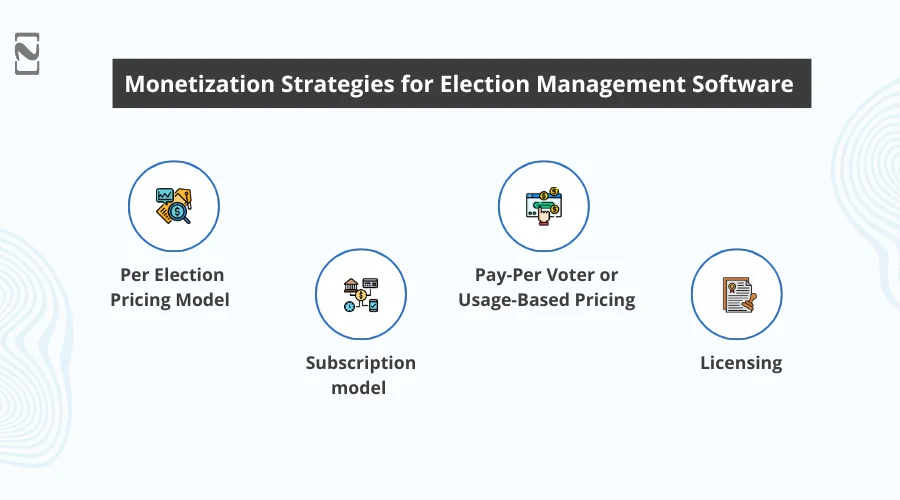
♦ Per Election Pricing Model
In this model, you earn revenue by charging users a fixed fee every time they conduct an election. Pricing can scale based on election size, number of voters, modules required, or support level.
This monetization model ensures a predictable income for each event and works well for organizations running elections occasionally.
♦ Subscription Model
This is the most common way to earn money. In this model, you generate recurring income by offering monthly or annual subscription plans. Users pay for continuous access to the platform and premium features.
For example, analytics, automation, or multi-election management. Different tiers allow you to upsell advanced modules, support packages, and higher usage limits.
♦ Pay-Per Voter or Usage-Based Pricing
Instead of charging a fixed price, the cost depends on how many people vote. This model earns revenue by charging based on actual usage. For example, the number of registered voters, ballots cast, or polling stations.
So, larger elections bring higher fees. It is flexible for users and scales your profits automatically as election size or activity increases.
♦ Licensing
Some governments or large organisations prefer to buy the complete election petition management software. They pay for the installations and then a small yearly fee for updates, support, and security patches.
This may include one-time license fees, annual renewal fees, and additional charges for upgrades or new features. Licensing generates high upfront revenue and long-term institutional relationships. This model works best with government bodies, large enterprises.
How Nimble AppGenie Can Help Develop Election Management Software?
Do you want to make election management software? Nimble AppGenie can help you by working like a true development partner, not just a vendor. As a professional software product development company, we start by listening to what you actually need.
Our professional team then creates a visually appealing and easy-to-use design so people can understand the system without any training. Security is a big focus. So, we make sure all data is protected and that every vote is recorded safely and accurately.
If you need features like real-time dashboards or automated reports, we can build those too. Once the software is ready, Nimble AppGenie handles testing, setup, and ongoing support so everything runs smoothly during elections. So, if you are planning to build election management software, book a free consultation with us for a robust solution.
Conclusion
Hopefully, you liked this blog and found it helpful. Election management software plays a huge role in making voting easier, safer, and more organised for everyone.
As technology is growing continuously, more organizations are choosing online solutions to manage their elections. No matter if it’s reducing manual work, improving accuracy, or speeding up results, good software can make a real difference.
Therefore, if you’re planning to upgrade an election system or build a political app, now is a great time to build a solution that truly fits your needs. With the right political app development company, even complex election processes can become smooth and transparent.
FAQs
- Identity verification
- De-duplication algorithms
- Risk scoring
- Cross-checking with national identity databases

Niketan Sharma, CTO, Nimble AppGenie, is a tech enthusiast with more than a decade of experience in delivering high-value solutions that allow a brand to penetrate the market easily. With a strong hold on mobile app development, he is actively working to help businesses identify the potential of digital transformation by sharing insightful statistics, guides & blogs.
Table of Contents
No Comments
Comments are closed.