


In a Nutshell:
- AI virtual makeup apps use smart technology to suggest the most suitable shades and styles based on each user’s skin tone and features.
- Accuracy matters most. Users trust apps that look natural and realistic in different lighting and movements.
- You can start with just the main features first, test that the app works, and then add more advanced functions later.
- The overall cost to make an AI makeup app depends on the smart features, personalization, and AR tools you include.
- When done right, these apps help users feel confident about their choices and help brands sell more while cutting down returns.
Imagine a client walks up to your AI virtual makeup app and instantly sees a lipstick shade suggestion that matches their last choice. They try it on with their phone camera, swipe to preview a bold eyeshadow, all in a few clicks. That’s the kind of experience beauty customers expect.
For years, beauty apps mainly helped with browsing or appointments. They made online shopping things really very convenient, but did not feel personal. Now, everything in the beauty industry is changing.
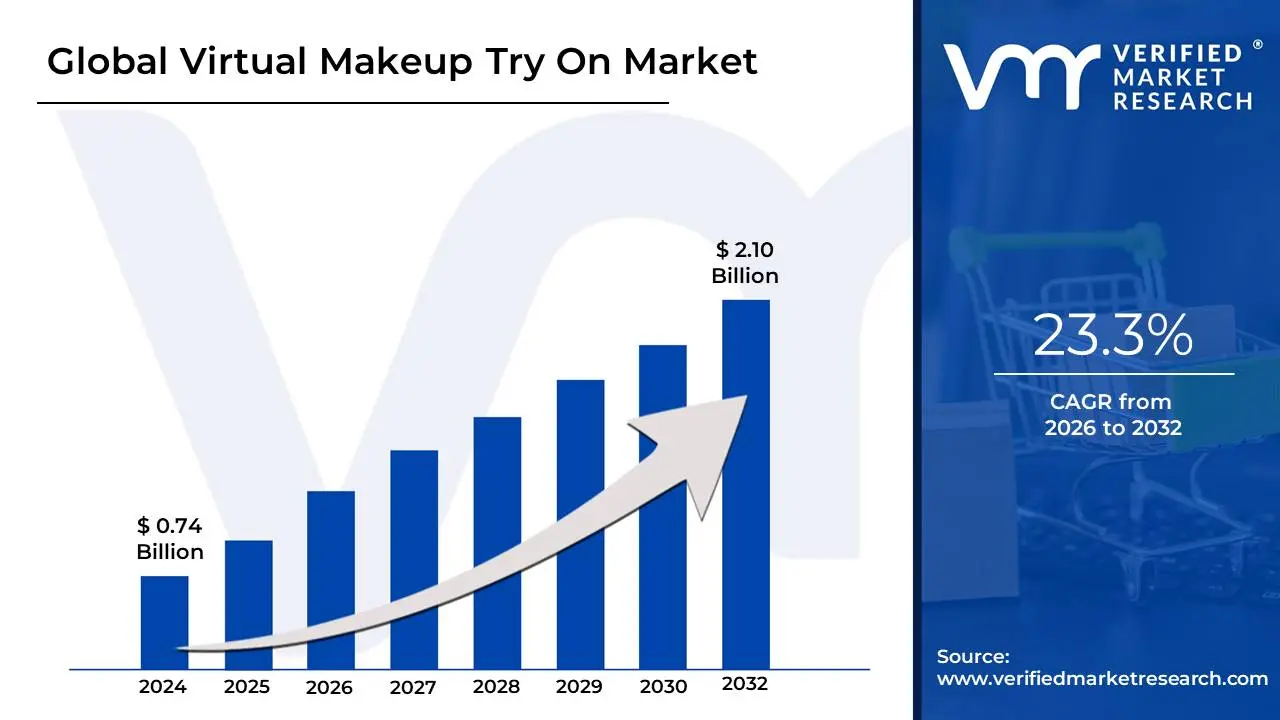
The market size of virtual makeup try-on is forecasted to hit $2.10 billion by 2032, which was $740 billion in 2024. And no surprise here. The driving force behind this rapid growth? Artificial Intelligence.
Today’s shoppers want more than just products; they want apps that understand their style and help them make confident choices. That’s why more and more beauty brands are eager to develop an AI virtual makeup app.
Thus, this step-by-step development guide of an AI virtual makeup app will walk you through must-haves and advanced user-friendly features, costs, and challenges that can take your beauty brand to the next level.
What is an AI Virtual Makeup App?
An AI virtual try-on makeup app is a mobile app that leverages AI and AR to allow users to try on makeup without physically applying it.
It uses the user’s phone camera to detect their face, skin tone, and facial features. Then it applies virtual makeup in real time, so they can see exactly how products will look on them.
How it helps users:
- Virtual Try-On: Users can test lipsticks, foundations, eyeshadows, and more in seconds. No messy application, no guessing.
- Shade Matching: AI suggests shades that suit your skin tone, undertone, and preferences.
- Personalized Experience: Over time, the AR virtual makeup app can learn your style and recommend products you’re most likely to love.
Users are more confident when they buy products. They can find new styles without fear that leads to higher satisfaction. Also, this minimizes product returns for brands, which is a huge business advantage.
Market Overview of AI Beauty and Virtual Makeup Industry
The AI beauty and virtual makeup industry is booming. We will take a closer look at AI beauty app statistics in the sections below to understand market growth and opportunities for brands.
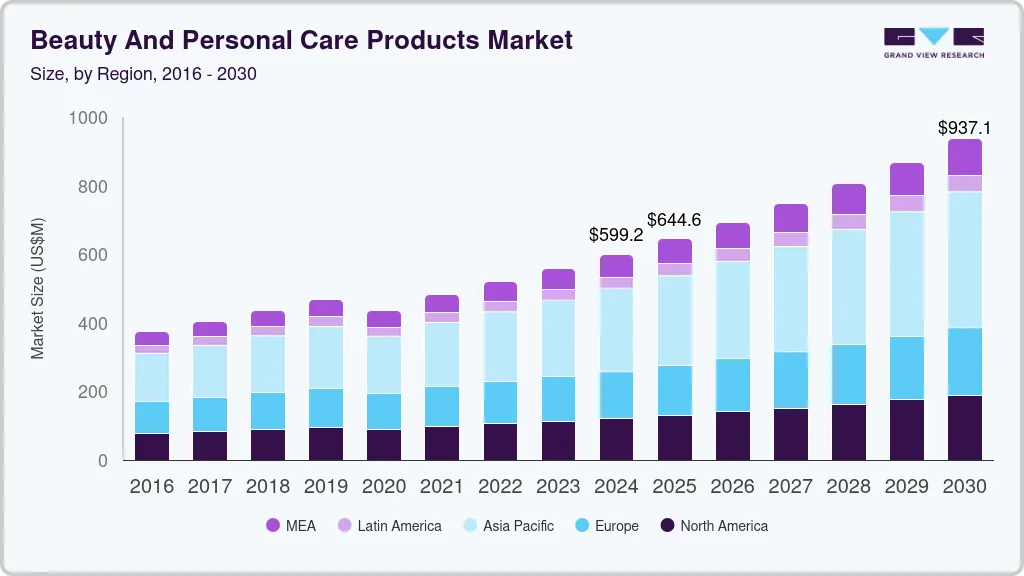
- The worldwide market size of beauty care items is forecasted to hit $937.13 billion by 2030. In the past year, beauty sales went up by 10% that shows a stronger growth than before.
- About 45% of makeup brands are already implementing AI for personalized experiences.
- Augmented reality beauty tools have been shown to increase conversion rates by up to 25% for brands that integrate virtual try-on features.
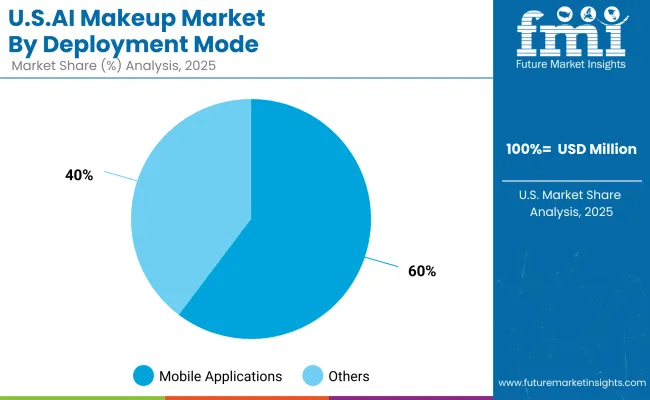
- Virtual try-on is the most widely used feature today, supporting over 40% of use cases where real-time results and accuracy matter most.
Looking at these stats, it’s easy to see why many beauty brands are putting AI virtual makeup apps on their roadmap. Thus, it is the best time to create an AI-based hairstyle app that meets modern customer expectations.
How Does an AI Virtual Makeup Try-On App Work?
Now, let’s see how an AI makeup virtual try-on app actually works and what goes on behind the scenes to make the experience feel so real and smooth.
- The app first detects the user’s face through the camera and maps key features like lips, eyes, and cheeks.
- AI then analyzes skin tone and undertones so makeup shades look natural on different complexions.
- Using AR, makeup is applied in real time and stays in place as the user moves or changes expressions.
- The system adjusts for lighting so colors don’t look too bright, dull, or unrealistic.
- When everything feels accurate and smooth, users trust what they see and feel more confident trying and buying products.
Must-Have Features of an AI Virtual Try-On Makeup App
When you develop an AI virtual makeup app, some features are not optional. They are must-haves. These essential AI makeup and salon app features make sure your product is functional, engaging, and keeps users coming back.
| Features | How AI Powers It | Business Impact |
| Real-time virtual makeup try on with AI | AI detects facial landmarks and applies makeup instantly. It adjusts as the user moves. | It boosts user engagement, confidence, and purchase likelihood |
| Shade matching (foundation, lipstick, eyeshadow) | AI analyzes skin tone and undertones to suggest accurate shades. | It reduces returns, increases conversions, and improves user satisfaction. |
| Skin tone detection and analysis | AI studies skin texture and tone for realistic makeup application. | It provides personalized AI-powered beauty recommendations to boost trust and brand loyalty. |
| Product catalog integration | AI links facial analysis to available products in the catalog. | It drives sales by allowing users to try and buy directly from the app. |
| Save and compare looks | AI remembers previous tries and renders multiple looks for comparison. | It encourages experimentation and repeat usage that increases time spent on the app. |
| Share looks on social media | AI applies AR filters that work in photos and videos for sharing. | It increases organic brand promotion and app visibility. |
| Push notifications and updates | AI tracks user behavior to send personalized alerts. | It boosts retention, promotes new products, and drives repeat purchases. |
| Multi-lighting adjustments | AI adjusts makeup appearance according to lighting conditions. | It makes sure realistic previews, building user trust and confidence. |
| AR-based makeup filters | AI overlays fun filters that respond to facial expressions. | It boosts engagement and user retention through interactive experiences. |
Advanced Features of AI Virtual Makeup App Development
Once the must-have features are set, advanced AI makeup app features make your app stand out. But in 2026, advanced AI makeup app development features will not be just for fun. They are really powerful and help you sell more, spend less, and understand the customers better.
Take a look:
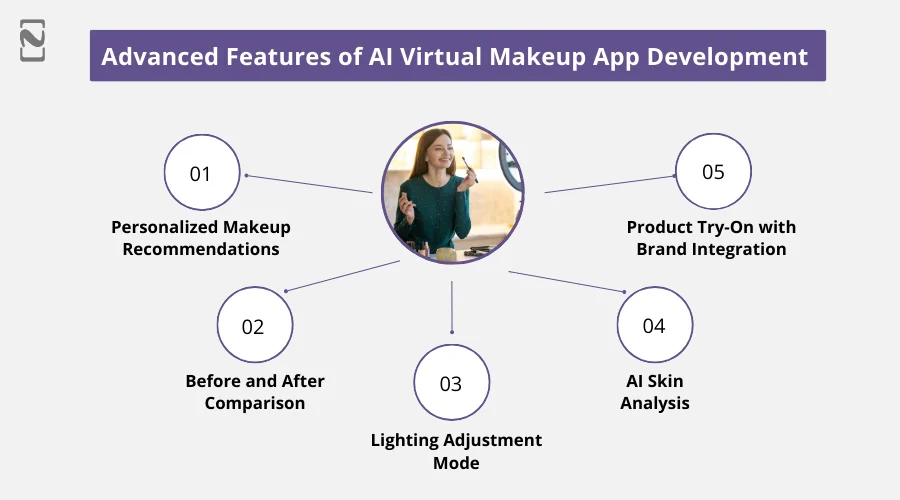
► Personalized Makeup Recommendations
Based on the user’s skin type, face shape, and preferences, your app recommends makeup that suits each user’s unique features. It is like having a personal makeup artist who helps to choose the right products.
► Before and After Comparison
With this feature, users can simply compare their natural look to the makeup version. This helps them to see how different items enhance their look. It will be easier to decide the preferred makeup style.
► Lighting Adjustment Mode
Users can easily switch between different lighting settings like daylight, party lights, or indoor lighting. This helps them see their makeup looks in various environments for choosing the perfect look.
► AI Skin Analysis
Your AI virtual makeup app analyzes the user’s skin, detecting blemishes, wrinkles, and imperfections, and suggests makeup that works to cover or boost these areas. This offers custom advice for every skin type.
► Product Try-On with Brand Integration
Users can try on real makeup items from popular brands. It shows how products like lipsticks or foundations will look on them. This helps them make better decisions before buying any product.
How to Develop an AI Virtual Makeup App?
Developing an AI virtual makeup app is a process. You cannot rush it. Each step builds on the previous one.
So, we have jotted down the step-by-step roadmap to build an AI virtual makeup app.
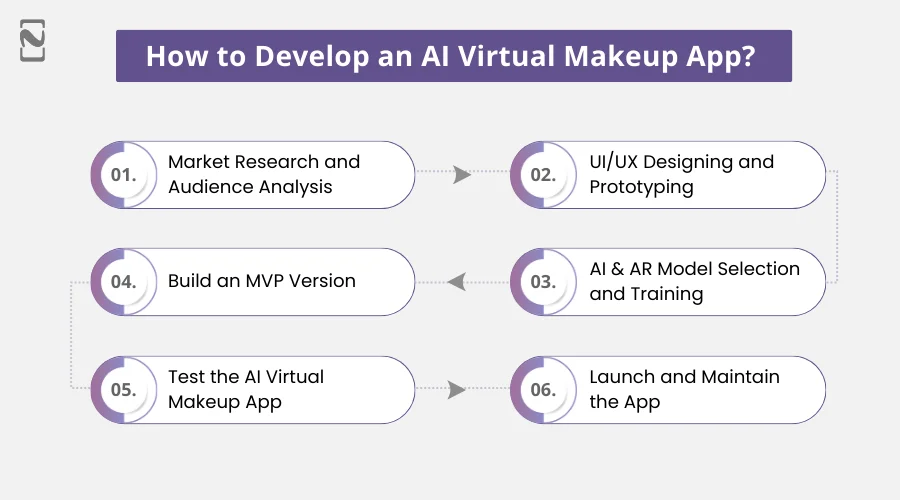
1. Market Research and Audience Analysis
The mobile app market research is the first step to developing an AI virtual makeup app, and do not skip this. You need to carefully understand who your app is for and how AI can help them.
Ask yourself :
- Are you going to target regular users, beauty enthusiasts, or professional makeup artists?
- Should your virtual makeup try on an app focus on makeup, skincare, or both?
- What age groups will use it the most? Do you want a virtual beauty consultation app feature in it?
Additionally, it is vital to properly study competitor augmented reality makeup apps, read user reviews, and pay close attention to complaints and requests.
This research helps you avoid unnecessary features, focus on AI experiences users actually need, and develop a product people will actually enjoy.
2. UI/UX Designing and Prototyping
Once you know your target audience and how they will use AI features, it is time to design a mobile app. Your AI virtual makeup try-on app should be simple and minimalist so that users can easily open the camera, and the AI detects the face and applies makeup.
You can ask yourself :
- How will users interact with AI features like real-time shade suggestions?
- Is the app easy for newbies to use, or is it more for professionals?
- Does the AI feel natural, realistic, and responsive in every lighting condition?
Mobile app designers can create a mobile app wireframe and a clickable prototype to test these interactions. This step makes sure AI feels smart but natural. This makes your app more enjoyable and keeps users coming back.
3. AI & AR Model Selection and Training
This is the heart of your augmented reality makeup app. An app like Vagaro uses this makeup visualization technology to make everything look real. Your virtual makeup AI tools need to detect facial features, track expressions, and understand skin tones while AR places makeup naturally on the face.
You need to remember these parameters:
- Which AI models will best detect lips, eyes, cheeks, and nose perfectly?
- How will the AI adapt to different skin tones, lighting, and face shapes?
- Can AR and AI work together so that makeup moves naturally when users smile or turn their head?
It is vital to train your AI smart makeup assistant on diverse images to ensure realistic outcomes. The better the AI learns, the more users trust your AI-based virtual try-on makeup and enjoy their experience.
4. Build an MVP Version
Once your AI models are ready, the next step is to build an MVP version of your AI virtual makeup app. In this, you have to focus on must-have features only, not everything at once. It is because you have to check whether the AI works well in real use.
For better results, you can ask yourself:
- Which makeup products will be added to the first AI try-on experience?
- Can the AI apply shades smoothly on different skin tones?
- Does the makeup move naturally when the user moves their face?
Additionally, AI is used here to match real product colors, adjust shades in different lighting, and keep the makeup realistic. When you build a strong MVP with an advanced salon app tech stack, it will help you test AI accuracy and user trust early.
5. Test the AI Virtual Makeup App
Testing is extremely vital for an AI virtual makeup app because AI behaves differently in real-world situations. The app should not only work in perfect lighting but also in daily use.
During the mobile app testing stage, you need to check:
- Does the AI detect faces correctly in low light, sunlight, and indoor lighting?
- Does the virtual makeup stay aligned when users smile, move, or turn their face?
- Is the AI output consistent across different skin tones, face shapes, and devices?
It assists in identifying AI errors like shade mismatch, lag, or tracking issues. It is vital to fix these issues in advance to improve accuracy, build trust, and make sure users enjoy a smooth virtual try-on experience.
6. Launch and Maintain the App
Before the final launch, release a beta version of your AI virtual makeup app to a small group of users. This allows you to see how the AI performs with real people and real devices.
It is vital to collect feedback on:
- Whether the AI makeup looks natural or feels fake
- If the app is easy to use or confusing
- Where the AI feels slow or inaccurate
Once your app is launched, it is crucial to thoroughly maintain the app. AI models need regular updates, new features, integrations, and performance should improve over time.
How Much Does it Cost to Build an AI Virtual Makeup App?
The cost to develop an AI virtual makeup app can be around $20,000 to $200,000 or more. This is just the ballpark estimation; the actual AI virtual makeup app development cost relies on app complexity, integrations, and project requirements.
For instance, a simple app that allows users to try on makeup with basic skin tone matching is more affordable. But if you want a complex app like Booksy with advanced features, you will be looking at a bigger budget.
Let’s understand the cost to develop an AI virtual makeup app in the following table.
| Versions | What’s Included | Estimated Cost |
| MVP App | Basic AI-powered makeup try-on, skin tone matching, simple UI, minimal features, and integrations | $20,000 – $50,000 |
| Mid-Level app | Adds real-time makeup try-on, AR features, basic personalized product suggestions, and improved UI | $50,000 – $100,000 |
| Full-Scale App | Complete AI and AR integrations, advanced makeup effects, personalized recommendations, and data analytics. | $100,000 – $200,000+ |
So, depending on your goal and budget, you can start small and scale up as you know more about your target audience and market.
How Can an AI Virtual Makeup Try-On App Generate Revenue?
If you have built an AI virtual makeup app, you are probably wondering how to make money with it. There are multiple ways you can generate revenue, depending on the type of app and the audience you are targeting.
Below are the most effective salon app monetization strategies you can take into consideration:
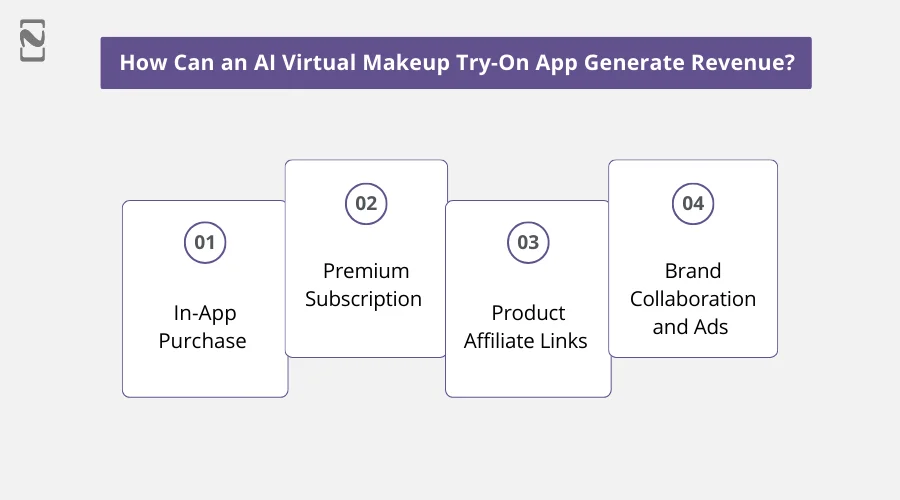
➤ In-App Purchase
One best ways to make money is by offering in-app purchases. Users can try on makeup, but they might want to unlock premium features. For instance, they might pay for access to exclusive makeup products, special makeup looks, and personalized tutorials.
This will keep your AI makeup app free to use, but allows you to earn money from users who want more than the basic options.
➤ Premium Subscription
If you provide a premium subscription, it will be a great way to earn money from AI virtual makeup apps. You can allow users to use the app for free, but if they want premium features, they have to purchase a monthly or yearly subscription.
This creates a recurring income for your business and gives users a good reason to keep coming back to your AI virtual makeup app.
➤ Product Affiliate Links
Another AI virtual makeup app monetization model is product affiliate links. You can partner with makeup brands and beauty retailers and include product links inside your app. When a user tries on makeup, they can be directed to the store to buy a product.
Every time someone purchases through your affiliate link, you earn a commission. It is a win-win situation for both users and brands.
➤ Brand Collaboration and Ads
Brand partnerships and advertising are another good revenue stream. You can partner with makeup brands to feature their products in your AI virtual makeup app. In return, they can pay you for the exposure.
Additionally, you could run in-app advertisements like banners or video ads. Just be sure not to overwhelm your users with ads, or it could hurt their experience.
What Challenges Will You Face in AI Virtual Makeup App Development and Possible Solutions?
Creating an AI virtual makeup app is quite exciting. But like any other project, it comes with its challenges.
Let’s take a look at some common ones you might run into, along with ways to tackle them:
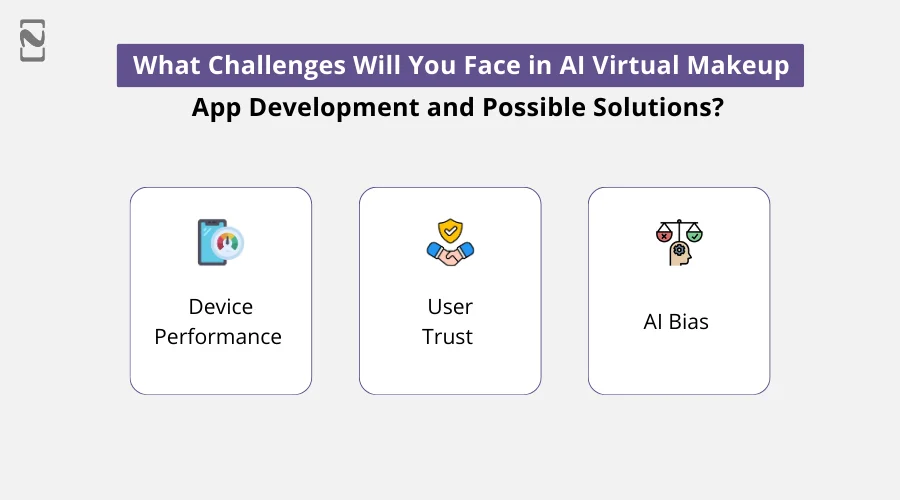
♦ Device Performance
Not all users have the latest, most powerful phone. If your app is slow or crashes on older devices, you will lose users fast. Especially when using AR and AI technology, performance can take a hit, so it is important to make sure the app runs smoothly on all devices.
Solutions:
You should focus on optimization. It is vital to use lightweight algorithms that can run efficiently on both high-end and budget devices. Test your AI virtual makeup try on an app on multiple devices, from the latest models to older ones. A smooth, fast experience is key to keeping users happy.
♦ User Trust
With so much data involved, users might be concerned about privacy. Their face data and skin analysis are sensitive, and users need to feel like their information is safe.
Solutions:
You have to be transparent about how you collect and use data. Besides, you can give users control over their personal information and make sure they can opt out if they want.
You have to follow data privacy laws like GDPR to stay on the right side of things. Additionally, if you add a clear privacy policy, you will build trust and allow users to feel safe using your makeup virtual app.
♦ AI Bias
AI bias can happen when the AI virtual makeup app does not recognize certain skin tones or faces accurately. This can be frustrating for us who feel the technology does not represent them fairly.
Solutions:
To avoid bias, it is vital to make sure your AI is trained with diverse data. You can take assistance from a salon app development company. The best tech stack and AI models you need to include faces, skin tones, and makeup looks in the app.
Additionally, you have to continuously evaluate the AI and retrain it as required to show a wide variety of users. Users’ feedback will be key here to fix any issues fast.
Why is Nimble AppGenie the Right Choice to Build Your AI Product?
An AI virtual makeup app is much more complex to build than it looks. Nimble AppGenie, a trusted AI development company, approaches this kind of product with a problem-first mindset.
Instead of starting with buzzwords like AR and AI, we start with questions like:
- How fast should AI respond?
- What will break when thousands of users try it at once?
Our expert team has 8+years of hands-on experience working on AI projects. That matters because the virtual makeup app fails when blending looks fake, color shift under different lighting, or the app lags. We focus on fixing these exact issues in advance, not after launch.
Additionally, we build the future updates in mind. If you plan to add new makeup styles, product reviews, or catalogues, or e-commerce features later, the app architecture would not need to be rebuilt.
This saves time, money, and frustration down the road. So, if you are planning to build a virtual makeup app with AI, Nimble AppGenie builds bespoke products, not demos.
Conclusion
Now that you know how to develop an AI virtual makeup app, the question is: what do you want users to get out of it? Well, if the goal is fast experimentation, the AI in a beauty app needs to be fast and simple.
But if the goal is to help users choose the right shade, then accuracy matters more than effects. Everything in the development comes back to that decision. So, it is vital to clear your purpose for an amazing AI personalized makeup try-on solution.
FAQs

Niketan Sharma, CTO, Nimble AppGenie, is a tech enthusiast with more than a decade of experience in delivering high-value solutions that allow a brand to penetrate the market easily. With a strong hold on mobile app development, he is actively working to help businesses identify the potential of digital transformation by sharing insightful statistics, guides & blogs.
Table of Contents
No Comments
Comments are closed.