


In a Nutshell:
- Marketplace app development starts with choosing a suitable business model, like B2C, B2B, hyperlocal, vertical, or horizontal marketplaces, to align scalability, features, and monetization.
- Key marketplace app features incorporate user registration, vendor dashboards, product listings, secure payment gateways, ratings, reviews, and admin analytics.
- An ideal tech stack includes React or Flutter for frontend, PostgreSQL or MongoDB for databases, Node.js or Django for backend, and AWS or other cloud platforms for performance and reliability.
- The cost to build a marketplace app varies, with MVPs ranging between $25,000 and $50,000 and enterprise platforms demanding higher investment.
- Data security, scalability, compliance, and encryption, such as GDPR and PCI-DSS, are significant for safeguarding user data.
- Marketplace apps generate revenue via subscriptions, commission–based models, freemium strategies, and ads.
- Partnering with a leading marketplace app development company, like Nimble AppGenie, ensures secure, custom, and scalable solutions for sustainable growth.
Did you know that choosing a marketplace model is a trend that’s catching on these days? Marketplace apps revolutionize how digital businesses expand, monetize, and connect users.
| The global eCommerce marketplace is anticipated to be valued at $83.26 trillion by 2030, up from $25.93 trillion recorded in 2023. |
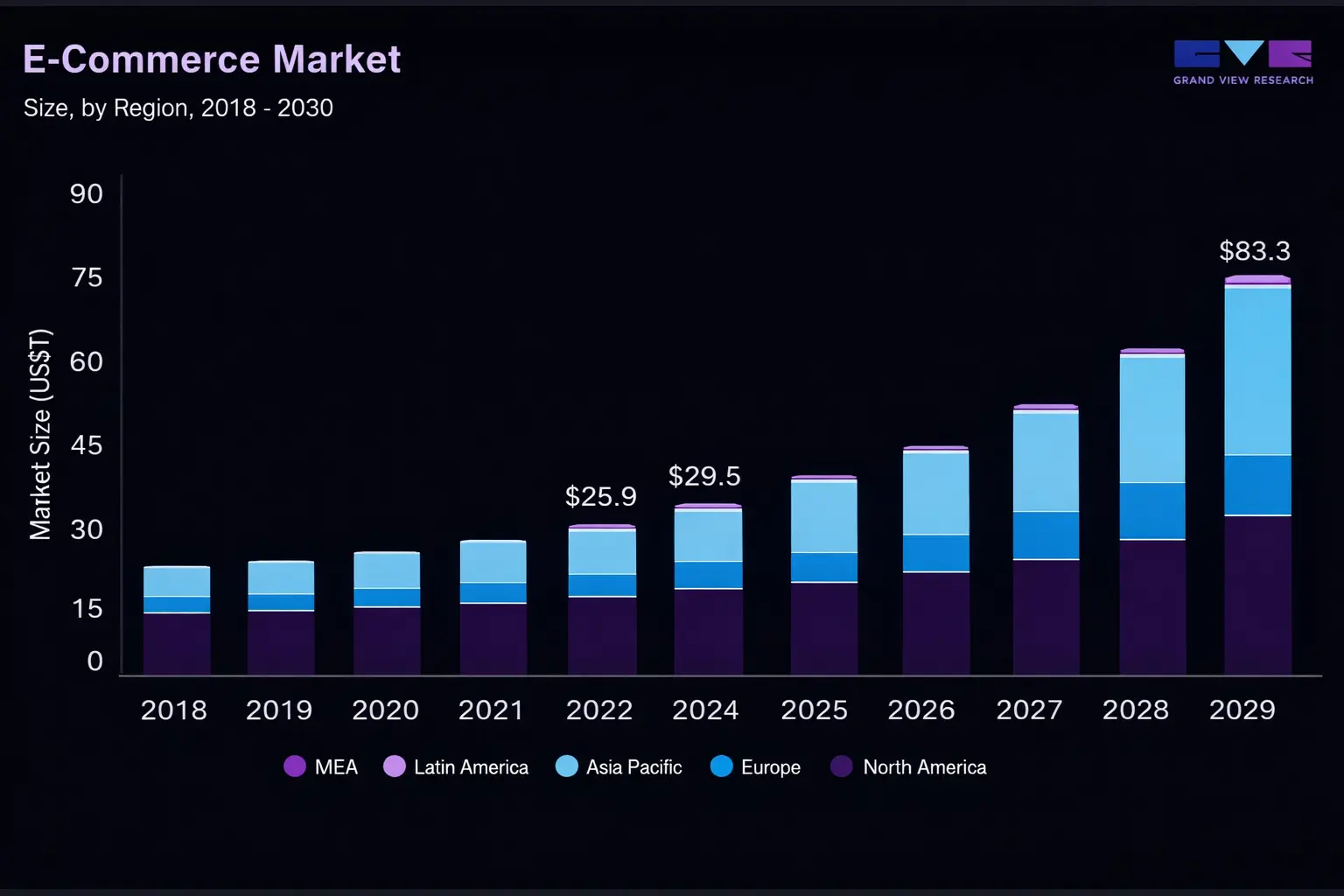
Amazon, Airbnb, and Uber are the top marketplace platforms that are gaining traction and inspiring other businesses worldwide to create a marketplace app.
How to build a marketplace app?
Well, it’s an uphill battle to develop a successful marketplace app, which goes beyond just launching a basic platform. It demands a scalable architecture, the right business model, smooth user experience, and a transparent go-to-market strategy from the beginning.
This guide talks about how to build a marketplace app step by step, market overview, types of marketplace apps you can create, marketplace app features, challenges you can encounter during development with solutions to overcome them, marketplace app development cost, and the best tech stack.
Startups, enterprises, and product leaders who are seeking to build a marketplace app to onboard vendors, drive users, and generate lasting revenue, this guide is for you.
Whether you are planning an MVP or a full-scale multi-vendor marketplace app development, this page will help you with every minute detail you need to make business-ready decisions.
What Is a Marketplace App?
A digital platform, a marketplace app, connects buyers and sellers, facilitating smooth transactions for products or services within a single ecosystem.
Unlike traditional apps that commonly act as a single business purpose, a marketplace app enables multi-vendor interactions, payments, order management, and user reviews all in one place.
Performing as an intermediary, such apps ease the process of buying and selling, permitting users to explore products or services, while vendors expand their reach to the audience worldwide without any need to manage separate storefronts.
Marketplace apps provide value by efficiently bridging supply and demand, whether it’s a service-based platform like Uber or a product-based platform like Amazon.
♦ Marketplace app vs. Traditional E-commerce Website
| Features | Marketplace App | Traditional E-Commerce Website/App |
| Vendors | Multiple independent vendors | Single brand or business |
| Product Range | Wide variety from different sellers | Limited to the company’s own products |
| Revenue Model | Commission, subscription, ads, and freemium | Direct sales, limited subscriptions |
| User Interaction | Buyers can review and compare multiple vendors | Users only interact with one seller |
| Platform Role | Intermediary connecting buyers & sellers | Seller-centric, sells their own products |
| Scalability | High, supports multiple vendors and services | Moderate, limited to one business |
Why Businesses Should Create a Marketplace App – Global Market Analysis
By aggregating demand and supply in a single ecosystem, the marketplace model is attaining success, allowing businesses to scale more rapidly than traditional standalone or ecommerce services.
Today, customers increasingly opt for the platform that offers an extensive choice, smooth payments, competitive prices, and community trust. And, here marketplaces meet the exact expectations often via mobile applications that are now chiefly the engagement touchpoints for billions of users.
► Compelling Growth Trends Raising Marketplace Adoption
- Swift Growth Projections: The marketplace business model is backed by network effects, diversified monetization, and lower entry obstacles for sellers, so expected to outpace traditional platforms.
- Massive Gross Merchandise Value (GMV) Expansion: Widely-known global marketplaces like Amazon, JD.com, Shopee, Tmall, and Taobao together contribute almost half of the total marketplace GMV, revealing geographic diversity and depth in the model’s reach.
- Emerging Markets Boom: In distinct regions, online marketplaces are likely to hit $350 billion in GMV by 2027, unlocking new opportunities for MSMEs to expand online and enterprise value.
| About one-third of all US business comes from eCommerce, of that 63% is conducted through marketplaces. |
► Why This Matters for Businesses
- Global Reach & Scalability: Marketplace apps violate geographic barriers, permitting startups and enterprises to enter into international customer bases and provide round-the-clock commerce without any traditional retail restrictions.
- Network Effects & Growth Potential: As more buyers and sellers join, marketplaces surpass linear business models.
- Multiple Revenue Streams: Besides direct transactions, marketplace platforms help earn from advertising, commissions, featured placements, and premium vendor services, expanding income and elevating lifetime value.
- Innovation & Competitive Edge: Advanced technologies, such as mobile-first experiences, AI-driven recommendations, and integrated payments, further boost engagement, conversion, and retention.
In the era of digital purchasing behavior and mobile usage, a well-crafted marketplace app development will help your business stay competitive and generate profits.
Future Trends in Marketplace App Development
Ahead, in the upcoming years, you will witness marketplace app development transforming to intelligent ecosystems, which were, at some time, a simple transactional platform, prioritizing multi-channel commerce, trust, and deep personalization.
• AI-powered Recommendations
These empower personalized product and service suggestions that boost engagement and transaction rates.
• IoT-enabled Marketplaces
These are gaining traction, connecting smart devices to trigger automated services, smooth supply chain management, and real-time inventory tracking.
• Blockchain Payments
These foster trust and transparency by protecting transactions and easing multi-vendor settlements.
• Hyperlocal and Niche Platforms
These marketplaces are becoming popular as they offer specialized products or services within particular communities or industries, providing highly personalized user experiences.
Matching the steps of these trends ensures your marketplace app stays innovative, competitive, and set to scale.
What are the Types of Marketplace Apps With Real-World Examples
You can build any form of marketplace app available in the market, each meeting unique business models and user requirements.
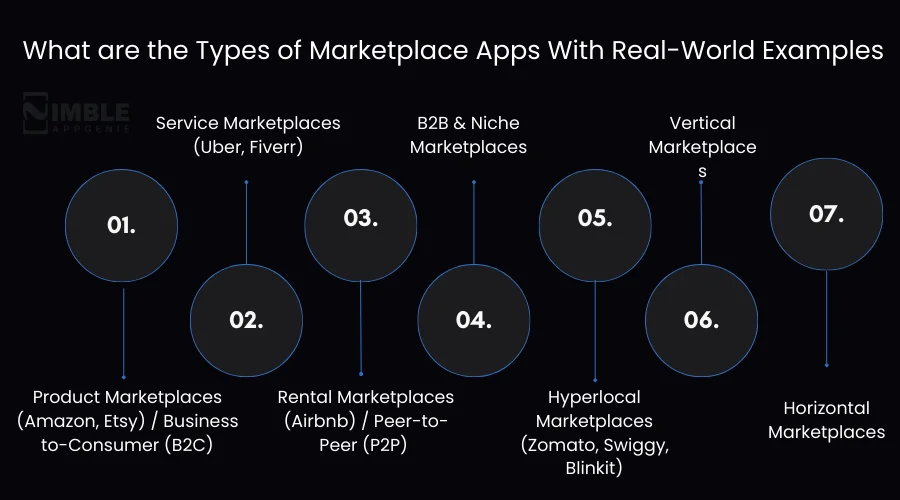
Understand the types of marketplaces in this section to choose the appropriate strategy for your platform.
1. Product Marketplaces (Amazon, Etsy) / Business-to-Consumer (B2C)
Creating product marketplaces lets multiple vendors sell digital or physical products to a wider audience.
Business Use Case: Product marketplaces are perfect for businesses planning a broad range of products without any need for inventory management themselves.
2. Service Marketplaces (Uber, Fiverr)
Developing service marketplace apps connects service providers or freelancers with customers demanding task completion.
Business Use Case: Service marketplaces are ideal for startups focusing on monetizing skills, gig economy offerings, or on-demand services.
3. Rental Marketplaces (Airbnb) / Peer-to-Peer (P2P)
Building rental marketplaces allows users to rent assets, like vehicles, homes, or equipment, from several providers.
Business Use Case: It’s amazing for businesses catering to peer-to-peer rentals and yielding revenue through commissions.
4. B2B & Niche Marketplaces
Developing B2B platforms targets particular business needs or industries, connecting businesses with specialized service providers or suppliers.
Business Use Case: Custom B2B marketplace solutions are suitable for enterprises focusing on automating procurement, niche vertical markets, or logistics.
5. Hyperlocal Marketplaces (Zomato, Swiggy, Blinkit)
Creating hyperlocal marketplaces connects consumers with local vendors for the rapid delivery of goods or services, usually within a small geographic area.
Business Use Case: Hyperlocal marketplaces are great for businesses looking to connect local vendors with customers nearby for rapid, location-specific delivery of groceries, food, or essential services with a restricted geographic radius.
6. Vertical Marketplaces
Building a vertical marketplace lets you focus on selling products or services of a specific industry or niche.
Business Use Case: Vertical marketplace is ideal for businesses that want to rule a specific niche or industry by providing specialized products or services with higher trust, deeper expertise, and targeted user engagement.
7. Horizontal Marketplaces
Developing a horizontal marketplace permits offering a diverse range of products across various categories.
Business Use Case: Horizontal marketplaces are suitable for companies seeking to develop large-scale platforms that provide a broad range of products or services across distinct categories to magnetize a wider customer base.
What are the Key Features of a Marketplace App
If you want your marketplace app to attain expected outcomes, you should balance vendor efficiency, user experience, and platform control.
Above that, including the right feature set will help you enhance engagement and drive transactions, sustainable scalability, and retention.
Below, we will check out what features you should incorporate panel-wise and their business impact.
► User Panel Feature
| Feature | What It Does | Business Impact |
| User Registration & Profiles | Enables users to sign up via email, phone, or social login | Reduces friction and increases onboarding conversion |
| Advanced Search & Filters | Helps users quickly find products or services | Improves user experience and boosts conversion rates |
| Secure Payments | Supports multiple payment methods with encryption | Builds trust and reduces cart abandonment |
| Ratings & Reviews | Allows users to review sellers and services | Increases credibility and drives informed purchases |
| Order Tracking & Notifications | Provides real-time updates on orders | Enhances transparency and customer satisfaction |
Business Value: A well-crafted user panel boosts engagement, transaction frequency, and repeat usage, which are the key metrics for marketplace expansion.
► Vendor Panel Features
| Feature | What It Does | Business Impact |
| Vendor Onboarding | Enables sellers to register and verify accounts | Accelerates platform supply growth |
| Product/Service Management | Allows vendors to add, edit, and manage listings | Ensures fresh inventory and better catalog quality |
| Order & Booking Management | Helps vendors track and fulfill orders efficiently | Improves service delivery and reduces disputes |
| Earnings Dashboard | Shows revenue, commissions, and payouts | Encourages vendor retention and transparency |
| Communication Tools | Enables direct buyer–seller interaction | Reduces friction and improves service satisfaction |
Business Value: Vendor-focused features diminish churn, improve retention, and ensure ongoing supply, which are significant for marketplace liquidity.
► Admin Panel Features
| Feature | What It Does | Business Impact |
| User & Vendor Management | Controls approvals, suspensions, and profiles | Maintains platform quality and compliance |
| Commission & Pricing Control | Manages platform fees and monetization rules | Enables flexible revenue strategies |
| Analytics & Reporting | Tracks user behavior, sales, and performance | Supports data-driven decisions and optimization |
| Content & Category Management | Organizes listings and platform structure | Improves discoverability and UX |
| Security & Fraud Monitoring | Detects suspicious activity | Protects revenue and user trust |
Business Value: A robust admin panel offers businesses scalability, complete control, and the capability to optimize performance in the growing market.
How to Build a Marketplace App: Step-by-Step Guide?
How to build a marketplace app like Uber/Airbnb/Amazon?
You need to follow a structured approach that balances technology, business strategy, and user experience.
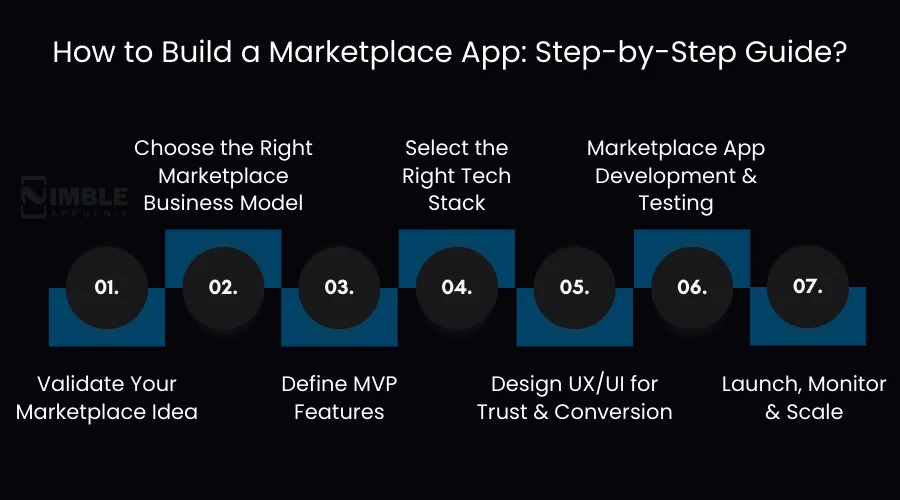
Below, we will discuss a proven step-by-step process that reliable marketplace app development companies follow.
Step 1: Validate Your Marketplace Idea
First things first, you should start by validating the actual demand of buyers and sellers, two slides of the marketplace.
Research thoroughly your competitors, target audience, gaps in current platforms, and pricing models.
Perform interviews, MVP-level testing, and surveys to ensure users are interested in conducting transactions on your platform.
Robust validation diminishes risk, prevents expensive pivots, and drives investors.
Step 2: Choose the Right Marketplace Business Model
Pick a business model that aligns with your revenue goals and market demands.
Common options embrace subscription, commission-based, hybrid, or freemium models.
Decide the type of your marketplace, B2B, B2C, or C2C, and whether it focuses on services, rentals, or products.
The right model directly influences monetization, scalability, and long-term profitability.
Step 3: Define MVP Features
You should aim to build a Minimum Viable Product (MVP) with core features for vendors, admins, and users. Like prioritize registration, payments, listings, search, and key management tools.
Avoid overloading features in the early stage of development. A lean MVP will help you launch rapidly, accumulate real user feedback, and optimize the platform before you invest in advanced functionality.
Step 4: Select the Right Tech Stack
Choose a marketplace app tech stack that supports performance, security, and scalability. Be sure that the tech stack aligns with your traffic expectations, app type, and future expansion plans.
Your decision for frontend frameworks, databases, backend architecture, payment gateways, and cloud infrastructure directly impacts development cost, lasting maintenance, and speed.
Step 5: Design UX/UI for Trust & Conversion
Your marketplace success relies heavily on ease of use and user trust.
UI/UX designers craft intuitive user flows for sellers and buyers, targeting clear navigation, transparent pricing, rapid search, and secure payments. Trust elements such as reviews, verification badges, and ratings boost conversions.
A well-optimized UI/UX diminishes drop-offs and escalates transaction completion rates.
Step 6: Marketplace App Development & Testing
You should ensure the development of a marketplace app leveraging an agile approach, allowing faster releases and iterative improvements. Also, guarantee smooth integration of features, third-party services, and APIs.
Rigorous testing is crucial, including performance, functional, usability, and security testing, to avoid data breaches, downtime, and poor experiences at roll-out.
Step 7: Launch, Monitor & Scale
Post-launch, you should monitor transaction flow, platform performance, and user behavior utilizing analytics tools.
Accumulate feedback from vendors and buyers to address improvement areas.
With time, introduce advanced features, optimize infrastructure, and scale into new markets for increased traffic.
Continuous monitoring and expansion ensure sustainable growth and platform stability.
Which is the Best Tech Stack for Marketplace App Development?
Well, there’s no one-size-fits-all tech stack for marketplace app development.
The best marketplace app tech stack depends on your scalability objectives, business model, feature complexity, budget, and expected traffic.
However, a top-performing marketplace app commonly merges scalable frontend frameworks, secure databases, a strong backend architecture, and cloud infrastructure.
Below is a recommended tech stack used by a marketplace app development company:
♦ Recommended Tech Stack for Marketplace App Development
| Layer | Technologies | Why It’s Recommended | Business Impact |
| Frontend (Mobile) | Flutter, React Native, Swift, Kotlin | Enables cross-platform or native app development | Faster time-to-market and better user experience |
| Frontend (Web) | React.js, Vue.js, Angular | Modern, responsive UI frameworks | Higher engagement and improved conversion rates |
| Backend | Node.js, Django, Laravel, Ruby on Rails | Handles business logic, APIs, and real-time processing | Ensures scalability and smooth transaction management |
| Database | PostgreSQL, MySQL, MongoDB | Secure and efficient data storage | Reliable performance and secure data handling |
| Cloud & DevOps | AWS, Google Cloud, Azure, Docker, Kubernetes | Supports auto-scaling and high availability | Handles traffic spikes and ensures uptime stability |
| Payments & APIs | Stripe, PayPal, Razorpay, Braintree, Twilio | Secure transaction processing and integrations | Builds user trust and reduces cart abandonment |
| Security Layer | SSL, OAuth, RBAC, PCI-DSS, GDPR compliance | Protects user data and transactions | Prevents fraud and strengthens platform credibility |
What is the Cost to Build a Marketplace App in 2026?
The cost to develop a marketplace app in 2026 depends on the technology stack, complexity of features, development location, and scalability needs.
Marketplace platforms include multiple-vendor architecture, admin controls, and payment integrations; pricing varies notably based on business goals.
1. MVP Marketplace App Cost
A basic MVP with core features like vendor onboarding, user registration, listings, payments, search, and admin management typically ranges between $25,000 – $50,000.
This is great for startups seeking idea validation and a quick launch.
2. Mid-Scale Marketplace Cost
A more advanced marketplace with real-time tracking, improved UI/UX, advanced search filters, analytics dashboards, and third-party integrations may cost between $50,000 – $120,000.
This is ideal for growing businesses focusing on competitive and scalability differentiation.
3. Enterprise-Grade Marketplace Cost
Large-scale marketplaces with AI-driven recommendations, custom architecture, advanced security layers, high-traffic handling, and microservices infrastructure can range from $120,000 – $300,000+, relying on complexity and global deployment needs.
♦Marketplace App Development Cost Breakdown:
| Marketplace Type | Estimated Cost Range | Best For | What’s Typically Included |
| MVP Marketplace App | $25,000 – $50,000 | Startups validating an idea | Core features (user registration, vendor onboarding, listings, search, payments, basic admin panel) |
| Mid-Scale Marketplace | $50,000 – $120,000 | Growing businesses scaling operations | Advanced UI/UX, analytics dashboard, real-time tracking, enhanced search filters, third-party integrations |
| Enterprise-Grade Marketplace | $120,000 – $300,000+ | Large businesses with high traffic needs | Custom architecture, AI recommendations, microservices, advanced security, global scalability |
A detailed cost breakdown aligned with your business model ensures sustainable platform success and better ROI.
Factors Affecting Marketplace App Development Cost
- UI/UX sophistication
- Feature complexity and customization level
- Choice of tech stack and architecture
- Third-party integrations (payments, APIs, logistics)
- Security, compliance, and scalability requirements
- Development team location (US, Europe, Asia)
What are the Challenges in Marketplace App Development & Solutions
How to build a marketplace app smoothly without encountering any hurdles?
Undoubtedly, creating a marketplace app demands handling complex transactions, two-sided users, and real-time operations. And you should address them or be prepared to confront them to experience a smooth app development journey.
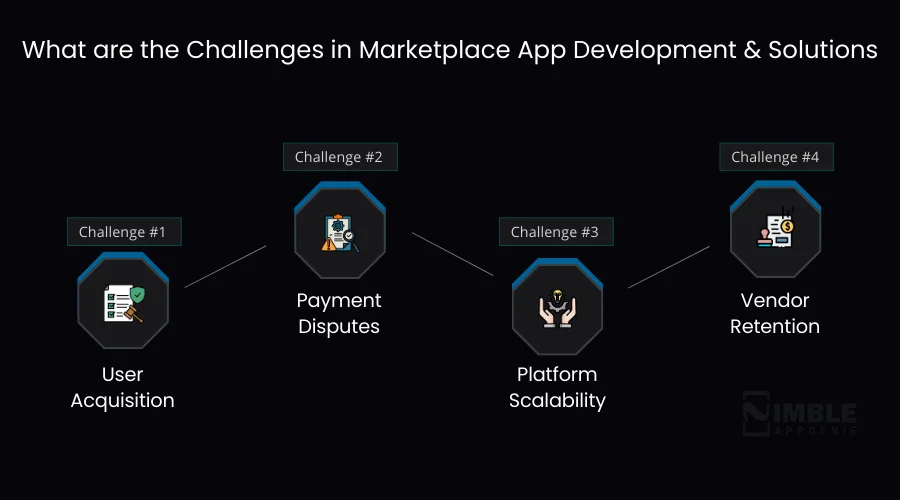
Let’s know common challenges you can face and possible solutions toresist them.
1. User Acquisition
Magnetizing buyers and sellers simultaneously in the early stage of the marketplace
Solution: First, aim at a niche market to create liquidity. Offer incentives, such as referral bonuses, diminished commissions, or promotional visibility, to onboard early adopters and initial vendors faster, creating the network effects.
2. Payment Disputes
Handling chargebacks, multi-vendor payouts, refunds, and commission splits can lead to operational complexity.
Solution: You should integrate secure payment gateways with automated commission management and escrow systems. Dispute resolution workflows and transparent refund policies assist in fostering trust and mitigating friction.
3. Platform Scalability
Managing surging user traffic, transactions, and listings without performance issues
Solution: Businesses should leverage the potential of cloud-based infrastructure with load balancing, auto-scaling, and microservices architecture to ensure consistent performance and high availability during traffic spikes.
4. Vendor Retention
Maintaining service quality and keeping vendors engaged across the platform
Solution: You should offer clear payout systems, offer performance dashboards, ranking incentives, and marketing tools to motivate lasting participation and enhance service standards.
So, by addressing such challenges thoughtfully, you can ensure your marketplace app stays scalable, sustainable, and competitive.
Which Monetization Models for Marketplace Apps are Suitable for Your Business?
Enterprises should choose the right monetization strategy to attract investors and ensure lasting profitability.
A well-crafted revenue model aligns with user behavior, the marketplace’s growth stage, and competitive positioning.
1. Commission-Based Model
When you choose this model, the platform charges an amount, a percentage of every transaction.
Business Goal: It’s perfect for raising revenue proportionally with the increasing transaction volume. Thus, it’s considered performance-driven and sustainable. The commission-based model is popular with rental marketplaces, products, and services.
2. Subscription Model
Users or vendors pay an annual or monthly recurring fee to access the platform.
Business Goal: This monetization model generates anticipated recurring revenue and boosts cash flow stability, specifically useful for B2B and niche marketplaces.
3. Featured Listings
To promote products or services and make them appear in the top search results, the vendors pay an extra amount.
Business Goal: Featured listings unlock an additional revenue stream while supporting sellers with increased visibility and conversions.
4. Advertisements
The marketplace platform earns through sponsored placements, third-party promotions, and banner ads.
Business Goal: Choosing Advertising for monetization maximizes revenue from high traffic without a surge in transaction fees.
5. Freemium Model
Well, basic access to features and other functionality of the marketplace app is free in this model, but advanced analytics or tools are chargeable.
Business Goal: Freemium model escalates user adoption at scale while monetizing users looking for premium capabilities.
#Tip: Choose a hybrid monetization strategy to deliver a powerful revenue performance for expanding marketplace apps.
Why Choose Nimble AppGenie to Build a Marketplace App
Marketplace app development demands technical execution, strategic thinking, sustainable growth planning, and powerful architecture.
Nimble AppGenie, the best marketplace app development company, has deep marketplace proficiency in business-driven development.
By offering custom marketplace app development services, the firm helps startups and enterprises roll out revenue-oriented platforms tailored to their objectives.
Key Reasons to Go For Nimble AppGenie for Marketplace App Development
- Custom Marketplace Development
- Agile & Scalable Architecture
- Security-First Approach
- Post-Launch Support & Optimization
- End-to-End Delivery
Need more? Let’s go through a real-time case study successfully accomplished by Nimble AppGenie and outshining the competitors in the fierce market.
Real-Time Marketplace App Case Study by Nimble AppGenie
- Client: A rapidly-growing startup
- Challenge: Vendor onboarding, secure multi-vendor payment distribution, and real-time tracking.
- Requirement: A hyperlocal service marketplace to connect local vendors and customers in the metropolitan areas.
- Solutions We Offered: Our team of app developers created a scalable marketplace app by harnessing a cloud-based microservices architecture with integrated real-time geolocation tracking and payment gateways.
Also, we implemented an interactive vendor dashboard, AI-driven recommendations, and automated commission management to improve user engagement.
Results Achieved:
- 40% increased vendor onboarding process
- 30% growth in transaction completion rate
- Seamless scaling to handle 3x traffic growth within six months
- Improved user retention through enhanced UX and trust features
We successfully launched a marketplace platform across multiple cities, and it’s constantly scaling with revenue growth and performance stability.
Ready to turn your marketplace idea into a scalable digital platform? Let’s build it strategically.
Conclusion
At this point, you know how to build a market app in the right way, considering strategic validation, an appropriate technology stack, a transparent monetization plan, and a scalable architecture.
From conception to launch and post-deployment expansion, every phase performs an exclusive role in the long run.
If you are also planning to develop a marketplace app, partnering with a trusted marketplace app development company, like Nimble AppGenie, ensures your platform is scalable, secure, and crafted for lasting growth. Our team combines end-to-end development expertise with revenue-focused strategies to help startups and enterprises roll out, expand, and monetize effectively.
FAQs

Niketan Sharma, CTO, Nimble AppGenie, is a tech enthusiast with more than a decade of experience in delivering high-value solutions that allow a brand to penetrate the market easily. With a strong hold on mobile app development, he is actively working to help businesses identify the potential of digital transformation by sharing insightful statistics, guides & blogs.
Table of Contents
No Comments
Comments are closed.