


In a Nutshell:
- Fetch Rewards turns receipts into redeemable points, earning through brand partnerships, targeted ads, and data insights while maintaining user trust and compliance.
- To develop a reward app like Fetch, define your project scope, conduct detailed market research, select MVP features, design intuitive UI/UX, choose the right tech stack, test rigorously, and deploy with ongoing maintenance.
- The fast-growing reward app market offers strong revenue potential through partnerships, advertising, and premium engagement models.
- Features like AI personalization, predictive deals, AR integration, blockchain wallets, and card linking can give your app a strong competitive edge.
- Development costs to create an app like Fetch range from $20,000 to $150,000, depending on complexity, while challenges like OCR accuracy, fraud prevention, and scope creep require expert technical execution.
- Partnering with Nimble AppGenie ensures scalable development, secure systems, innovative features, and long-term business success.
Wondering to build a reward app like Fetch?
Well, you can simply build it with the right strategies that begin with market study, selecting the features, designing the app, selecting the right tech stack, testing, deployment, and maintenance.
No, it’s not rocket science; with the right guidance, it’s all possible.
Reward apps are the new trend in this competitive world, where people prefer passive income.
Therefore, this rewards and loyalty apps market is expected to reach USD 7963.56 million by 2035.
If you are an entrepreneur and an investor looking to invest in this app, then it’s an ideal industry for you.
In this guide to create an app like Fetch, we will walk you through the fundamentals, working process of the app, reasons to invest in it, features, steps to make it, cost, and much more.
Let’s begin the journey together.
What is Fetch App? An Overview of America’s #1 Rewards App
Fetch app turns the receipts into free gift cards. It turns any receipts into points that users can redeem for cash back rewards and gift cards.
Here, the users can scan receipts from any grocery store, retailer, restaurant, or gas station. This app automatically identifies the items, scans them, calculates points, and then adds them to the user’s account.
One of the important points to note is that the app monetizes the shopping data for personalized offers and is a real app for passive savings.
This app has become the real mate for shopping for millions of Americans. When it comes to security, the app follows GDPR compliance to ensure the trust of the users.
Let’s look at the following section for evaluating how this app works!
How Does the Fetch Rewards App Work?
Users download the app from the Play Store or App Store as per their requirements, log in and register, then start scanning the receipts.
Then the app features special offers from brands that provide users with certain points for making a purchase. It provides rewards based on the user’s value for purchase, then redeems them in exchange for gift cards or Visa cash cards.
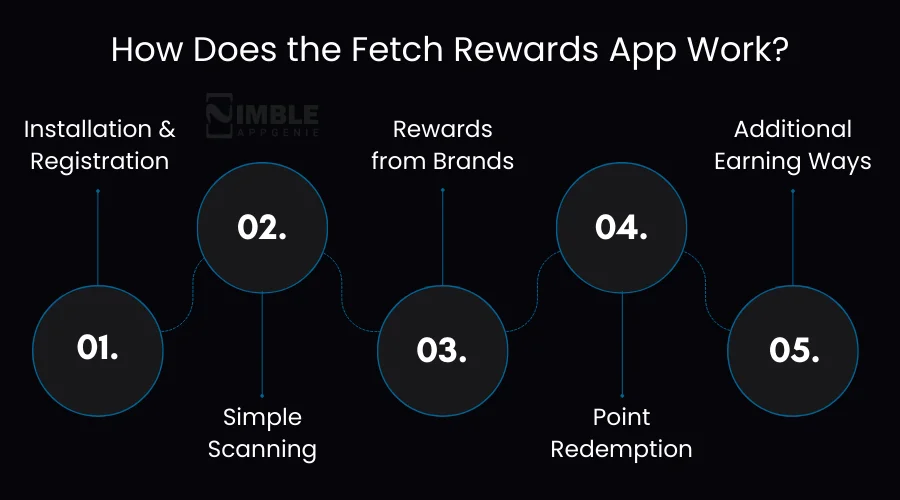
Let’s discuss this user journey with the Fetch App in brief:
Step 1: Installation & Registration
Install apps via available platforms, then register these apps by syncing email or phone number.
Here, users create their accounts and fill in all the essential details.
Step 2: Simple Scanning
With the given scanner, the users can simply scan the QR mentioned in the receipts.
Here, users take a picture of the receipt using the app’s camera icon, then the system begins to calculate points.
Step 3: Rewards from Brands
Through scanning, the app automatically fetches details and provides them with points for making a purchase.
These points depend on the type and amount of purchase made.
Step 4: Point Redemption
The app implements bonus multipliers (3x-10x) for partnering with brand purchases. Fetch is considering implementing “Streak bonuses” for consecutive days of scanning.
Additionally, the app offers instant gift cards from 500+ brands with redemption starting as low as $3.
Step 5: Additional Earning Ways
Fetch offers other ways to earn rewards, where users can earn points by playing games.
Along with this, the app helps users to earn from a specialized “Fetch Shops” option.
Still confused about building an on-demand app like Fetch?
The following section defines all the reasons.
Why Build a Rewards and Loyalty App Like Fetch in 2026?
You should consider building a loyalty clone like Fetch because of the growing market for rewards and loyalty apps, engaging users, high revenue potential, and offers to build valuable brand partnerships.
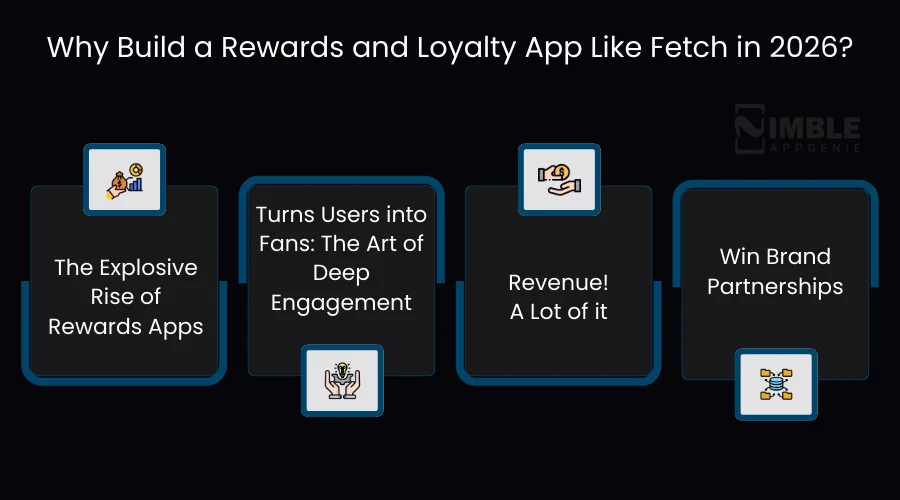
Here’s a brief of it all:
♦ The Explosive Rise of Rewards Apps
The global cash back rewards app market is expected to reach USD 7963.56 million by 2035, at a CAGR of 6.95% from 2026 (USD 4350.36 million).
Additionally, Fetch app records a revenue of $500 million in Q4 2024. The monthly active users grew to 12.5 million, with consumers scanning billions of receipts.
With this growth, you can develop a rewards app like Fetch and can contribute to this capital.
♦ Turns Users into Fans: The Art of Deep Engagement
Trust is the most supreme element in terms to create a loyalty app like Fetch. It’s true that users prefer transparency and prefer to consider apps that provide them with awareness about how they work internally.
Fetch is among them; here, 12.5 million users are submitting 11 million receipts per day. Wondering how they achieve this?
Well, by ensuring trust and transparency. Hence, by creating an app like Fetch, you will foster trust in the users that results in deep engagement.
♦ Revenue! A Lot of it
Fetch achieved an annual revenue run rate of $500 million, that makes 65% increase year over year.
Is Fetch earning revenue in one year? Yes, not this, its increasing profit percentage is proof of how well a rewards app like Fetch can be a good investment.
Once you gain trust and keep your promise of redemption, this revenue can multiply into trillions of dollars.
♦ Win Brand Partnerships
Apps like Fetch connect with multiple e-commerce brands, retail brands, malls, and even medical and gas stations.
Now, you can imagine that through building one app like Fetch, your company can link to popular brands.
After connecting with already trusted brands, your app will supposedly grow into the best apps list on the user’s phone. Hence, you will get brand partnerships, considering to build a reward app like Fetch.
Well, what’s more needed when you look to develop a mobile app in 2026? Handsome earnings, user engagement, promising future, brand partnerships, all these reasons are enough.
Ready to try your hand at Fetch-like app development?
Let’s start with understanding the features in the next section.
Top Fetch App Features to Replicate (And Improve)
Well, to create a clone like Fetch, you need to replicate its features, not just replicate; you need to keep one step ahead to gain users’ attention.
Let’s explore the list of top fetch app features in the table below:
| Features | Description |
| Receipt Scanning | Users earn points by simply scanning grocery, retail, or restaurant receipts. |
| E-Receipt Integration | Connect your email or Amazon account to automatically collect digital receipts. |
| Points-Based Rewards | Earn points on purchases that can be redeemed for gift cards. |
| Partner Brand Bonuses | Get extra points for buying featured or partner brand products. |
| Referral Program | Earn bonus points by inviting friends to join the app. |
| Daily Reward Offers | Spin or claim daily bonus point opportunities. |
| Gift Card Redemption | Redeem points for popular gift cards like Amazon, Target, and Visa. |
| In-App Special Promotions | Limited-time offers that multiply points on specific purchases. |
| Activity Tracking Dashboard | View purchase history, points earned, and reward progress. |
| User-Friendly Interface | Simple scanning process with an intuitive and clean design. |
| Secure Account System | Account verification and data protection measures for safe usage. |
| Gamification Elements | Progress tracking and milestone rewards to encourage continued engagement. |
Now, let’s talk about how you can keep one step ahead of Fetch.
POTENTIAL FEATURES FOR YOUR APP!
| Next-Gen Features | Description |
| AI Smart Spend Advisor | An AI assistant that analyzes purchase patterns and suggests smarter saving opportunities in real time. |
| Auto-Capture via Card Linking | Automatic reward tracking through secure debit/credit card integration, no receipt scanning required. |
| Dynamic Cashback Engine | Personalized cashback rates that adapt based on user behavior and loyalty level. |
| Global Multi-Currency Rewards | Earn and redeem rewards seamlessly across countries with real-time currency conversion. |
| Blockchain-Based Reward Wallet | Transparent, tamper-proof reward tracking with transferable digital reward tokens. |
| Predictive Deal Alerts | Notifies users of upcoming discounts on frequently purchased items before they shop. |
| Augmented Reality (AR) In-Store Rewards | AR scanning inside stores to unlock hidden bonus rewards and gamified deals. |
| Sustainability Rewards System | Extra points for eco-friendly purchases and carbon-conscious brands. |
| Micro-Invest Rewards Option | Convert reward points into fractional stock or crypto investments. |
| Brand Co-Creation Marketplace | Allow users to vote on or co-create future brand offers for exclusive perks. |
| Tiered Elite Membership | Premium subscription tier offering boosted rewards, priority deals, and partner perks. |
| Smart Budget + Rewards Integration | Built-in budgeting tools that connect spending goals directly with reward optimization. |
Are you ready to learn the complete stepwise process to build a rewards app like Fetch?
Yes!
Then, let’s continue learning.
How to Build a Rewards App Like Fetch? Development Process
You can create an app like Fetch by clarifying the scope of your app, evaluating the needs of the market, calculating the gap, selecting features, designing, tech stack selection, testing, and then deployment.
Don’t be afraid of this process. This might seems you like rocket science, but actually it’s simple.

Well, for now, let’s proceed with the step-by-step process to develop a reward app like Fetch
Step 1: Clarify the Project Scope
When you have a mobile app idea, it’s important to answer the following questions.
- What is the project goal?
- Who are the target users?
- What is the market gap you observe to address?
Well, these are not just questions; these are the response of what your app can do in the market.
Clarity avoids confusion, that prospers transparency, and ensures the delivery of effective results. This is the foundation of your business.
Step 2: Perform Detailed Market Research
In the second step, you need to perform a detailed market research. Where you should evaluate the following questions:
- What are the competitors doing?
- How are they leading and capturing users’ interest?
- What is the market gap exists in the case of loyalty and rewards?
Answering these can help you to know the current market landscape, how the loyalty and rewards app are changing users’ perspective.
Studying the market can help you explore revenue, figures, and even users’ demographics.
Step 3: Select the Features (Consider MVP)
Now, it’s time to select the right features for building your reward app like Fetch. Here, you should improve model accuracy, reduce training time, and prevent overfitting. Evaluate the following questions:
- What types of features should be included?
- Which types of features can make your rewards app different?
- Is this specific number of features ideal for your project?
You should consider hiring mobile app developers to identify features that impact the target variables.
Additionally, consider selecting features for building an MVP (minimum viable product).
Step 4: Designing the App
When an individual opens an app, the foremost thing that they interact with is the interface. This is one of the most important and common aspects of judging the app. Hence, let’s answer the following questions:
- What is the right design for your customized loyalty app?
- What tools should be used in mobile app design?
- How many screens do you need for your app?
Well, you should create a mobile app wireframe and an app prototype to design your app successfully.
This will help you to have a blueprint for your app.
Step 5: Selecting the Right Tech Stack
To build an app like Fetch, you need a backend support. Hence, selecting the mobile app tech stack can be your next step. Let’s evaluate the questions on the same:
- What is the relevant app tech stack for your a
- pp?
- What platforms are suitable for launching your rewards-based app?
- Is react native relevant, or is Python best?
Here, you should hire Android app developers or iOS app developers based on the requirements of your app.
Consider the following table for considering the tech stack for creating an app like Fetch:
| Tech Stack Layer | Technology Options | Description |
| Frontend (Mobile App) | Flutter / React Native / Swift / Kotlin | Build high-performance cross-platform or native mobile applications for iOS and Android. |
| Backend Framework | Node.js / Django / Ruby on Rails | Handles business logic, APIs, authentication, and reward processing. |
| Database | PostgreSQL / MongoDB | Stores user profiles, transactions, reward data, and analytics. |
| Cloud Infrastructure | AWS / Google Cloud / Microsoft Azure | Provides scalable hosting, storage, and server management. |
| Authentication & Security | Firebase Auth / OAuth 2.0 / JWT | Secure user login, session management, and data protection. |
| AI & Personalization | Python (TensorFlow / PyTorch) | Powers recommendation engines and personalized reward suggestions. |
| Receipt Scanning & OCR | Google ML Kit / AWS Textract | Extracts data from uploaded receipts automatically. |
| Payment Integration | Stripe / PayPal API | Manages secure reward redemptions and financial transactions. |
| Push Notifications | Firebase Cloud Messaging | Sends real-time offers, reminders, and engagement alerts. |
| Analytics & Tracking | Mixpanel / Google Analytics | Tracks user behavior, retention, and monetization performance. |
Step 6: Testing of App
Do not launch the app like Fetch without rigorous mobile app testing. In this step, you should perform testing based on security, performance, functionality, design, and environmental factors. Let’s discuss the following questions for the same:
- Does the app behave as expected?
- Are security communication protocols in place?
- Are font sizes and buttons working properly?
You should test your app on different devices to check its compatibility. Check for the network connectivity, evaluate if the app can handle heavy traffic, or needs improvement.
Additionally, you should check the app performance under interruptions, such as during calling, notifications, and even under low battery.
Step 7: Deploy, Maintain, and Update
Now, you should consider deploying the app on your selected platforms by cross-checking the platform guidelines and other compliances based on regions and states. Let’s analyze the following questions here:
- What platforms to consider to launch an app like Fetch?
- What is the frequency of app maintenance?
- How many times should you update the app?
Your task will not end after app deployment; now you should consider continuously maintaining the app and then updating it whenever it seems correct.
Here, connecting with mobile app maintenance services can be helpful to launch the app based on current technologies and updates.
Till now, we have discussed reasons to create an app like Fetch, its steps, and features. Now, the next question is “ what’s the cost to make an app like Fetch?”
Hence, let’s evaluate it in the following section:
What’s the Cost to Make an App like Fetch in 2026?
An average cost to develop a rewards app like Fetch can vary from $20,000 to $150,000. Depending on diversified factors such as the complexity of the app, the design of the app, the selection of tech stack, the platform selection, and the skills of the developers.
Let’s evaluate the cost breakdown of a reward app like Fetch in the given table:
| Cost Factor | Estimated Cost Range (USD) | What It Covers |
| UI/UX Design | $5,000 – $20,000 | Wireframes, user journey mapping, interactive design, branding, and prototyping. |
| Mobile App Development | $15,000 – $50,000 | iOS & Android development (native or cross-platform). |
| Backend Development | $10,000 – $40,000 | Server setup, APIs, database architecture, admin panel. |
| AI & Personalization Engine | $5,000 – $25,000 | Recommendation systems, smart reward logic, predictive analytics. |
| OCR / Receipt Processing Integration | $3,000 – $15,000 | Automated receipt scanning and data extraction setup. |
| Payment & Card Integration | $3,000 – $15,000 | Secure payment gateway setup and financial transaction handling. |
| Cloud Infrastructure & Hosting | $2,000 – $10,000 (initial setup) | AWS/GCP/Azure deployment, storage, scaling configuration. |
| Security & Compliance | $3,000 – $15,000 | Data encryption, fraud detection, GDPR/PCI compliance setup. |
| Testing & QA | $5,000 – $15,000 | Functional testing, performance testing, bug fixing. |
| Maintenance (Annual) | 15–20% of total cost | Updates, server costs, feature upgrades, and technical support. |
Well, after evaluating the on-demand app development cost, another important section to cover is monetization strategies for an app like Fetch.
How do Apps Like Fetch Make Money?
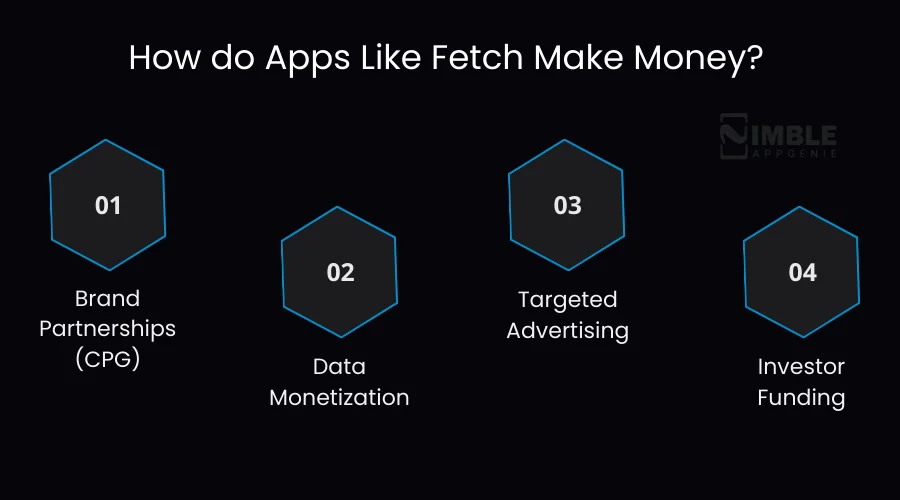
Apps like Fetch make money through brand partnerships, data monetization, Targeted advertising, and via investor funding.
Let’s evaluate the complete list of mobile app monetization strategies below:
1. Brand Partnerships (CPG)
When you build an app like Fetch, you need to connect with the diversified brands. Well, here you earn money from them instead of charging consumers.
There are major brands such as Unilever or General Mills that pay Fetch to list and feature their products, and when the users buy these featured products, Fetch earns commission.
Thus, here the companies pay Fetch for promotion, that drivers their sales, and acts as a primary revenue model for Fetch.
2. Data Monetization
Fetch, evaluate the user’s data, prepare reports, and then sell the aggregated data to the brands. Who uses this data for evaluating the user’s demand, their preferences, and even to evaluate the shopping habits of the users.
This is an additional source of income for Fetch. However, here, the Fetch considers security as a prime factor before selling data.
It is an important monetization source, but here you should attain users’ consent for selling their data to the brands.
3. Targeted Advertising
Another important revenue model for building an app like Fetch is targeted advertising. Here, the app uses user data to show targeted offers, prompting the users to buy specific items in exchange for the bonus points.
This revenue model works by using granular purchase data from scanned receipts to build detailed consumer profiles, allowing brands to deliver hyper-personalized offers and ads.
It is an additional source of revenue that delivers personalized ads based on users’ demographics, online behavior, and their interests.
4. Investor Funding
Investor funding is the process of raising capital for a business via external individuals or institutions, such as venture capitalists, angel investors, and private equity firms.
Fetch has raised a total of $691.51 million from investors Morgan Stanley, private Credit, SoftBank, Greycroft, ICONIQ, and many others.
Thus, this is one of the important sources of revenue when it comes to building an app like Fetch.
Now, let’s proceed with evaluating the challenges in creating a Fetch-like rewards app in the following section.
Challenges in Building a Fetch-Like Rewards App (And How to Overcome Them)
When you create a clone like Fetch, you might come across diversified challenges. Learning about these challenges in the very beginning can help you address them at priority.

Let’s evaluate the complete list of challenges to create an app like Fetch, below:
Challenge #1: Scope Creep
If you are not clear about the project goal and scope, this can result in scope creep. This further results in budget overruns and missed deadlines.
You can overcome it by defining a clear scope of your app to the developer and by planning the complete budget for your app.
Challenge #2: Technical Challenges
Technologies like implementing an advanced OCR and receipt parsing system, which can read, interpret, and process the unstructured data is highly complex.
The solution for this challenge is to connect with a top-rated mobile app development company, which knows effective technologies and tools to implement them successfully.
Challenge #3: Lack of Market Research
Another challenge that you might face while creating an app like Fetch is poor market research. This will result in building an app that does not fulfill the desired project scope.
The solution for this challenge is to conduct a proper market study related to the industry, target audience, and changing demands of the users.
Challenge #4: Poor App Design
If the user finds the buttons of the app not working, or a poor UI interface with unclear fonts, then they will automatically abandon it.
Hence, you should create a clear and prompt design for your app. The user interface should be intuitive, consistent, and accessible, focusing on clarity to minimize the cognitive load.
Challenge #5: Fraud Prevention
When you develop a reward app like fetch one of the critical challenges that you will come across is breach of data.
The solution for this challenge is you should include robust internal controls, advanced technology, and a proactive organizational culture.
After evaluating the challenges, one of the elements that remains is “what is the future of rewards apps like Fetch?”
Hence, let’s proceed to learn it in the next section.
Future of Rewards & Loyalty Apps — Trends to Watch
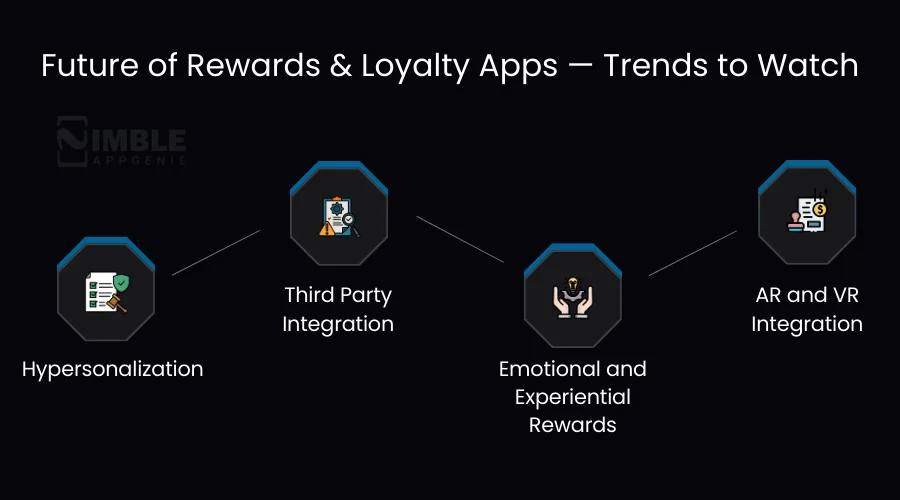
By the end of 2026, the rewards and loyalty apps will shift their focus to the emotional, experiential rewards, integrating with the digital wallets, blockchain for cross-brand redemption, and augmented reality for building user engagement.
Let’s discuss the complete future trends for apps like Fetch, below:
• Hypersonalization
With AI in apps like Fetch, you can evaluate the demands of the users by scanning receipts. This will help you to identify what types of brands the user prefers to shop.
Additionally, by evaluating their selection over gifting cards, you can examine what next to offer.
• Third Party Integration
Integrating payment systems in apps like Fetch can help you to offer users a platform where rewards can directly turn into monetary benefits.
Along with this, you can integrate social media platforms that even help you to have an advantage in promotion via sharing and comments. It will improve your brand awareness.
• Emotional and Experiential Rewards
These are non-monetary, intangible incentives such as travel, exclusive events, and the persoanlized experiences, that are built to foster deep emotional connections with the target audiences.
With this type of technology, you can improve the users’ trust in the brand.
• AR and VR Integration
AR and VR integration is the future of apps like Fetch, as these technologies help to foster emotional connections through transforming passive consumption into an immersive and active experience.
These experiences trigger psychological and physiological responses such as trust, empathy, and excitement.
Now, if you are ready to build your app like Fetch, then considering a reputed firm is important.
Hence, the following section says it all.
Connect with Nimble AppGenie and Build an App like Fetch
Confused about which company to select to build your dream reward app like Fetch?
Don’t worry, Nimble AppGenie is here to help.
We are the trusted On-demand App Development Company with a team of the most skilled developers and designers who know how to convert your idea into reality.
From intuitive UI/UX design to advanced AI-driven personalization and secure payment integrations, their team helps you craft a feature-rich, future-ready solution tailored to your business goals.
Whether you’re launching an MVP or building an enterprise-level loyalty ecosystem, they provide end-to-end development, strategic consultation, and post-launch support. Connect today to transform your vision into a high-performing rewards app that drives engagement, builds trust, and maximizes revenue.
Conclusion
Building a rewards app like Fetch Rewards in 2026 is more than replicating receipt scanning and cashback features.
It requires strategic planning, deep market research, advanced technology integration, and a strong focus on user trust and engagement. With the market rapidly expanding and revenue models evolving through brand partnerships, data monetization, and hyper-personalization, the opportunity is massive.
By selecting the right tech stack, defining a clear scope, prioritizing security, and continuously updating your platform, you can create a scalable and profitable loyalty ecosystem. The future belongs to innovative, transparent, and user-centric rewards platforms.
FAQs

Niketan Sharma, CTO, Nimble AppGenie, is a tech enthusiast with more than a decade of experience in delivering high-value solutions that allow a brand to penetrate the market easily. With a strong hold on mobile app development, he is actively working to help businesses identify the potential of digital transformation by sharing insightful statistics, guides & blogs.
Table of Contents
No Comments
Comments are closed.