


In a Nutshell:
- The overall music app market size is expected to grow to $8.98 billion in 2026.
- Integrating Music APIs in the app enables instant access to vast, licensed music libraries, significantly reducing the overall development time and costs.
- Music APIs are the protocols that assist mobile apps in getting access to music-related data or features programmatically.
- The best Music APIs are Spotify web API, Amazon Music API, SoundCloud API, Napster API, Musickit API, Deezer API, Pandora API, Shazam API, and Bandcamp API.
- To select the best Music APIs, you need to evaluate project needs, look at the music library, check the features, ensure it’s easy to use, and do not forget reliability.
- You can add the best Music APIs or can build your own APIs with Nimble AppGenie, whose professionals are experts in this field.
Music APIs are sets of protocols that help developers to integrate music data, such as artist information, lyrics, and even audio streaming, directly into their own websites and applications.
Do you know that the music app market size can grow from $7.97 billion in 2025 to $8.98 billion in 2026, at a CAGR of 12.6%?
Yes, it’s true, and in the coming years, this industry can boom further. This is exciting for artists, managers, producers, and label teams, but it also means more data, more trends, and more decisions to handle.
Additionally, tracking song performance, playlists, audience insights, and metadata manually can take hours every week.
Thus, Music APIs come into the picture. They give music professionals fast access to real-time data and help you track charts, monitor listeners, manage metadata, and more.
With the right music API, you can save time, work smarter, and focus on growing your music business.
If you want to streamline your workflow with music APIs, this guide will walk you through different APIs and how to select the right one.
What Exactly is a Music API?
Music APIs are a tool that allows developers or mobile apps to access music-related data or features programmatically. Instead of manually searching or building everything yourself, a music API allows your app to connect directly to platforms.
For example, Spotify, Deezer, and Amazon Music. This enables features like streaming previews, fetching playlists, searching tracks, accessing artist information, and analyzing user listening habits seamlessly.
Instead of developing a music database or streaming system from scratch, mobile app developers can use a music API. These APIs integrate features into mobile apps, websites, or other software quickly and efficiently.
Basically, music APIs save a lot of time, reduce development complexity, and help your music app deliver a better music experience to users.
What are the Top Music APIs that You Should Know?
In this section, we will discuss the best APIs in the music industry that many professionals rely on. These APIs make it easier to access, analyze, and integrate music data into mobile apps and services.
Let’s take a look at each one of them :
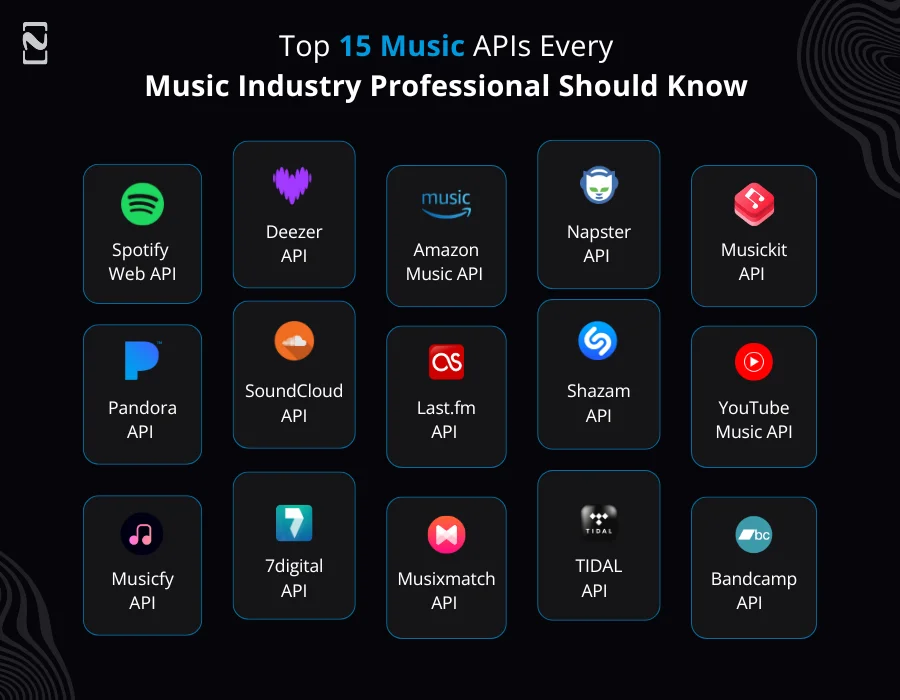
1. Spotify Web API
The Spotify Web API is the most popular music API out there. It allows developers to access Spotify’s huge music catalog, lyrics, search for tracks, albums, and artists, and fetch playlists or top charts.
Additionally, you can retrieve the user’s listening history, show album artwork, and play song previews. It is perfect for apps like Spotify, Deezer that want to create personalized recommendations, social music sharing features, or playlist curations.
This is the best music API, which is well-documented, easy to integrate, and supports multiple programming languages. This makes it a go-to choice for music app developers globally. If you are building a modern music app or discovery platform, Spotify is one of the best places to start.
2. Amazon Music API
Amazon Music API allows developers to access music from Amazon. You can get songs, albums, and playlists. Additionally, the API provides album artwork and song details. It can show charts and popular music.
Developers can leverage the Amazon Music API to integrate music into websites or mobile applications. The best part is that it works with Alexa and other Amazon devices. If you want to develop a mobile app for music streaming or AI music recommendations, the Amazon Music API is the best.
The Amazon Music API is among the top music APIs that are simple to use and have clear documentation. It is useful for mobile apps that want a large music library, and help people find and listen to music easily.
3. YouTube Music API
YouTube Music API gives access to music videos, songs, playlists, and trending content from YouTube’s large library. It allows developers to show video thumbnails, song details, charts, and recommendations inside an app.
Integration is done through Google’s API system, using API keys and endpoints that return data in JSON format. With the YouTube Music API, developers can integrate features like search, playlist browsing, or embedded video playback.
This API is best for mobile apps that want both music and video, like discovery apps, content-rich music platforms, or apps that highlight trending music across the internet.
4. SoundCloud API
SoundCloud API offers massive access to the music library of user-generated, independent, and emerging music, along with robust features for embedding, searching, players, and accessing metadata.
SoundCloud API is great for apps focused on independent artist creators, remixes, beats, and community-generated audio. You can allow users to discover trending tracks, playlists, and new artists. It supports audio previews and allows users to explore music by genre or mood.
SoundCloud API is ideal for apps that want to focus on indie music or emerging talent. It can help your app feel fresh and unique. Your users can listen, like, and share music within the app. It is easy to integrate, which makes your app engaging for users who want new and creative music content.
5. Napster API
Napster API gives your mobile app access to millions of songs, albums, and playlists. You can show top charts and popular tracks. It also enables your audience to discover new music and explore playlists.
Napster also provides song previews so users can listen before they play or save tracks. A dedicated development team can integrate music recommendations and favourite lists in your app with the Napster API.
It is one of the best Music APIs that focuses on music streaming, social sharing, and discovery. This API helps make your app engaging for users who want to explore music easily.
6. Musickit API
Musickit API allows your app to connect with Apple Music. Users can easily explore multiple songs, albums, and playlists right inside the app. It can provide personalised recommendations, show album artwork, and create curated playlists.
Your mobile app can access a user’s library if they allow it. It works on iPhone, iPad, Mac, and web platforms. Musickit API is perfect for mobile apps that want high-quality music streaming and a seamless Apple Music experience.
Moreover, Musickit APIs are among the top music APIs that help attract Apple users and build engaging music discovery or playlist mobile applications with familiar music content.
7. Deezer API
Deezer is one of the lightweight and impactful music API that offers access to a large music catalog, curated playlists, mood-based collections, and metadata like genres. The API provides information about genres and song details. Deezer helps apps show playlists, music charts, and popular songs.
You can create a mobile app that shows music recommendations. The Deezer API can easily connect with other mobile applications. Mobile app developers can develop a music streaming or discovery platform. It also works on websites and mobile apps.
It is the best music API that allows free, easy access to a massive music catalog without needing any complex authentication. This API offers ease of use with free audio previews, no data limits, and flexible integration.
8. Pandora API
Pandora API enables your music application to create personalised radio stations for users. You can provide recommendations based on user preferences. It enables your app to show song, artist, and album details.
Pandora’s main focus is on music discovery, which helps keep users engaged. With the Pandora API, you can create mobile applications that feel personal and interactive. It is easy to integrate and helps your app keep users returning for new music.
However, if you want to develop an app like Pandora with automated playlists or music discovery features, this music app’s API development is the best. Pandora API can enhance apps with trending music, favourite songs, and personalized listening experiences.
9. Last.fm API
Last.fm API helps your mobile app track music trends and user listening habits. You can show top tracks, artists, and albums. Also, it provides recommendations based on user preferences. Last.fm API is ideal for apps that focus on discovery, analytics, or personalized playlists.
You can create charts or trending music sections with the integration of Last.fm API. It helps your users explore music they might like. The API is simple to integrate and adds value by giving insights into music popularity and listening behavior.
This is a unique music API that focuses on collecting and sharing more modern, well-documented, and consistent RESTful APIs, helpful in better error handling and efficient for large-scale data retrieval.
10. Shazam API
Shazam API allows apps to identify any song playing nearby by using the device’s microphone. It returns the song name, artist, album, lyrics, and artwork.
Developers can integrate the Shazam API by capturing short audio samples and sending them to Shazam’s recognition engine through API security requests. Results are fast and accurate.
This makes it easy to build interactive music features. Also, this API for music platforms is ideal for apps focused on music recognition, discovery, or interactive music experiences. For instance, apps that help users identify songs instantly, explore trending music, or view lyrics based on a song match.

11. Musicfy API
Musicfy API provides access to a large music catalog with tracks, albums, playlists, and charts. Developers can integrate it through simple HTTP requests that return song metadata, artwork, and preview URLs.
It supports search, recommendations, and trending music features. Musicfy API is easy to plug into mobile and web apps. This makes it a good choice for apps that want general music streaming, discovery tools, or playlist features without complex setup.
This is one of the latest music APIs used for businesses that want a simple, all-purpose music API to power a modern music experience with charts, top songs, and personalized suggestions.
12. 7digital API
7digital API gives legal access to licensed music for streaming, downloads, and previews. It provides high-quality metadata, track previews, and catalog search through REST endpoints.
Developers integrate it using an API key and make calls to fetch albums, artists, or songs. The API supports e-commerce features. This makes it possible to sell music or offer previews inside the mobile application.
It is best for apps that combine streaming with digital music sales or platforms that want legal, licensed music content. 7digital is also trusted by major music services. This makes it reliable for business use.
13. Musixmatch API
Musixmatch API is the largest global lyrics database used by many major music apps. It provides lyrics, translated lyrics, synced lyrics, and song metadata. You can integrate it by calling endpoints that return structured lyric data linked to songs, artists, or albums.
The Musixmatch API can also sync lyrics with the music playing in the app. It is best for apps focused on lyrics, karaoke features, music education, or interactive singing tools.
With the Musixmatch API, you can enhance your mobile apps by showing real-time lyrics, building sing-along features, or offering lyric-based music recommendations.
14. TIDAL API
The TIDAL API is a public web API that allows developers to integrate their apps with TIDAL’s music platform. It allows apps to search for songs, artists, albums, and playlists, and access detailed music information.
Developers can also work with user features like saved songs, favorite artists, and personal playlists. The API follows the JSON: API format, so the data is clean and easy to use.
This is the top music API that offers high-quality music content, premium audio, or personalized music tools. This API assists businesses in building apps with TIDAL’s rich catalog and user features.
15. Bandcamp API
The Bandcamp API lets developers connect their mobile apps to Bandcamp’s music platform. With it, apps can pull information about artists, albums, and songs, and also handle merch orders and view sales details through the Sales API.
It uses OAuth for secure access. The API includes tools to work with music data, fan activity, and sales reports. This makes it easy to build apps for music discovery, fan engagement, analytics, or online merch stores.
Bandcamp API is among the best music APIs that want to support independent artists and make use of Bandcamp API’s strong music community.
How to Choose the Right Music API for Your Workflow?
If you’re working on a project that needs music data like song details, audio features, or a simple track search, then you’ll need a music API. But with so many options out there, it can be hard to figure out which one fits what you’re trying to build.
Here are some factors that can help you choose the right Music API for your project :
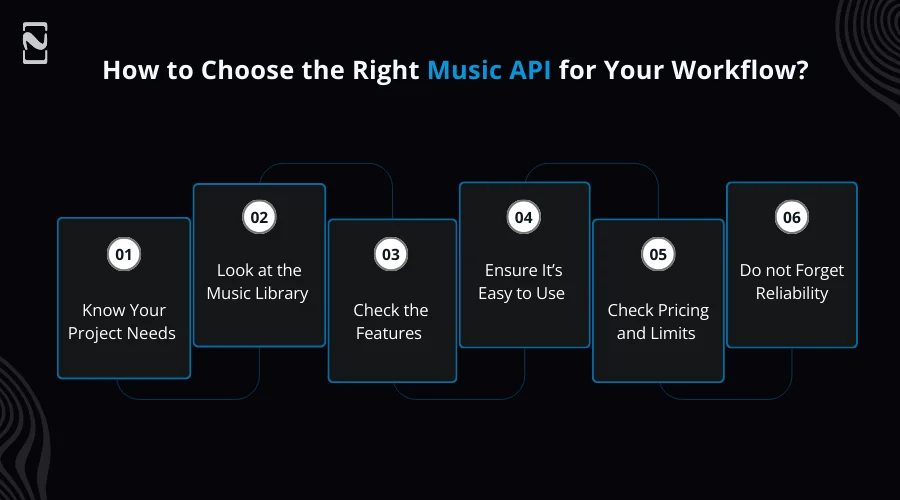
► Know Your Project Needs
Firstly, get clear on what you want your project to do. Do you need basic things like song titles and artists? Do you want deeper stuff like tempo, mood, or audio analysis?
Or maybe your focus is on recommendations and playlists? Once you know what you require, it becomes quite easy to find which API can deliver it.
► Look at the Music Library
Not every music API has the same music collection. Some have very popular music while others have indie tracks, remixes, and old music.
If your project depends on variety, just make sure your music API has a wide and updated library. There is nothing worse than searching for a song and realizing the music API can not find it.
► Check the Features
As you know, different APIs for music provide different tools. Some give short song previews, others offer genre tags, lyrics, and mood data. If your project uses particular features, make sure the API supports them.
You don’t want something overloaded with things you don’t need, or something too basic that won’t get the job done.
► Ensure It’s Easy to Use
Good documentation matters a lot. A music API should not feel like you are trying to solve a puzzle. You can look for examples, simple guides, and setup processes that do not take forever. If the platform has a helpful community or support team, that’s even better.
► Check Pricing and Limits
Some music streaming APIs are free, some cost money, and some give you a limited free plan. You can check the limits and think about how many calls your app will make each day. A plan that seems fine at first can get expensive fast if your project grows, so it is worth planning.
► Do not Forget Reliability
A music application can only run smoothly if the API behind it is stable and reliable. You can look for services that are known for good uptime and quick responses. Slow or unreliable music industry APIs will cause problems for your users and headaches for you.
How Can Nimble AppGenie Help Integrate Music API in Your App?
Adding music features to your app sounds simple, but behind-the-scenes work can get challenging fast. Different APIs have their own rules, data formats, and limits. This is the part where Nimble AppGenie can really help.
Our skilled music app development team has worked with many music APIs before, so we know how to set things up without turning it into a long, confusing process.
However, if you want simple features like song search or something more detailed like mood-tracking or audio data, we can integrate the right music API. We also make sure the music loads smoothly in the music application so users do not deal with slow screens or broken links.
Another relief is that we handle all the testing. Instead of you trying to fix odd bugs or connection issues, our experts check everything until it runs properly. If you want to integrate the Music API in your app, Nimble AppGenie is the one-stop destination.
Conclusion
For anyone working in the music industry, having the right music API can make everyday tasks much easier. No matter if you are building platforms, organizing large music libraries, or studying listener behavior, these APIs help you get clear, structured data without the extra effort.
Some APIs focus on song and artist details, while others dig deeper into metadata, audio insights, or user trends. The useful APIs for your next project depend on what your project requirements are, whether it’s quick searches or advanced analysis.
So, when you choose an API, always look at accuracy, ease of use, and how dependable it is over time. Choosing the right one can save hours of work and help you deliver better outcomes in your music projects.
FAQs

Niketan Sharma, CTO, Nimble AppGenie, is a tech enthusiast with more than a decade of experience in delivering high-value solutions that allow a brand to penetrate the market easily. With a strong hold on mobile app development, he is actively working to help businesses identify the potential of digital transformation by sharing insightful statistics, guides & blogs.
Table of Contents
No Comments
Comments are closed.