

 Free Consultation
 PCI-DSS Compliant
 GDPR Ready
 ISO 27001
 NDA Protected
 AI Services
 AI App Development
 Generative AI Development
 AI Chatbot Development
 AI Integration Services
 AI Consulting Services
 AI For Fintech
 AI Financial Assistant Solution
 AI Insurance Agent Development
 Tech Stack
 OpenAI / GPT-4
 Claude / Anthropic
 Gemini / Google AI
 Llama / Open Source
 LangChain / LlamaIndex
 Pinecone / Pgvector
 AWS / Azure AI


 Fintech Solution
 Core Fintech
 App Development
 Neobank Solutions
 eWallet Solutions
 Lending Software
 Banking Solutions
 BNPL Solutions
 BNPL Solutions
 Insurance App
 Wealth Management
 Crypto & DeFi
 Blockchain Development
  Payroll Software
 DeFi Solutions
 Crypto Wallet
 Crypto On/Off Ramp
 Crypto Exchange
 Trading Platform
 Payments
 Compliance
 Regulations & Compliance
 Fraud Detection
 Lending Ecosystem
 P2P Lending Platform
 Mortgage Software
 Engagement
 Fintech Outsourcing

 Mobile Development
 Mobile App Dev
 iOS App Development
 Android App Development
 React Native
 Flutter Development
 Web Solution
 Node.js Development
 React.js Development
 Angular Development
 App Services
 UI/UX Design
 App Maintenance
 By Stage
 MVP Development
 Industry Solutions
 Healthcare App Dev
 Education App Dev
 Travel App Dev
 Real Estate App Dev
 Logistics Software
 Social Media App

 Hire Mobile Developers
 Hire iPhone Developers
 Hire Android Developers
 Hire React Native Devs
 Hire Flutter Developers
 Hire Web Developers
 Hire Node.js Developers
 Hire Angular Developers
 Hire PHP Developers
 Hire Laravel Developers
 How It Works
 Pre-Vetted Developers
 Ready In 48 Hours
 NDA From Day One
 Replace Guarantee
 Company
 About Us
 Our Work Process
 Portfolio
 Case Studies
 Blog / Insights
 Careers
 Contact Us
 Awards
 Recognition


 Offices



In a world where almost 99.5% of users uninstall a mobile application within 30 days, user retention is not just another KPI anymore. It is the deciding factor between the mobile app that grows and an app that quietly disappears.
Today, mobile app developers and marketers operate in one of the most competitive environments we have ever seen. User attention spans are shorter, expectations are higher, and advertising costs continue to rise.
You can spend thousands of dollars bringing users in, but if they don’t stick around, every new app becomes a short-lived victory. That’s the core problem this guide will solve.
This blog is not just about tracking user retention in mobile apps or knowing what “Day 1 Retention” means. It’s about understanding how to engineer retention, how to design products, experiences, and communications that give users clear reasons to come back.
We will also discuss some crucial strategies to assist you in improving user retention rates and ensuring long-term mobile app success.
So, let’s begin!
What is User Retention Rate?
User retention is a metric that shows how many users return to your mobile app or website after their first visit. Let’s understand this with an example. It measures loyalty, engagement, and how valuable users found your product.
User retention is really important because retained users mean longer-term success. It helps you understand:
- Do users like your product?
- Are they getting value from it?
- Are they coming back regularly?
- Was your onboarding experience good?
- Are your features useful?
Retention is more important than downloads. Anyone can get 1000 downloads. But how many will stay? That’s what really matters.
What Counts for a Retention Rate?
For years, user retention was measured in a very basic way: “A user opened the app again within X days.” But modern apps, those competing for long-term loyalty, need a deeper understanding.
Today, retention is less about activity and more about value. Modern retention focuses on questions like:
- Are users achieving something inside the app?
- Do they feel progress or improvement?
- Is the app helping them reach a goal?
- Are they forming a habit of using it?
This is known as value-based retention, and it’s a much stronger indicator of long-term success. A user may open your app once or twice out of curiosity, but they’ll only keep coming back if it continues to benefit them in a meaningful way.
You can take the example of fitness apps. Opening the app doesn’t matter. Completing workouts, tracking progress, or hitting weekly goals, that’s what shows actual value.
How to Measure Your Mobile App User Retention?
Before you can improve retention, you need to measure it properly. Retention tells you how many users are still active after a certain period of time.
Traditionally, this meant checking how many people opened your app again after they installed it. But in 2026, teams will use more detailed methods because app behavior has become more complex. Let’s take a look at the different ways to calculate mobile app user retention.
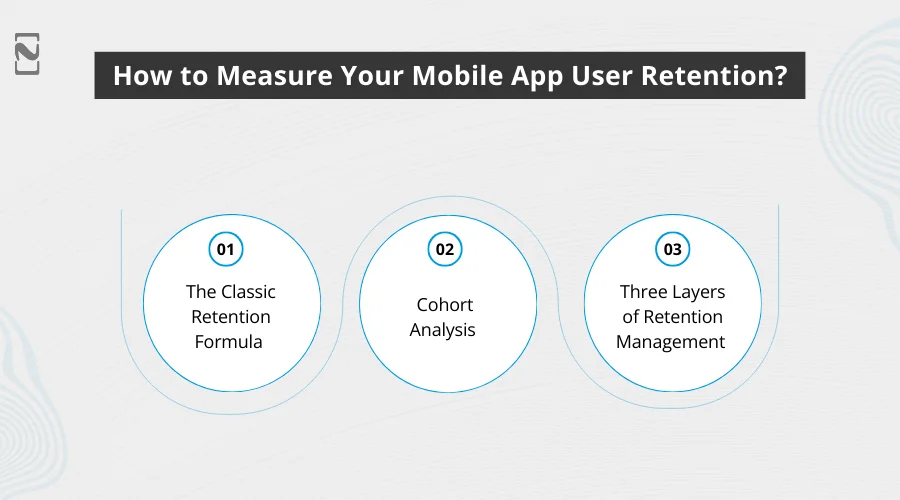
1. The Classic Retention Formula
The basic formula is still useful and looks like this:
| Retention rate = Returning users / total user starts at the start * 100 |
Let’s say 1000 people installed your payment mobile app on January 1. 350 of them opened it again on January 2. Your day 1 payment apps user retention is 35%. This formula helps you track:
- Day 1 retention, which is an immediate value
- Day 7 retention, which is early habit formation
- Day 30 retention, which is a longer time value or stickiness
These checkpoints are standard because they tell you different things. For example, did your onboarding work on day 1? Did users understand the value on day 7? Are users forming a habit or seeing real results on day 30?
2. Cohort Analysis
Instead of looking at all users together, modern retention tracking uses cohorts. A cohort means a group of users who started using your app during the same period.
For example, everyone who installed your mobile app on January 1 is in one cohort. Everyone who was installed on January 2 is in another cohort. You can then track each cohort’s retention rate separately.
This matters because different marketing campaigns attract different types of users, app updates may affect certain cohorts, and bugs or onboarding tweaks may impact retention temporality. Cohorts help you see cause and effect much more in advance.
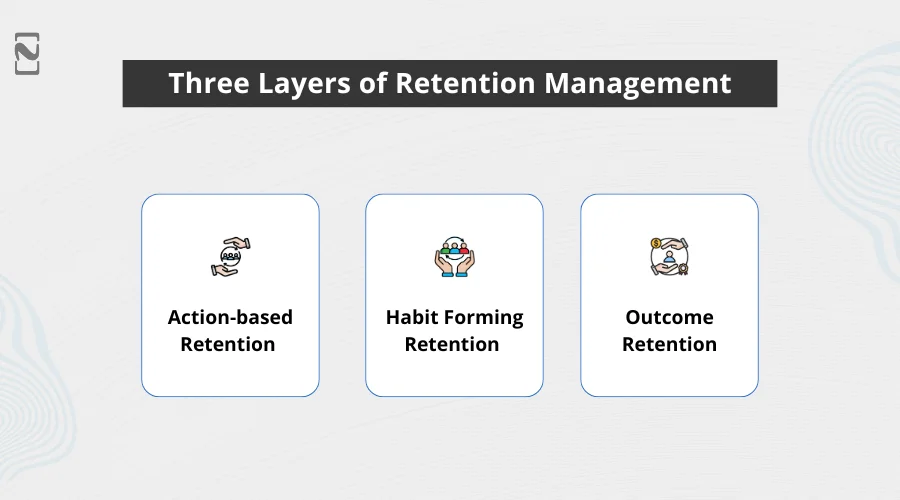
3. Three Layers of Retention Management
Today, retention tracking has changed completely, far beyond “did they open the app again?” Modern user retention in mobile apps has three deeper layers that give you a much clearer picture of user behavior. Let’s break down each one.
-
Action-based Retention
This majorly focuses on particular actions inside your mobile app that show value, not just the app opening. Why does this matter? Because a user might open your mobile app out of curiosity, but leave immediately. That does not mean they are retained.
Action-based retention focuses on meaningful actions like completing a workout, playing a level, saving a recipe, adding an item to the cart, sending a message, finishing a lesson, and so on. These actions show true engagement.
For instance, if 100 users opened your language learning app like Udemy but only 40 completed a lesson, your action-based retention for that key event is 40%. This helps you find where users drop off inside the app, not just when.
-
Habit Forming Retention
Some mobile applications depend on routine behaviour. Habit-forming retention rate looks at patterns like daily active users, weekly active users, streaks, check-ins, and repeat behaviours.
This type of retention rate answers questions like: Is the user forming a habit around the app? This is especially vital for fitness apps, meditation apps, language-learning apps, news apps, and social media platforms.
For instance, if a user opens your meditation application every morning, that is strong habit-based retention even if they do not use it multiple times per day.
-
Outcome Retention
Outcome retention focuses on whether users are achieving outcomes, not just completing tasks or work. This is the strongest form of retention because users keep returning when your app helps them save money, lose weight, complete coursework, improve mental health, manage time, etc.
But here is the main difference. In habit retention, users show up regularly. In outcome retention, users make progress. For instance, a finance app that helps a user save $500 their first month has much stronger retention potential than one that just tracks spending.
Outcome retention is what turns a mobile application into part of someone’s life routine. They do not want to stop because stopping would mean losing progress.
User Acquisition vs User Retention: Why Focusing on the Wrong One Can Break Your App?
Many companies get this wrong. They focus mainly on user acquisition, like spending on ads, campaigns, and app performance optimization, without thinking about user retention. Here’s the simple truth: acquisition gets people in the door, while retention keeps the lights on.
User acquisition is quite exciting. You can see the downloads rise and feel immediate success. User retention is slower to show results. It is indivisible at first, but far more powerful.
Instead of thinking about how many users we can bring in? You can ask:
- How many of these users will stick around?
- How many will find value repeatedly?
- How many will become long-term advocates?
If you spend $10 to acquire a user who leaves in a day, it is totally wasted. But if you spend $10 on a user who sticks around for months, they can pay dividends over and over. So you should focus on retention first, and acquisition becomes far more efficient.
What Does a Good Retention Rate Look Like?
A common question is: What’s a good retention rate? Well, the short answer: it depends.
User retention in mobile apps figures vary by app type, user intent, region, and update frequency.
However, if we look at other mobile applications, they provide context, but your expectations should match your strategy, not just industry benchmarks. Let’s understand this with the table below:
| App Type | Typically Early Retention | Notes |
| Social or gaming app | High frequency usage | Users come back multiple times per day |
| Finance or travel app | Periodic usage | Users return when needed, like weekly budgeting or trip planning |
| E-commerce | Medium frequency | Users return to discover new products or promotions |
Key insights: You should compare yourself to similar mobile applications with similar usage patterns, not generic benchmarks.
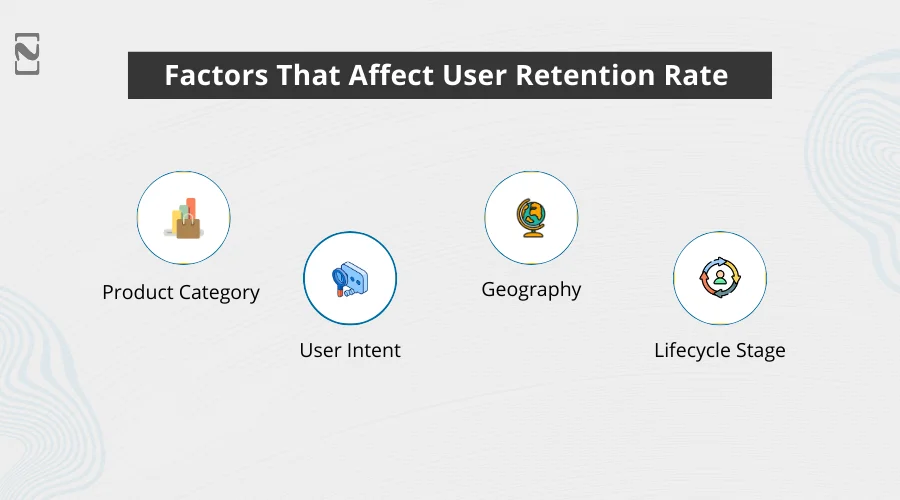
Factors That Affect User Retention Rate
► Product Category
Mobile apps for businesses that encourage daily habits like social, fitness, and meditation apps will naturally have a higher retention rate than apps with episodic use, like banking or travel.
► User Intent
Users looking for a utility like expense tracking might only return when they need to. But users seeking entertainment might return multiple times per day.
► Geography
Mobile app user retention rates vary by region depending on culture, internet availability, and mobile habits.
► Lifecycle Stage
User retention rate is usually lower for new mobile applications or new features. Early adopters may behave differently from mainstream users.
Why Does Direction Matter More than Numbers?
Instead of obsessing over a single good percentage, you can track trends over time, like whether they are sticking around longer after updates. Also, segment by cohorts. Which users retain better? Why? Focus on improvement, not just hitting a random benchmark.
A smart retention strategy measures value delivered, habit formation, and outcomes achieved, not just raw opens. For example, just imagine a meditation app:
- Day 1 retention = 50%
- Day 7 retention = 20%
- Day 30 retention = 10%
These numbers might seem low compared to a social app. But if your users complete meditation sessions and build a habit weekly, your value-based retention could be much higher than what raw percentages suggest.
| The takeaway: look deeper than numbers, measure meaningful engagement, not just clicks. |
How to Increase User Retention in Mobile Apps?
Now comes the main part, which is to increase mobile app user retention. But how will you do that?
Well, for that, you have to follow some strategies that may help you boost your user retention in mobile apps. Below are the 5 major user retention strategies that you must take into consideration.
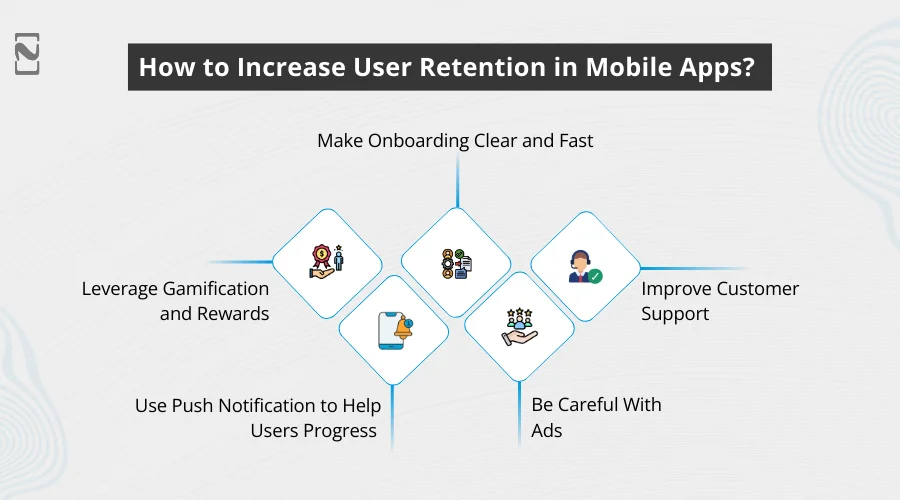
1] Make Onboarding Clear and Fast
Onboarding is very frequent, where users decide if a mobile app is worth keeping. If new users feel confused, they tend to drop off fast. In fact, mobile applications with optimized onboarding flows see higher early user retention.
As per Business of Apps, the average mobile app retains about 25.3% of users on Day 1. However, the retention rate is around 5.7% by Day 30, with the sharp decline often linked to a poor onboarding experience.
Good onboarding does not confuse; it guides. The objective is to help new users complete a meaningful action quickly so they understand what your mobile application does for them.
For example, finish one fast task that shows value, set a preference for personalised content, and see a small one within the first session.
Mobile applications that personalize onboarding, like customizing the first screen to user input, are more likely to hold attention. It is because users feel understood right away.
2] Improve Customer Support
When users run into problems and can not find help, they easily get frustrated. This often leads to churn. Good customer support plays a bigger role in retention than many teams realize.
If people feel stuck or confused during their first few sessions, they are more likely to abandon the mobile app. Clear, accessible support assists in preventing this by giving users confidence that they can get solutions when required.
Making support easy to reach is key. Adding in-app help options such as live chat, guided FAQs, or quick response systems can make the experience feel smoother. Modern support platforms also offer ways to automate simple questions.
This keeps users from waiting too long. The easier it is for users to get assistance, the more positive their experience becomes, and a positive early experience is one of the strongest drivers of long-term retention.
3] Be Careful With Ads
Ads can help your app make money, but they need a soft touch. Just like notifications, ads can become annoying if they show up at the wrong time or very frequently. If users feel disturbed, they may stop using your mobile app.
Additionally, timing matters a lot. People do not want ads popping up when they are focused on doing something. A better idea is to place ads during natural breaks.
For example, after finishing a game level, between articles, or when switching screens. This feels less annoying. Besides, relevance is just as important. If you show ads that match users’ interests, it will feel more natural than random promotions.
And yes, most importantly, do not allow ads to interrupt navigation or cause accidental clicks. When ads fit smoothly into the mobile application experience, users are more likely to stay.
4] Use Push Notifications to Help Users Progress
Messaging is most effective when it supports the user’s journey rather than interrupts it. Research shows that well-implemented in-app and push notifications can boost user retention in mobile apps. It is especially in the first week when churn is low.
To use messaging effectively, you can:
- Send gentle reminders to complete unfinished steps
- Highlight user progress and benefits
- Re-engage users who haven’t returned in a few days
- Each channel has a clear role:
- Push notifications for timely nudges
- Email for deeper insights or weekly summaries
- In-app messages for context-driven guidance
Since the average app loses around 77% of its daily active users within three days, well-timed, helpful messages can make a real difference.
When messaging feels relevant and supportive, users are more likely to return and explore further. The key is to keep the tone helpful and the timing thoughtful, not pushy.
5] Leverage Gamification and Rewards
Mobile app gamification is the best way to make your mobile app more fun and keep users coming back. When you add game-like elements, you can turn regular actions into something really fun and motivating.
Features like progress levels, small challenges, badges, or achievement milestones enable users to stay active and engaged. Rewards also play a crucial role. When a user receives something in return for their effort, they feel appreciated.
These rewards can be simple, like virtual points, special access to content, discounts, or extra in–app features. Loyalty-based rewards work especially well when they are easy to understand and fun to earn.
The best part is that gamification can fit into almost any type of mobile application, like education, finance, fitness, entertainment, and so on. You need to make sure that these features support your mobile app’s main goal and feel meaningful to users.
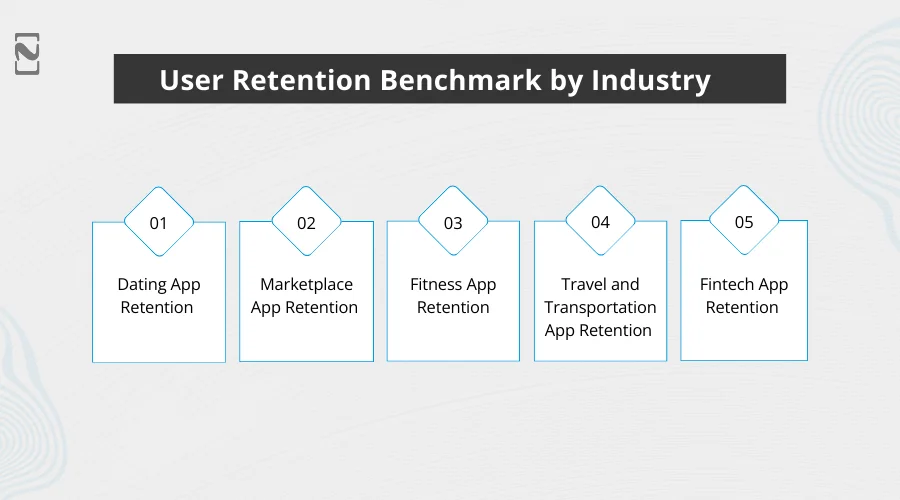
User Retention Benchmarks by Industry
Not every mobile application keeps users the same way. Some are used daily, while others are used once and forgotten.
Mobile app user retention is not the same for all types of apps. It relies on the industry. Let’s take a look at how different mobile applications performed in 2026.
-
Dating App Retention
Dating mobile applications are mostly about short-term excitement rather than long-term engagement. Day 1 retention is around 26-28%, but by day 7, it often drops below 10%. By day 30, only 3-5% of users are still active, and that is considered a good value.
The reason is very simple. People try dating applications for curiosity or for casual swiping or when they are free, and novelty fades really fast. You may not believe it, but apps like Bumble and Tinder also face quite a drop.
You need to understand that user retention here is not about usefulness. It’s about the thrill, which is harder to maintain over time.
-
Marketplace App Retention
Mobile app users often prefer marketplace applications over regular shopping apps. However, general shopping apps perform really well, but their retention numbers are a bit below average.
Data shows that shopping applications retain 24.5% of users on the 1st day, 10.7% on the 7th day, and 5.6% on the 30th day. Some reports place the day 30 retention slightly lower at 4.83%.
Marketplace apps like Amazon, Walmart, and Poshmark perform much better. These mobile apps see a 33.7% day-one retention rate, 16.1% by day seven, and 8.7% by day 30.
The reason is simple. Marketplace platforms provide a wide variety of products that give users more reasons to return and make repeat purchases.
-
Fitness App Retention
Fitness apps start strong but struggle to hold attention. On day 1, the retention is about 30-35%, but it drops to 15-18% on day 7th and by day 30 it reaches 8-10%.
Many popular and successful applications like Fitbit and Strava keep users coming back with streaks, wearable integration, and gamified rewards. Even simple notifications like You crushed it! After a week of inactivity, users can re-engage.
The key is not perfect workouts, but providing feedback, tracking progress, and making users feel accomplished. Personalized experiences and visible progress loops can almost double compared to generic fitness apps.
-
Travel and Transportation App Retention
As you know, travel and transportation mobile applications are not required daily. This automatically keeps the app retention low. Day one retention ranges from 20-25%, day 7 sits around 12%, and day 30 often falls below 6%.
This is not because users do not like the applications. It is just that they use them when required. Travel mobile apps like Hopper and Citymapper succeed by being helpful exactly when needed.
Smart notifications, location prompts, and smooth app flows make them easy to open when necessary. The goal is not daily engagement. It is indispensable when the moment comes.
-
Fintech App Retention
Mobile banking applications tend to retain users well. It’s because there’s usually money involved. Day-1 retention for traditional and digital banking apps sits at 30.3%, with 17.6% by day seven, and 11.6% by day 30.
It is one of the highest user retention rates in fintech apps among industries. Other finance mobile apps show weaker loyalty. On average, they hold 22.7% users initially, dropping to 5.8% by day 30.

Final Thoughts
We hope by now it’s clear why user retention is important for mobile apps. Getting someone to download your app is just the first step; the real challenge is to retain them.
Different types of mobile apps have different ways of holding attention. But if you follow a few strategies, it will always help. It’s also about listening to your users. Fix bugs quickly, make improvements, and show that you care about their experience.
Even small changes can make a big difference in whether someone sticks with your app or forgets about it. That’s why working with an experienced mobile app development company can be so valuable.
They not only build your mobile app but also help ensure it continues to engage and delight users.
FAQs

Niketan Sharma, CTO, Nimble AppGenie, is a tech enthusiast with more than a decade of experience in delivering high-value solutions that allow a brand to penetrate the market easily. With a strong hold on mobile app development, he is actively working to help businesses identify the potential of digital transformation by sharing insightful statistics, guides & blogs.
Table of Contents




No Comments
Comments are closed.