

 Free Consultation
 PCI-DSS Compliant
 GDPR Ready
 ISO 27001
 NDA Protected
 AI Services
 AI App Development
 Generative AI Development
 AI Chatbot Development
 AI Integration Services
 AI Consulting Services
 AI For Fintech
 AI Financial Assistant Solution
 AI Insurance Agent Development
 Tech Stack
 OpenAI / GPT-4
 Claude / Anthropic
 Gemini / Google AI
 Llama / Open Source
 LangChain / LlamaIndex
 Pinecone / Pgvector
 AWS / Azure AI


 Fintech Solution
 Core Fintech
 App Development
 Neobank Solutions
 eWallet Solutions
 Lending Software
 Banking Solutions
 BNPL Solutions
 BNPL Solutions
 Insurance App
 Wealth Management
 Crypto & DeFi
 Blockchain Development
  Payroll Software
 DeFi Solutions
 Crypto Wallet
 Crypto On/Off Ramp
 Crypto Exchange
 Trading Platform
 Payments
 Compliance
 Regulations & Compliance
 Fraud Detection
 Lending Ecosystem
 P2P Lending Platform
 Mortgage Software
 Engagement
 Fintech Outsourcing

 Mobile Development
 Mobile App Dev
 iOS App Development
 Android App Development
 React Native
 Flutter Development
 Web Solution
 Node.js Development
 React.js Development
 Angular Development
 App Services
 UI/UX Design
 App Maintenance
 By Stage
 MVP Development
 Industry Solutions
 Healthcare App Dev
 Education App Dev
 Travel App Dev
 Real Estate App Dev
 Logistics Software
 Social Media App

 Hire Mobile Developers
 Hire iPhone Developers
 Hire Android Developers
 Hire React Native Devs
 Hire Flutter Developers
 Hire Web Developers
 Hire Node.js Developers
 Hire Angular Developers
 Hire PHP Developers
 Hire Laravel Developers
 How It Works
 Pre-Vetted Developers
 Ready In 48 Hours
 NDA From Day One
 Replace Guarantee
 Company
 About Us
 Our Work Process
 Portfolio
 Case Studies
 Blog / Insights
 Careers
 Contact Us
 Awards
 Recognition


 Offices


With every step digitization takes forward, businesses’ demand for digital solutions also surges, acknowledging the need to go the extra mile and enhance customer experience.
| The digital transformation market is quickly expanding and predicted to reach $1,864.94 billion by 2031 at a CAGR of 9.1%, up from $1,107.06 billion in 2025. [Source] |
For the time being, businesses struggle between custom development vs white label development, wondering what will help them to pass with flying colors. They usually find themself in a muddle about what and how to choose between custom and white label solutions.
So, custom development vs white label, which is best, and why should you pick one early?
You should step ahead with the right choice, as the decision impacts initial costs, time-to-market, brand differentiation, customization, and long-term scalability. The delay can make you face financial and operational challenges later in the product lifecycle.
Startups, fintech companies, SaaS businesses, and SMEs seeking digital transformation should make a choice. Custom software development or white label software solutions, the decision is yours. But don’t fret, as you don’t have to do it all by yourself.
We are here with a build vs buy software guide explaining different software development options and helping you conclude without being a part of the never-ending debate on custom app development vs white label.
Let’s get cracking on a discussion, white label vs custom software!
What is Custom Development?
Custom development involves the creation of an app, software, or digital platform from the ground up, specifically personalized based on a business’s requirements.
Custom development doesn’t utilize ready-made solutions or pre-built templates; rather, it facilitates companies to build features, integrations, workflows, and UI/UX designs perfectly matching their objectives.
How It Works
Typically, custom development follows a well-structured approach. Let’s have a quick walkthrough:
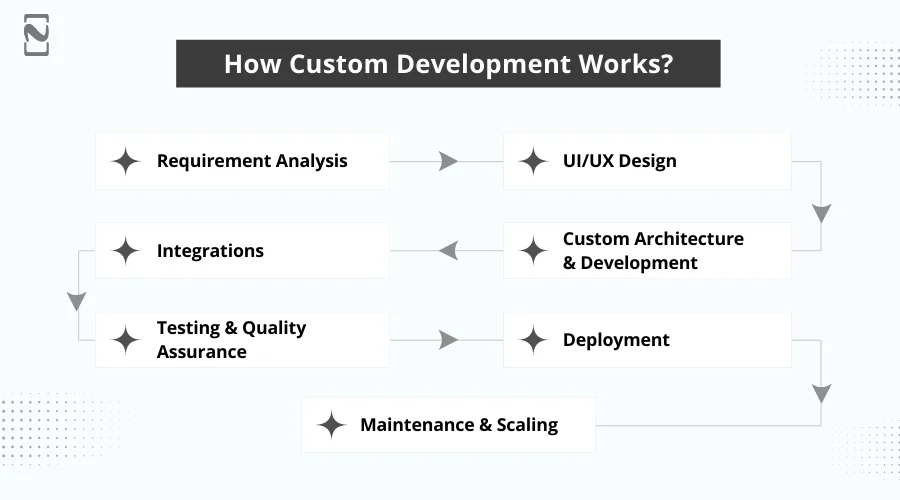
1. Requirement Analysis: First, consultants understand the business objectives, user requirements, and technical needs and move ahead with this analysis to create a custom development strategy.
2. UI/UX Design: The designers create user flows, wireframes, and custom interface designs to make the platform easy to use.
3. Custom Architecture & Development: Next, the developers build features and write fresh code for the business, suiting their business model.
4. Integrations: In this stage, the solution is connected with APIs, internal tools, third-party services, and CRMs for improved functionality.
5. Testing & Quality Assurance: The QAs and testers make the platform undergo rigorous testing to ensure it’s functional, secure, and bug-free.
6. Deployment: Next, the custom-built solution is launched on its respective platform to be available to end users.
7. Maintenance & Scaling: With the growing business, the product is consistently monitored with continuous updates, feature expansion, and performance enhancement.
What is White-Label Development?
White label software solutions development leverages the potential of ready-made software solutions that third-party providers create for businesses, customizing them lightly, rebranding, and launching rapidly, thereby suiting their needs.
Don’t get confused with software that is developed from scratch. To get ownership of white-label products, firms buy the rights to brand and use them, which saves time, development effort, and cost.
How It Works
Pre-built software solutions follow an easy implementation process. Let’s have a look:
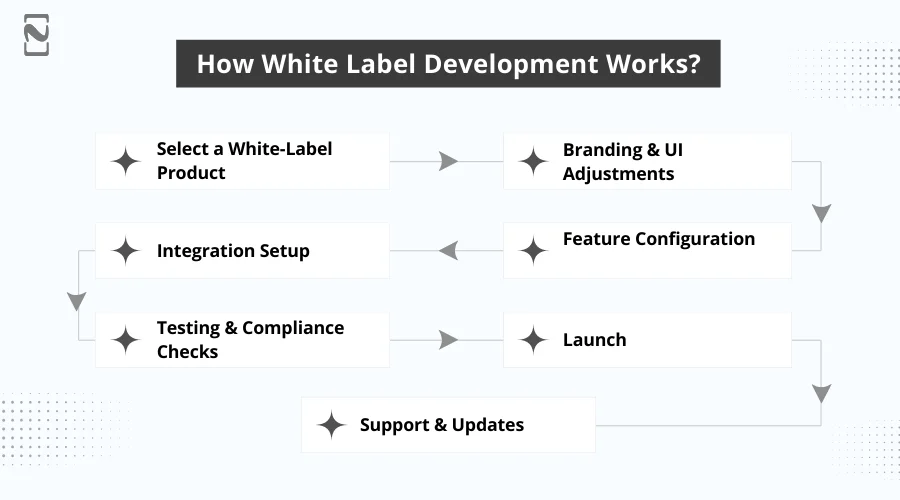
1. Select a White-Label Product: Companies seeking a ready-made solution choose a pre-built one that suits their business model needs, like food delivery, eWallet, or BNPL.
2. Branding & UI Adjustments: Next, the logo, company brand, and colors are applied to the chosen product with minor UI customization (as per demand).
3. Feature Configuration: The brand sets specific workflows, enables or disables features, and adjusts available modules.
4. Integration Setup: Ahead of the stage, the product is integrated with CRM, KYC, or analytics, and more such APIs for boosted performance.
5. Testing & Compliance Checks: In this stage, the company tests the solution to check if it meets the business regulatory and operational requirements.
6. Launch: The firm then deploys the customized, white-label software quickly, taking months or even weeks.
7. Support & Updates: The software provider manages updates, maintenance, and backend advancements, offering ongoing support.
Pros & Cons Comparison
Here, we will dig deeper to understand the pros and cons of custom-made vs white-label apps.
Custom Development Pros & Cons
Pros:
- The owner gets complete customization authority until the solution uniquely matches their business workflows.
- You get complete IP ownership in custom development with source code and product roadmap.
- The product is highly scalable, which adapts to the growth of your business.
- You get powerful security with tailored compliance configurations.
- The product will outshine the competitors as your solution is entirely original, developed from scratch, and not template-based.
Cons:
- Compared to ready-made solutions, you will experience a higher upfront development cost.
- Considering the development time, it’s also longer, and may take months to emerge with a fully-functional product.
- Above all, you will need a dedicated team of developers for consistent support post-launch for maintenance, updates, and scaling.
- You may find it complex in integrations, QA, and architecture.
White Label Development Pros & Cons
Pros:
- If you are looking for rapid market entry, then go for white label as it provides a faster time to market opportunity, where you can roll out your solution in weeks or days.
- You only have to pay for predictable licensing costs, so initially, you can anticipate lower investment.
- Proven and tested features lead to reduced bugs and failures.
- If you want to test your business idea early to avoid unexpected losses later, you can go for white label solution development, as it’s perfect for MVPs and testing business plans quickly.
- The provider handles all updates and maintenance, allowing you to give attention to other valuable jobs.
Cons:
- If the reseller picks a white-label product, the vendor regulates the scope, and the reseller can only request limited modifications with limited branding and fixed core functionalities.
- You will not own the ownership of the backend architecture and core IP.
- You may face scalability restrictions based on your vendor’s infrastructure.
- The UI/UX is also similar across the businesses using the exact solution.
- If the provider doesn’t support specific APIs, you have to face integration limitations in white label solutions.
Custom vs White Label: Comparison Table
What is the difference between custom and white label software?
Numerous factors can help differentiate custom solutions and white-label solutions, specifically in their approach.
In this section, we will explore the major aspects that will put forth how these software development approaches vary.
| Comparison Factor | Custom Development | White Label Development |
| Development Time | A long development cycle that can take months to build a fully-featured product from the ground up. | Extremely fast development and can be launched in weeks or even days. |
| Cost & Budget Requirements | High upfront cost because it incorporates custom coding, architecture, and design. | Lower initial cost as charges only subscription/licensing fees. |
| Customization & Flexibility | Fully customizable, where you can do unlimited feature adjustments and workflows. | Limited customization, also it restricts to what the provider allows. |
| Ownership & Intellectual Property | Full ownership of code, IP, and product. | No ownership because the product provider controls the core IP and backend. |
| Scalability & Future Growth | Highly scalable and is created to support long-term innovation. | Limited scalability, and growth depends on the vendor’s infrastructure. |
| UI/UX Freedom | Complete freedom to creatively customize UI/UX designs. | Template-based design with minimal UI freedom. |
| Security & Compliance | Security can be tailored per the applicable industry standards (PCI DSS, GDPR, and HIPAA). | Predefined compliance holds; above that may not meet specific industry requirements. |
| Integration Capabilities | Allows deep integrations with internal systems, APIs, and complex workflows. | Controlled or limited integrations relying on vendor support. |
| Maintenance & Support | Requires a dedicated team for bug fixes, updates, and scaling. | Vendor manages the post-support, including maintenance, updates, and technical support. |
| Time to Market | Slower as everything demands manual effort, embracing development, testing, and refinement. | Faster time to market with pre-built functionalities. |
Note: The choice between custom development and white-label solutions is based on your business objectives, timeline, and budget.
When to choose custom development over white label?
If you choose the former, you will get matchless control, evolution-centric development, and scalability.
Talking about the white-label solutions, you will enjoy affordability, speed, and a proven base.
Be sure you utilize this comparison, white label app vs custom-built app, as a strategic learning, not a strict rule that you should follow to determine an approach to product development aligned with your vision and lasting expansion.
Which Should You Choose?
When to choose custom development over white label? Let’s figure it out below.
Use Cases of Custom Development
Choose custom development when your business needs:

- Unique workflows or complex logic,
- Comprehensive control over features, design, and scalability,
- Industry-specific compliance,
- Deep system integrations with internal tools and legacy systems,
- Enterprise-grade platforms with ultimate security and large user bases,
- Innovative products that don’t fit pre-built templates,
- Advanced software customization, flexibility, and more.
Common Real-Time Examples of Custom Development
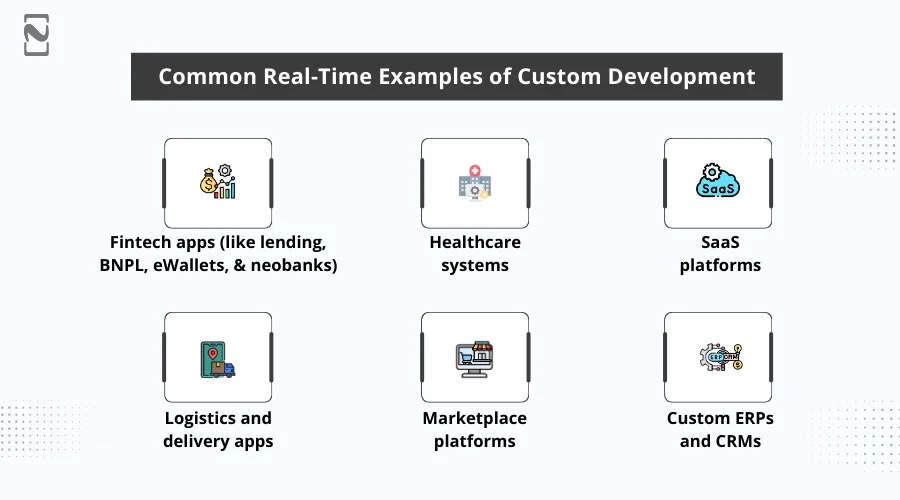
- Fintech apps (like lending, BNPL, eWallets, and neobanks),
- Healthcare systems,
- SaaS platforms,
- Logistics and delivery apps,
- Marketplace platforms, and
- Custom ERPs and CRMs
Use Cases of White-Label Software Development
Choose white-label development when your business needs:
- Fast time-to-market software decisions,
- Reduced upfront costs,
- Standardized features that don’t need unique innovation,
- Proven solutions with minimal development risk,
- Quick MVP launch for testing markets, and more.
Common Real-Time Examples of White-Label Software Development
- White-label eWallet apps
- White-label lending/BNPL apps
- Food and grocery delivery apps
- Ride-sharing apps
- Telemedicine platforms
- SaaS tools (CRM, email marketing, appointment scheduling)
- Loyalty and reward apps
- Crypto exchange or trading platforms
Tip: Enthusiasts have the misconception that custom development is expensive compared to white-label, but the former suits businesses looking to attain a competitive edge.
Industry-Specific Use Cases
How to choose between custom and white label solutions, industry-wise?
White label app vs custom-built app, the choice depends mostly on the industry’s particular requirements for differentiation, budget, compliance, and speed to market.
Let’s pick some major sectors and learn when to favor what software development strategy:
1] Fintech & Banking
Do you want to know which is better, custom development vs white label for fintech apps?
Custom Development for the Below Fintech Use Cases
- Neobanking platforms with unique workflows,
- Complex lending, underwriting, and risk-scoring systems,
- Enterprise-grade payment gateways, and
- Fully customized eWallet ecosystems.
White Label for the Below Fintech Use Cases
- White-label eWallet apps,
- BNPL/Installment payment apps,
- Crypto trading/exchange platforms, and
- Pre-built payment apps with basic KYC, wallet, and transaction modules.
2] Healthcare
What are the custom software benefits for the healthcare industry?
Custom Development for the Below Healthcare Use Cases
- Custom telemedicine platforms with multi-role access,
- Secure EHR/EMR systems,
- HIPAA-compliant custom patient portals, and
- AI-driven diagnostics dashboards.
White Label for the Below Healthcare Use Cases
- Ready-made teleconsultation apps,
- Appointment booking systems, and
- Patient engagement platforms with CMS controls.
3] eCommerce & Retail
Is white label better than custom development in the e-commerce and retail sector?
Let’s find out.
Custom Development for the Below E-commerce and Retail Use Cases
- Custom marketplace platforms (multi-vendor),
- Personalized recommendation engines,
- Inventory, ERP, CRM, and other integrated systems, and
- Custom checkout and loyalty features.
White Label for the Below E-commerce and Retail Use Cases
- White-label marketplace apps,
- Pre-built online store apps, and
- Basic loyalty and reward platforms.
4] Logistics & On-Demand Services
Custom Development for the Below Logistics and On-Demand Services Use Cases
- Route optimization + fleet analytics platforms,
- Custom courier management systems, and
- Delivery apps with advanced tracking and dispatch logic.
White Label for the Below Logistics and On-Demand Services Use Cases
- Food delivery or grocery delivery apps,
- Basic courier delivery solutions, and
- On-demand service booking apps.
5] EdTech
Custom software vs white label software for startups in the EdTech industry.
Custom Development for the Below EdTech Use Cases
- LMS platforms with unique learning paths,
- Custom student analytics and reporting systems, and
- Interactive classrooms and VR/AR-based learning tools.
White Label for the Below EdTech Use Cases
- Pre-built learning management systems,
- Course marketplace templates, and
- Tutor booking platforms.
6] Hospitality & Travel
Custom Development for the Below Hospitality and Travel Use Cases
- Custom hotel booking engines,
- Travel itinerary planner powered by AI, and
- Tailored property management systems.
White Label for the Below Hospitality and Travel Use Cases
- Hotel booking apps,
- Tour and travel agency apps, and
- Pre-built reservation systems.
Cost Comparison Overview
What is the cost difference between custom and white label development?
After walking through the white label vs. custom software factors, white label software benefits, custom software benefits, and industry-wise use cases, let’s discuss the average white-label and custom development costs.
Custom Development Costs
Generally, custom solutions have an increased upfront investment, as it’s about building from scratch.
So, you have to pay for everything, like features, integrations, complexity, and security demands.
The typical factors impacting the cost are:
- UI/UX design
- Backend + frontend development
- Custom architecture
- API integrations
- Security & compliance
- QA testing
- Deployment & scaling
- Ongoing maintenance
Talking about the custom development cost range, it ranges between $40,000 and $250,000 and can go up for full-scale applications.
Tip: Stay prepared with an increased cost range for your custom fintech or enterprise apps because they can cost significantly more.
Ideal for: Businesses seeking long-term product plans, complex workflows, larger budgets, and scalability needs.
White-Label Development Costs
Initially, the white-label solution development costs less, as you will be licensing a product that’s already built, instead of creating one from the ground up, which costs more.
The typical factors impacting the cost are:
- One-time licensing or setup fee
- Monthly/annual subscription
- Basic branding & configuration
- Add-ons can be custom features, modules, or support.
Regarding the white-label pricing, it ranges between $5,000 and $40,000 and can fluctuate depending on the monthly fees and features included.
Tip: Stay prepared with an increased cost range for your enterprise-level white-label solutions because they can cost significantly more.
Idea For: Businesses looking for faster launch, standard features, lower upfront investment, vendor-managed maintenance, and MVP validation.
Common Misconceptions About Custom & White Label
As white-label and custom-built app development is a confusing topic, especially for startups, you will have to confront numerous misinterpretations spreading the word.
Here we will dig deeper into every major misconception:
1. “White-label solutions are always the cheaper option.”
However, not necessarily.
You can find the upfront costs to be lower compared to a custom development one. But ahead in your journey, you will unveil more factors contributing to the cost, like long-term licensing fees, customization charges, and add-ons.
2. “Custom development takes forever.”
Custom does sound slow, but it’s not always like that.
Following the latest development practices, agile processes, and choosing pre-built components can notably diminish timelines.
3. “White label cannot be customized at all.”
This misconception is heightened.
You can brand and configure your white-label product, but within limits. The provider’s architecture restricts major customizations.
4. “Custom software is too complex to maintain.”
Yes, you can get a head start with no technical guidance.
You should partner with a bespoke software development firm and work with proper documentation, which will make maintenance predictable, structured, and entirely aligned with your business goals.
5. “White-label apps are low quality.”
No! You can find various white-label solutions well-tested, stable, and reliable. But some are deprived of evolution and usually share similar designs across varied businesses.
6. “Custom development is only for enterprises.”
Nay! Frequent choice of startups is custom development when they start with a product vision demanding unique features, competitive differentiation, and proprietary workflows.
7. “White label will scale as my business grows.”
Well, this is a half-truth.
Scalability in software development relies on the provider’s infrastructure, and numerous white-label platforms struggle with advanced scaling needs.
How Nimble AppGenie Can Help You Choose a Software Development Approach?
At this point, you might be wondering how to start with software development.
Well, whether you are planning a custom-built application or exploring a white-label solution, a bespoke software development company with years of experience and expertise can help you emerge with an ideal approach for your business.
You should go for Nimble AppGenie, where a team of developers follows the most cost-effective and growth-ready path, providing custom software development services to worldwide clients.
Still not convinced? Let us help you.
Real-Time Case Study: How Custom Development Transformed a Fintech Lending Startup
Overview: A fintech startup wanted to launch a digital lending platform with custom risk scoring, deep integrations with banks and credit bureaus, automated loan processing, and multi-level KYC.
Challenges They Had:
- Required an unusual underwriting engine with custom risk rules,
- Needed bank-level security and compliance workflows,
- Wanted complete ownership of algorithms and data,
- Demanding deep integrations with the credit bureau, KYC provider, and payment gateways, and
- Expected to scale swiftly to thousands of users daily.
Approach We Chose:
At the time of the decision, we found that:
White-label solutions were available, but none helped with the complex workflows, compliance rules, or scoring models the business required.
So, our team chose a custom development solution and built a platform customized to their growth roadmap and operational model with automated loan approval workflow, custom risk-scoring engine, flawless integration, scalable cloud architecture, personalized UI/UX, and custom eisk-scoring engine.
Results Achieved:
- 100% Alignment with Business Logic
- Full Ownership & Control
- 4x Scalability within 12 Months
- Strong Competitive Advantage
- Better Compliance & Security
Verdict:
Today, to satiate the craving for a competitive edge, custom development is the best choice.
Book a free consultation today to discuss your product goals, technical requirements, and the most promising development strategy for your business.
Conclusion
Custom development vs white label, hope you have made your choice?
Undoubtedly, you can go for white-label solutions to fulfill your budget-friendly launches. But, do you know, custom development stays ahead of the curve when you want a robust and lasting investment to attain true distinction and scalability.
Yes, custom development is the only approach that can help you gain complete ownership, the freedom to evolve, and get unlimited flexibility without being confined to vendor restrictions.
With your growing product, you need to innovate, and here, only custom-built software can help you adapt smoothly to your exceptional workflows, expansion plans, and integrations.
White label can support quick starts, but a custom one backs sustainable growth, confident scaling, and a competitive long run.
So, choose custom software over white-label as your superior choice for next-gen digital product development.
FAQs
Custom development approach starts from scratch to meet unique needs, while white-label is a ready-made solution that you can rebrand and launch faster.
White-label is cheaper upfront, but custom development delivers better long-term value via full ownership and scalability.
White-label solutions can launch in days or weeks, whereas custom development typically takes 2 to 6 months, depending on complexity.
Businesses demanding unique features, deep integrations, or long-term scalability should pick custom development.
Yes, custom development gives full IP and source-code ownership, unlike white-label, where the provider has core rights.

Niketan Sharma, CTO, Nimble AppGenie, is a tech enthusiast with more than a decade of experience in delivering high-value solutions that allow a brand to penetrate the market easily. With a strong hold on mobile app development, he is actively working to help businesses identify the potential of digital transformation by sharing insightful statistics, guides & blogs.
Table of Contents




No Comments
Comments are closed.