

 Free Consultation
 PCI-DSS Compliant
 GDPR Ready
 ISO 27001
 NDA Protected
 AI Services
 AI App Development
 Generative AI Development
 AI Chatbot Development
 AI Integration Services
 AI Consulting Services
 AI For Fintech
 AI Financial Assistant Solution
 AI Insurance Agent Development
 Tech Stack
 OpenAI / GPT-4
 Claude / Anthropic
 Gemini / Google AI
 Llama / Open Source
 LangChain / LlamaIndex
 Pinecone / Pgvector
 AWS / Azure AI


 Fintech Solution
 Core Fintech
 App Development
 Neobank Solutions
 eWallet Solutions
 Lending Software
 Banking Solutions
 BNPL Solutions
 BNPL Solutions
 Insurance App
 Wealth Management
 Crypto & DeFi
 Blockchain Development
  Payroll Software
 DeFi Solutions
 Crypto Wallet
 Crypto On/Off Ramp
 Crypto Exchange
 Trading Platform
 Payments
 Compliance
 Regulations & Compliance
 Fraud Detection
 Lending Ecosystem
 P2P Lending Platform
 Mortgage Software
 Engagement
 Fintech Outsourcing

 Mobile Development
 Mobile App Dev
 iOS App Development
 Android App Development
 React Native
 Flutter Development
 Web Solution
 Node.js Development
 React.js Development
 Angular Development
 App Services
 UI/UX Design
 App Maintenance
 By Stage
 MVP Development
 Industry Solutions
 Healthcare App Dev
 Education App Dev
 Travel App Dev
 Real Estate App Dev
 Logistics Software
 Social Media App

 Hire Mobile Developers
 Hire iPhone Developers
 Hire Android Developers
 Hire React Native Devs
 Hire Flutter Developers
 Hire Web Developers
 Hire Node.js Developers
 Hire Angular Developers
 Hire PHP Developers
 Hire Laravel Developers
 How It Works
 Pre-Vetted Developers
 Ready In 48 Hours
 NDA From Day One
 Replace Guarantee
 Company
 About Us
 Our Work Process
 Portfolio
 Case Studies
 Blog / Insights
 Careers
 Contact Us
 Awards
 Recognition


 Offices


In a Nutshell:
- A restaurant reservation system allows customers to book tables online in seconds and helps restaurants manage availability, guest flow, and peak hours in one place.
- Online restaurant reservation systems work with real-time updates, instant confirmations, and reminders, making the whole booking process simple and reliable.
- Must-have features of restaurant reservation software are real-time availability, waitlist management, guest profiles, and POS integration, which help improve operations and customer experience.
- Advanced features like AI in restaurant reservation systems can predict busy hours, reduce no-shows, and automate bookings.
- The tech stack to develop a restaurant reservation software includes backend, database, real-time engine, and cloud infrastructure to keep the system fast, secure, and scalable.
- The cost to build a restaurant reservation system depends on features, integrations, and system complexity, usually ranging from basic to advanced levels.
- Restaurants can monetize a reservation system through per-booking charges, monthly subscriptions, and featured listings on the platform.
- Common challenges in restaurant reservation system development include avoiding double bookings, handling peak traffic, and integrating with existing systems.
Missed bookings. Double reservations. No-shows. A front desk team that never gets a break. If you run a restaurant, you already know how quickly a bad booking process turns into a bigger problem. One that costs you guests, revenue, and reputation without you even realising it.
That is exactly why restaurant reservation system development has become a priority for restaurant owners, multi-outlet operators, startup founders, and food tech entrepreneurs alike. And the numbers back it up:
The worldwide market size of the restaurant reservation system is forecasted to grow from $488 million in 2026 to $873 million by 2034 with a CAGR of 10.3%. This means investing in a proper reservation system today is not just fixing a problem. It is positioning your business right at the centre of where the industry is heading.
This guide walks you through everything to develop a restaurant reservation system that can take your restaurant business to the next level.
What this guide covers :
- Core features every restaurant reservation system needs
- Step-by-step process to build one from scratch
- Cost to develop a restaurant reservation system
- Monetization models to earn huge revenue
- Common mistakes and how to avoid them
What is a Restaurant Reservation System?
A restaurant reservation system is software that helps customers book a table at a restaurant in advance. Instead of calling the restaurant, customers can choose a date, time, and number of people through a website or mobile app.
The best restaurant reservation system shows available tables and confirms the booking instantly. For restaurant owners, it helps manage all bookings in one place. They can see the number of tables that are booked, avoid overbooking, and reduce long waiting times.
How does an online restaurant table reservation system work?
The online reservation systems for restaurants work in the following ways:
- The restaurant adds table details and available time slots into the system
- Customers select date, time, and number of guests
- The system checks table availability in real time
- If a table is free, the booking gets confirmed instantly
- The system updates the schedule to avoid double bookings
- Customers receive confirmation and reminder messages
Why Invest in Custom Restaurant Reservation System Development in 2026?
The restaurant industry is changing fast, and more people now prefer booking tables online instead of calling. This shift is pushing restaurants to develop flexible reservation systems.
Let’s have a look at the major reasons to invest with real market insights:
► The Market itself is Growing Fast
The market size of online reservation systems for restaurants is forecasted to reach $46 billion by 2035 with a CAGR of 10.3%. North America has led the market with more than 35%.
That is not a niche trend. That is the whole industry moving toward digital-first operations. The restaurants investing in their own best reservation system for restaurants today are the ones that will own their guest relationships tomorrow.
► Technology is Now a Competitive Necessity
Around 25% of restaurants now leverage AI technology for their reservation system. Additionally, it is reported that 6 in 10 Gen Z adults and millennials said they place an order or book a table with an AI-generated bot.
Therefore, this is the perfect chance for your business to invest in AI in restaurants to win on technology and stay ahead of the curve before your competitors make the move first.
► Shift is Already Happening and Fast
Restaurant tech mergers and acquisitions rose 45% in the first half of 2025 alone. The whole industry is merging around better technology. OpenTable data shows that around 44% of Americans plan to leverage AI tools to find restaurants and book tables in 2026.
So if you are looking to start an online restaurant business or already running one, making your booking system available on these channels helps you reach more people and get more table bookings.
► Customers Book Online Table Reservations
65% of customers directly go to the restaurant’s website instead of Google to make a reservation. This means the table booking experience you own is the first real impression most customers have with your restaurants.
This can be the golden opportunity for your business to develop an online restaurant reservation booking system in 2026 for huge revenue.
6 Types of Restaurant Reservation Systems
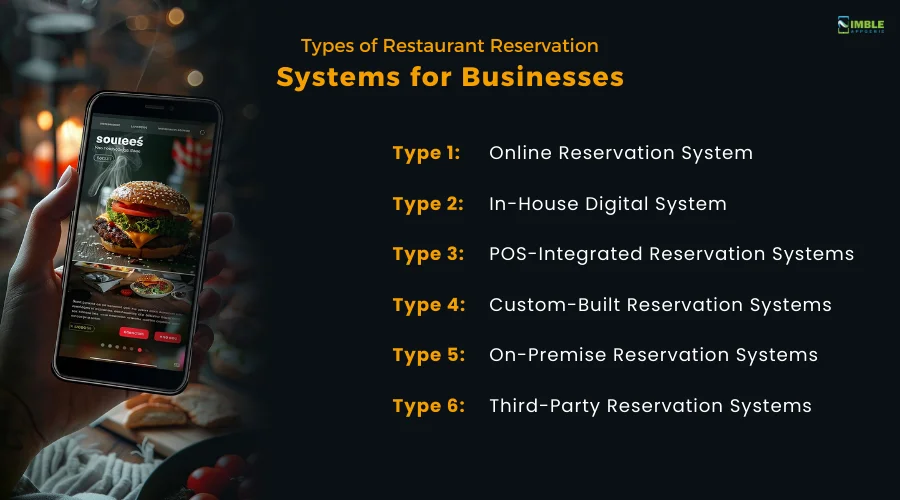
The major types of online restaurant table reservation systems are mentioned below:
- Online Reservation System
- In-House Digital System
- POS-Integrated Reservation Systems
- Custom-Built Reservation Systems
- On-Premise Reservation Systems
- Third-Party Reservation Systems
You can choose the online reservation system restaurant that best aligns with your business requirements.
Let’s take a look at each type in detail:
1. Online Reservation System
Online reservation systems are platforms that allow users to book tables simply via the website or using an app. These systems help manage reservations in real-time by preventing overbooking as well as allowing restaurants to optimize seating.
2. In-House Digital System
Some restaurants opt for developing their custom reservation software that helps them make instant, real-time changes to their menu and design. In other words, you have greater control over the brand.
3. POS-Integrated Reservation Systems
You can adopt this kind of system that is integrated directly with the restaurant’s Point of Sale (POS) systems, which offers seamless operations where the users’ data can be synchronized. It will help you to provide the users with personalized service.
4. Custom-Built Reservation Systems
The larger restaurant chains choose this type of system for developing a custom reservation system that can be tailored to the particular requirements of the users, for instance, VIP services, event management, and group bookings.
5. On-Premise Reservation Systems
The on-premise reservation systems were installed on-site within the restaurants. Such systems are localized and may not always offer online booking. These systems are developed to provide high control over data as well as its related operations.
6. Third-Party Reservation Systems
Some businesses opt to use third-party services such as Google Reservations, where users can directly book a seat at the restaurant just by searching out via maps without performing any navigation to a separate link or website.
Must-have Features For Restaurant Reservation System Development
An online reservation system for restaurants should include must-have features like:
- online booking engine
- real-time availability
- Automated confirmations & reminders
- No-show & cancellation tracking
- Guest profiles & visit history
- waitlist management
- POS integration
- Floor plan & table management
These system restaurant features help reduce no-shows, improve customer experience, and make it easier for restaurants to manage bookings and increase table usage. When you make a restaurant reservation system software, you must include the following features in it.
| Features | Why It Matters |
| Online Booking Engine | It allows customers to book a table anytime, like 2 am, Sunday, mid-rush, without calling you. |
| Real-time Table Availability | It shows exactly what is open right now, so no two guests ever get the same table. |
| Automated confirmations & reminders | It sends SMS or email reminders before the booking, the single biggest way to cut no-shows. |
| Guest profiles & visit history | It remembers preferences, dietary needs, and past visits so every customer feels like a regular. |
| Waitlist Management | When you are fully booked, customers join a digital queue and get notified the moment a table opens. |
| No-Show & Cancellation Tracking | It flags repeat no-shows and lets you collect a deposit upfront to protect your revenue. |
| POS Integration | It connects bookings directly to your POS, so the kitchen and front-of-house are always in sync. |
| Floor Plan & Table Management | It gives your host a live view of every table, who is seated, who is coming, and what is free. |
Advanced Features to Build a Restaurant Table Reservation System
Once your core system is running, these are the advanced features that separate a basic table booking software from a reservation system that actively grows your business. During restaurant reservation system development, it is vital to integrate the advanced features.
Let’s have a look at the advanced features table below:
| Features | Why It Matters |
| AI-powered demand forecasting | AI predicts busy and slow nights using past booking data, so you can staff and prep accurately instead of guessing. |
| Dynamic pricing engine | It charges higher deposits on peak nights and lower on slow ones to fill tables across the whole week, not just weekends. |
| Smart waitlist with auto-notify | It automatically contacts the next guest when a table opens, gives them a window to confirm, and moves on if they don’t respond. No manual chasing. |
| Pre-ordering & upsell at booking | It allows customers to add extras at booking. It increases the average spend before they even walk in. |
| Two-way SMS & WhatsApp messaging | Customers confirm, cancel, or modify by replying to a text or WhatsApp. No app, no login. It improves the reminder response rates. |
| VIP & loyalty recognition | Tags regular and high spenders, so your host knows before they arrive and can trigger special treatment automatically. |
| Multi-location central dashboard | One view of all bookings, covers, and revenue on every location. No switching between systems. |
| POS & Kitchen display sync | Pre-orders and dietary requirements flow to the kitchen display the moment a booking is confirmed, and not just when customers are seated. |
| Predictive no-show scoring | Flags high-risk bookings based on behaviour patterns so you can decide whether to overbook, send an extra reminder, or require a deposit. |
How to Develop a Restaurant Reservation System?
To build a restaurant reservation system, you need to follow the clear process that includes:
- Define requirements & booking flow
- Plant out the core features
- Create an intuitive UI/UX
- Build backend, API, and database
- Add AI and smart automation
- Test and launch the system
This restaurant’s online reservation system process focuses on solving real booking problems of the customers. This approach helps you develop a restaurant booking system that is reliable and ready for daily operations.
Let’s check out these steps in detail:
1. Define Requirements and Booking Flow
You can start by fixing the exact problem your system will solve. Is it reducing wait time, managing peak hours, or avoiding double bookings? Also, make a list of your users: customers, staff, and admins.
Now, create a full booking journey from search to confirmations by doing proper market research.
You can ask yourself:
- What details are required?
- Should booking be instant or request-based?
- Will users log in or book as guests?
Also, think about walk-ins and peak-time behaviours. A clear flow at this stage avoids confusion later and keeps the development focus.
2. Plan Features and Reservation Rules
Now, decide what your reservation system for restaurants must do on day one. You can add time slots, guest count, table assignment, booking confirmations, and cancellations.
- Will users pick tables or just time slots?
- How long will a table stay reserved?
- What happens if someone is late?
Define rules for overbooking, waitlists, and peak hours. These rules control how your system behaves under pressure. Also, keep the must-have features limited so the system stays fast and easy to manage during peak hours.
3. Design UI/UX for Fast Booking
After selecting the features, you can keep the interface simple so users can book in seconds. Show available time slots clearly and avoid too many steps.
Additionally, you can ask yourself:
- Should users see a table layout or just availability?
- How many clicks does it take to confirm a booking?
- Design for mobile first since most users book on phones.
Also, build a visually appealing dashboard for restaurant staff to manage tables and bookings. A Good design reduces drop-offs and errors, which directly improves the booking success rate.
4. Build Backend, APIs, and Database
Now, develop the core restaurant system that handles bookings. A dedicated development team can create APIs for searching availability, creating bookings, and managing cancellations. You can design a database for users, tables, time slots, and reservations.
Also, check:
- How will you prevent double bookings in real time?
- Use proper locking or validation logic.
- Make sure the system can handle multiple users booking at once.
This step of restaurant reservation system development is crucial because any mistake here leads to wrong reservations and a poor user experience.
5. Test, Launch, and Scale the System
Test real scenarios before launching the reservation system for restaurants, especially peak-hour bookings.
You have to check what happens if many users try to book at once.
- Can the system handle cancellations and updates instantly?
- After launch, track booking success rate, drop-offs, and system errors.
- Where do users face issues? Improve based on real data, not guesses.
Also, prepare your system to scale as more restaurants or users join. A reservation system must stay fast, stable, and accurate every single day.
Tech Stack to Build an Online Reservation System For a Restaurant
When you create a restaurant reservation system, the tech stack includes backend, database, real-time updates, and cloud infrastructure. These technologies help manage bookings, track table availability, and send notifications smoothly while keeping the system fast, secure, and scalable.
Here is the table of tech stack you must take into consideration while developing a system.
| Component | Technology Options | Why It Matters |
| Backend / Server | Node.js, Django, Spring Boot, Ruby on Rails | Core system that handles bookings, logic, and operations. |
| Database | PostgreSQL, MySQL, MongoDB | Stores reservations, table data, and customer details |
| Real-Time Engine | WebSockets, Firebase Realtime DB | Keeps the table availability updated instantly |
| Cloud Infrastructure | AWS, Google Cloud, Azure | Runs the system reliably with high uptime and scalability |
| API Layer | REST API, GraphQL | Connects the system with apps, websites, and third parties |
| Authentication & Security | JWT, OAuth, SSL encryption | Protects user data and secures bookings |
| Payment System | Stripe, Razorpay, PayPal | Handles deposits, cancellation fees, or advance payments |
| Analytics & Tracking | Google Analytics, Mixpanel | Tracks usage, peak hours, and customer behavior |
| Third-Party Integrations | Google Maps API, POS systems | Helps with location, billing, and restaurant operations |
How Much Does it Cost to Develop a Restaurant Reservation System?
The restaurant reservation system development cost can range between $25,000-$250,000, depending on AI integrations, functionalities, and system complexity.
There is no one-size-fits-all cost to develop a restaurant system. A simple MVP for a single-location restaurant looks very different from a full-fledged, custom-built platform for a restaurant chain.
Let’s have a look at the clear cost breakdown to help you estimate realistically.
| System Complexity | Best For | Estimated Cost |
| MVP restaurant booking system | Single-location restaurants, startups testing the concept. | $40,000 – $80,000 |
| Mid-range restaurant table system | Growing restaurants, small chains needing custom features. | $80,000 – $150,000 |
| Full-fledged restaurant table system | Large chains, multi-location growups, white-label platforms. | $150,000 – $250,000+ |
These are just the ballpark figures. Just remember that restaurant reservation management system development cost does not only depend on features or tech stack, but also on scalability and AI integrations. So, it is best to first plan a proper budget and then make the investment.
► What Factors Affect the Cost to Develop a Restaurant Reservation System?
The factors that influence the restaurant reservation system development cost are:
- Number of features
- System complexity
- Custom design and UI
- Real-time and AI functionaries
- Third-party integrations
- Backend & infrastructure
- Cloud and hosting services
- Development team location
How to Monetize a Reservation System for Restaurants?
So you’ve built a table reservation system. Now, how does your restaurant reservation system make money? Well, there are some monetization models through which your software can earn revenue.
Let’s have a look at them:
➤ Charge Restaurants Per Booking
Every time a customer books a table through your system, you can take a small percentage. That’s exactly how OpenTable made its name. For example, you charge anywhere around $1-$5 for every seated guest that comes through your system.
A restaurant with good footfall would not even start at this. It is because you are bringing them paying customers, and that’s worth it. The best part? You do not need to change anything about your pricing as you grow. This way, you can earn huge revenue.
➤ Monthly Subscription for Restaurants
Not every restaurant wants to pay per booking; some want a flat monthly fee and no surprises. You can offer them that. Just put together two or three simple plans based on what the restaurant actually needs. A small cafe does not need multi-location analytics.
A growing chain of restaurants does. Price accordingly, and you have got huge money coming in every single month, regardless of how busy the restaurant gets.
➤ Sell Featured Spots on Your Platform
Once your booking software has restaurants listed and diners browsing, that visibility becomes valuable real estate. Restaurants will pay to show up first. It is especially on Friday evening or during holiday seasons when competition for diners is high.
It works the same way a food delivery app charges for sponsored listings. You are not changing your product at all; you are just charging for a prime position within it.
What Are the Challenges to Build a Restaurant Reservation Software and Its Possible Solutions?
The challenges you face while creating a restaurant reservation software are:
- Avoiding Double Bookings
- Sitting into the Restaurant’s Existing Setup
- Managing Peak Hour Traffic without Crashing
If you are planning to build one, here are the crucial challenges you will likely face and exactly what you can do about them.
Let’s have a look at:
► Avoiding Double Bookings
When two people book the same table at the same time, someone’s going home disappointed. And it happens more than you’d think once your platform picks up traffic.
How to solve this :
You can use real-time databases like Firebase that instantly update table availability the moment a booking is confirmed. There will be no delays and no conflicts.
► Sitting into the Restaurant’s Existing Setup
Most restaurants already have a POS, payment tool, or CRM they love. They don’t want to replace everything just to use your system.
How to solve this :
You can identify the systems your target restaurants already use, like Toast, Square, and Stripe. It helps you integrate with those first. Do a few integrations really well rather than many poorly.
► Managing Peak Hour Traffic Without the System Crashing
During busy hours, Friday nights, holidays, and special events, everyone is booking at once. A poorly built system will slow down or crash exactly when your restaurants need it the most.
How to solve this :
The dedicated development team can build on scalable cloud infrastructure like AWS or Google Cloud from day one. These automatically handle traffic spikes without you having to do anything manually. Do not wait until your system crashes to think about this.
Once you know how to overcome these restaurant reservation system development challenges. You are already ahead of most people who start building without thinking them through.
How Can Nimble AppGenie Help You Build a Restaurant Reservation System?
Searching for a company that can develop your dream reservation system?
Partner with Nimble AppGenie, we provide all the essential services related to the development and maintenance of systems as well as apps. We are the best Restaurant App Development Company, focused on delivering quality to our clients.
Our team knows well the importance of your resources and uses them to optimize the delivery of an app or system that can stand out within the market.
Conclusion
A restaurant reservation system is no longer a luxury. It is something every serious restaurant business needs today. Whether you want to reduce no-shows, manage your tables better, or simply give your customers a smoother booking experience, building the right system makes a real difference.
Yes, the development process takes time and investment. But when done right, it pays for itself, through better efficiency, happier customers, and stronger revenue.
Therefore, if you are thinking of investing in a restaurant reservation system development, you can start with clarity on what your restaurant actually needs, find the right development partner, and take it one step at a time.
FAQs

Niketan Sharma, CTO, Nimble AppGenie, is a tech enthusiast with more than a decade of experience in delivering high-value solutions that allow a brand to penetrate the market easily. With a strong hold on mobile app development, he is actively working to help businesses identify the potential of digital transformation by sharing insightful statistics, guides & blogs.
Table of Contents




No Comments
Comments are closed.