


Are you a startup looking to launch your product, an enterprise giant looking to remodel your legacy systems, or a tech team focusing on enhancing your delivery cycles?
Choosing the right software development methodology beforehand is crucial, as it directly influences your product quality, team efficiency, timelines, and cost. There’s no one-size-fits-all approach because every business’s requirements and project specifications are different.
Going deeper, you will know that there are numerous approaches, Agile, Waterfall, DevOps, RAD, Lean, and hybrid models, all with their strengths.
Talking about the modern development methodologies, AI-assisted development came to the surface with the digital shift, reshaping how developers plan, create, test, and launch software.
With a plethora of choices available in the landscape, organizations find it tough to choose the right methodology suited to their project objectives.
This guide simplifies everything in an easy-to-understand way with no heavy jargon to help you understand the differences between software development methodologies and make confident decisions.
By the end of this post, we assure you, you will learn about each methodology, best suited for, pros & cons, and how to pick the one for your product, team, and lasting vision in the year to come.
Software Development Methodologies: What’s New in 2026?
In 2026, software development methodologies will not fade, but evolve to match the pace of advancing products and dynamic customer expectations.
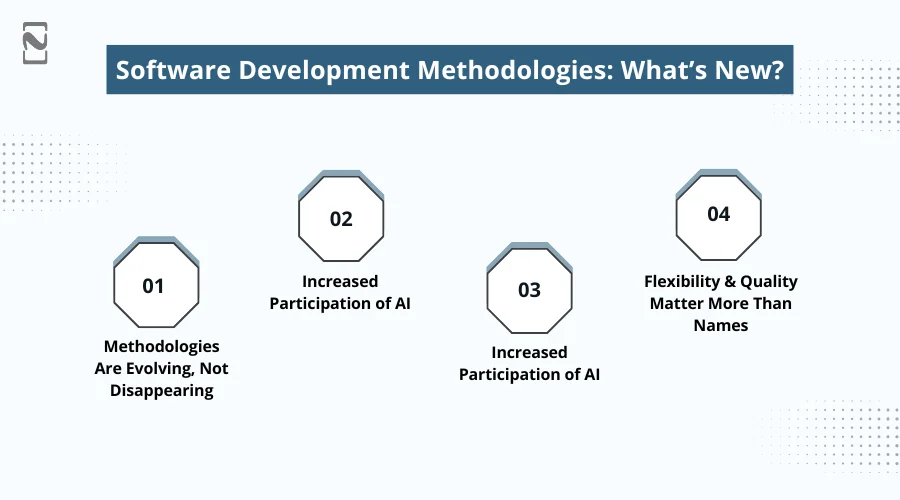
► Methodologies Are Evolving, Not Disappearing
Regardless of the changing ways of software development, the core concept of having a clear and dedicated way to plan, build, and deliver a product remains intact. Teams are adapting these methods in updated ways to make them the best fit for their goals and project needs.
► Increased Participation of AI
As in other endeavours, Artificial Intelligence is becoming a new normal in the development process. It plays a crucial role in planning, coding, documentation, testing, and quality checks.
This doesn’t mean that AI is replacing humans. They are still the decision makers, managing priorities and moulding the product vision. Simply put, AI accelerates development as directed by humans.
► Hybrid Methods Are Becoming the Current Norms
Gone are the days when teams used to follow only one methodology. Today, they fuse the power of more than one, like Agile, DevOps, Lean, and even Waterfall, according to their project specifications, to speed up feature creation, maintain stability for core jobs, and structure for long-term plans.
► Flexibility & Quality Matter More Than Names
Yes, there was a time when companies were going after the popularity of the methodology. But today, in the digital space, organizations are eyeing facets that make projects successful.
Business owners should pay heed to how perfectly the team collaborates, maintains quality, and adapts to change. In 2026, you will witness a shift from just a method to delivering consistent value.
Why Methodologies Matter Even More in 2026
No matter how you are all set with all the trending tools, AI assistants, and currently available automation options, you have to structure software development.
Here, software development methodologies come into existence :
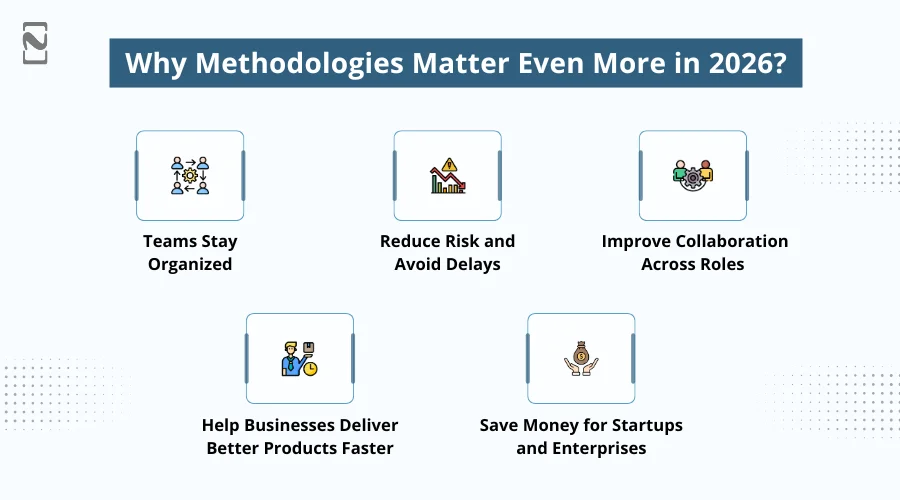
1. Teams Stay Organized
Imagine your team has started your software development with no clear approach. Next, they will get swamped with tasks, bugs, deadlines, and features.
Benefit: With a good methodology, you will get a shared plan that your team can follow, leading to a smooth workflow with no loss.
2. Reduce Risk and Avoid Delays
Projects usually get off track with changing priorities, requirement shifts, or the emergence of unexpected problems.
Benefit: With methodologies, businesses can craft an anticipated flow for managing change, identifying issues early, and reviewing processes. This saves the team from last-minute mess.
3. Improve Collaboration Across Roles
Every team member needs to stay aligned, whether it’s a UI/UX designer, a software developer, business stakeholders, or testers.
Benefits: Methodologies set simple routines, like reviews, stand-ups, Kanban boards, or sprint meetings, ease communication in the team, and allow them to stay on the same page.
4. Helping Businesses Deliver Better Products Faster
Different methodologies suit different objectives of quality, speed, and flexibility.
Benefits: When a company picks one that matches their requirements, they respond faster to customers, often release updates, and consistently enhance the product experience.
5. Save Money For Startups and Enterprises
Delays, miscommunication, rework, and mistakes definitely cost more; it’s better to go for the best software development methodology.
Benefits: Startups looking to scale and enterprises handling large teams can avoid excessive expenses, leverage resources more effectively, and diminish waste only by choosing the right methodology.
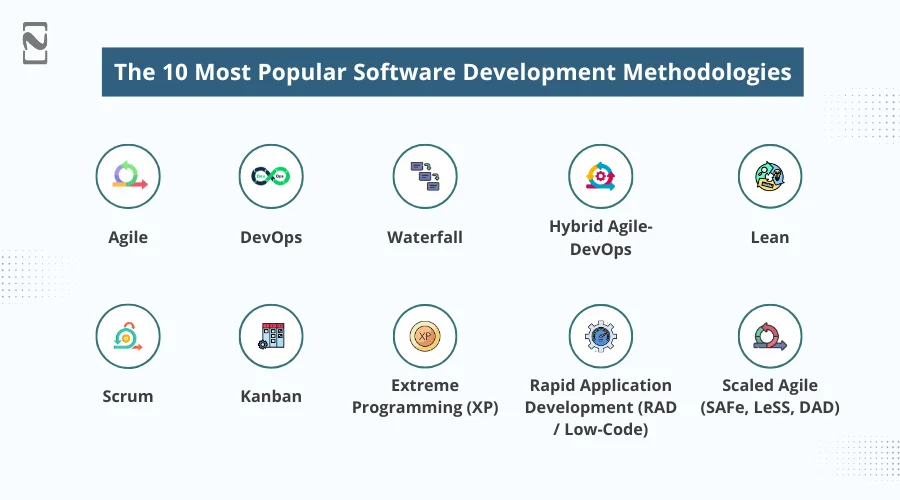
The 10 Most Popular Software Development Methodologies in 2026
Business owners typically ask the question: “Which software methodology is best for my project?”
To make you free from confusion, we have curated the most popular software development methodologies in 2026.
1. Agile
Best for: Startups, SaaS products, evolving apps, MVPs. One of the most flexible ways to build software is Agile, in which teams work in short cycles known as sprints.
Developers don’t have to plan everything ahead of time; Agile methodology allows them to deliver small but functional parts of the product, and that too faster. This way, teams can quickly adapt to changes, even if the concept or need shifts mid-project.
Pros: It enables fast delivery, effortless direction change, and transparent progress.
Cons: Client’s active involvement is mandatory, not suitable if the requirements are fixed.
With the introduction of AI tools, Agile software development methodology helps automate sprint planning, documentation, and testing. It’s kinda a default methodology in modern developers’ mindsets.
2. DevOps
Best For: Businesses that demand frequent updates, like e-commerce, SaaS, and fintech.
Combining the development (Dev) and operations (Ops) teams, DevOps facilitates software development and constant release with no delays. It automates deployments, testing, and monitoring to help products reach users rapidly with fewer errors.
Pros: It permits rapid releases, better collaboration, fewer bugs, and high automation.
Cons: It requires a cultural shift, and can also demand new tools and training.
With AI-powered automation, DevOps software development methodology experiences a major boost. Companies are already reaping the benefits of DevOps deliver software around 2 to 3 times faster. Thus, DevOps is considered a standard now, especially for growing digital businesses.
3. Waterfall
Best For: Government projects, fixed-scope enterprise systems, and compliance-heavy industries.
Known as a traditional, step-by-step development strategy, Waterfall mandates the completion of every stage before moving on to the next. Everything, be it requirements, costs, or timelines, is defined upfront. The Waterfall methodology is predictable, but less flexible compared to modern techniques.
Pros: It helps with predictable timelines, clear documentation, and repeatable processes.
Cons: The methodology is tough to change later, and for evolving products, it’s slow.
Industries still opt for the Waterfall software development methodology, where requirements stay the same and strict rules are followed. Many developers opt for the Waterfall in the start for planning, and then switch to Agile mostly to execute their project.
4. Hybrid Agile-DevOps
Best For: Fast-growing startups, SaaS companies, and enterprise digital transformation.
In 2026, this is the new normal. In Hybrid Agile-DevOps, Agile’s flexibility is combined with DevOps’ automation. Teams opt for short cycles to develop their product and then release it quickly and consistently.
Pros: With this methodology, you enjoy rapid delivery, best quality, great scaling, and adaptability.
Cons: It requires experienced teams, and software development relies on robust communication.
In 2026, Hybrid Agile-DevOps is going to be the most popular choice as it offers stability and speed. With the power of AI tools, this methodology smoothens hybrid workflows, diminishing manual work and boosting release frequency.
5. Lean
Best For: Startups, MVPs, and cost-sensitive projects.
Lean software development methodology aims to create just the necessary things, which saves businesses from unnecessary features, waste, and overplanning. With just minimal resources, the methodology helps developers maximize value, making it a perfect choice for budget-conscious teams.
Pros: It reduces cost, helps with rapid delivery, and improves efficiency.
Cons: This method demands strict prioritization and may also require long-term planning.
Lean is gaining traction because software development companies now prioritize efficiency. With the strength of AI in envisioning user behavior, teams can swiftly determine the most preferred features. This makes Lean even more useful.
6. Scrum
Best For: Teams that require structure within Agile and mid-sized development teams.
A widespread Agile framework, Scrum, is a software development methodology where work is performed in sprints, which typically take 2 weeks. A Scrum Master directs the team, and the Product Owner marks priorities. Routine short meetings help everyone be on the same page.
Pros: It provides predictable cycles, clear roles, and constant improvement.
Cons: Teams may find daily meetings absurd and also demand discipline.
Scrum methodology is still chosen, and with the support of AI Scrum tools, it helps track velocity, estimate tasks, and automate reporting. This leads to a smoother and more rapid process.
7. Kanban
Best For: Maintenance teams, support teams, or anyone requiring a steady workflow.
While knuckling down on visualizing work, Kanban utilizes a board exhibiting columns, like “In Progress,” “To Do,” and “Done.” Teams perform according to their calibre, pulling jobs at their own pace.
Pros: The methodology is highly flexible with no fixed sprints and is easy to address with great visibility.
Cons: It’s less structured and can get messy in the absence of discipline.
Now, being AI-powered, Kanban boards foresee bottlenecks, mitigate delays, and optimize workloads. This makes it comparatively more effective for constant development and support.
8. Extreme Programming (XP)
Best For: Intricate systems, high-risk projects, and teams that prioritize quality.
Extreme Programming (XP) eye mainly on code quality. And to ensure software reliability and ease of change, it leverages valuable practices, like test-first development (TDD), continuous integration, and pair programming.
Pros: Fewer bugs, improved code quality, strong collaboration.
Cons: Can be time-consuming; requires skilled developers.
Automated code reviews, real-time quality checks, and AI testing are empowering XP, making top-quality software faster and easier to deliver.
9. Rapid Application Development (RAD / Low-Code)
Best For: MVPs, internal business tools, and quick experiments.
RAD helps build software faster, utilizing iterations and prototypes. Teams reap the rewards of low-code and no-code tools to build applications in weeks, not in months.
Pros: RAD methodology is very fast and cost-effective, requiring minimal coding.
Cons: It has limited customisation and is not suitable for complex and large systems.
In 2026, low-code will boom as businesses want digital solutions faster with no heavy engineering investments. With AI low-code platforms, RAD is gaining more strength.
10. Scaled Agile (SAFe, LeSS, DAD)
Best For: Enterprises with 50-500+ engineers.
Large organizations opt for the Scale Agile methodology to apply Agile across various departments and teams. They normalize planning, communication, and delivery across big enterprises.
Pros: Scaled Agile offers ultimate visibility across teams, a clear structure, and rapid enterprise delivery.
Cons: If you fail to implement it well, it can give a heavy feeling.
With remote work and distributed teams, the Scaled Agile Frameworks help large organizations to stay aligned while moving rapidly, as supported by AI tools for resource allocation and planning.
AI-Assisted Development as a Methodology Layer to Explore
In 2026, AI-backed development will be the biggest shift, and the best thing about it is that you don’t have to be tech-savvy to get it. Now, AI acts as a smart help, not a replacer, but a supporter for the teams throughout the whole software development process.
Let’s know how :
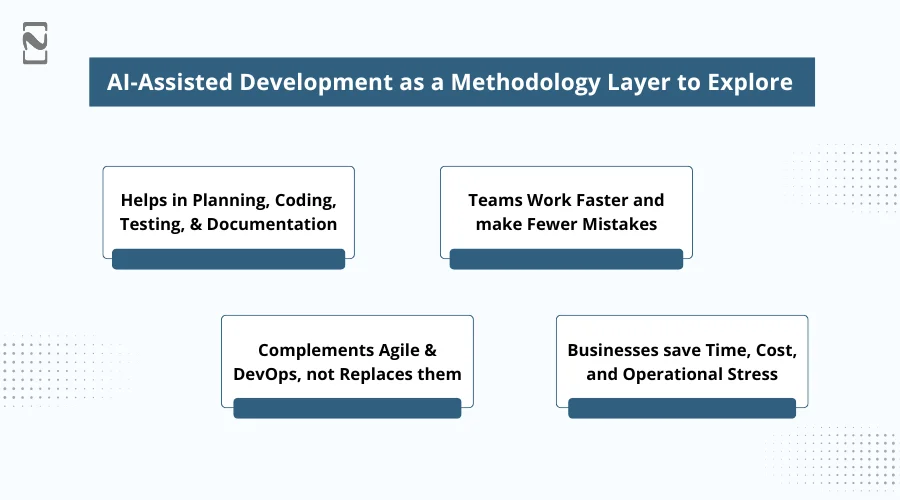
♦ Helps in Planning, Coding, Testing, and Documentation
You don’t have to do anything manually as AI is there to suggest project plans, write parts of the code, identify errors early, and even keep the documentation updated with no extra effort.
♦ Teams Work Faster and Make Fewer Mistakes
With AI, you experience diminished repetitive jobs and pinpoint issues before they take the form of costly problems. Thus, you can deliver useful software in less time.
♦ Complements Agile & DevOps, Not Replaces Them
Acknowledge AI as a layer that improves existing methods, making Agile more flexible and DevOps more automated, thereby leading to smoother moves.
♦ Businesses Save Time, Cost, and Operational Stress
By leveraging AI to address routine tasks, companies can maintain quality, ship products faster, and reduce development costs, which will be indispensable in 2026.
So forth, AI-assisted development is counted among the robust industry trends.
Every business seeks rapid delivery, predictable outcomes, and smarter planning. Here, AI becomes a key driver backing this new development age.
Which Methodology Should You Choose?
Not sure which software development methodology to choose for your project? Follow the simple directions below to get help that requires no technical knowledge.
➤ Choose: Agile or RAD (Low-Code)
Focuses on: Speed
Why: Both can lead to faster build and launch times.
Agile delivers in short cycles, while RAD utilizes low-code rapid application development and quick prototypes to accelerate things further.
➤ Choose: Waterfall
Focuses on: Maximum Reliability
Why: This methodology is ideal for compliance-focused or fixed-scope projects and meets your needs for detailed documentation and predictable steps.
➤ Choose: DevOps
Focuses on: Smart Automation
Why: DevOps is an ideal software development methodology that streamlines testing, monitoring, deployments, and updates, keeping everything running flawlessly with fewer errors and manual tasks.
➤ Choose: Hybrid Approach
Focuses on: Flexibility
Why: Hybrid approaches like Agile, DevOps, and Lean combination make you free to adapt with the project evolution, while maintaining speed, structure, and control.
➤ Choose: Scaled Agile (SAFe, LeSS, DAD)
Focuses on: Scaling a Large Team
Why: Enterprise-grade software development teams across distinct departments or locations demand coordination. Scaled Agile brings shared objectives, alignment, and expected delivery across hundreds of users.
➤ Choose: Agile, Lean, or RAD
Focuses on: Growth Startups
Why: Agile maintains accelerated progress, Lean keeps pricing down, and RAD helps build MVPs faster. The best software development methodology for startups in 2026.
This amalgamation brings about anticipated outcomes with a limited budget and time.
➤ Choose: Hybrid or DevOps
Focuses on: Modernizing Legacy Systems
Why: During transformation, you need flexibility, and Hybrid helps you with that.
Talking about DevOps, it smooths releases, ensures automation, and improves old systems faster. So, match your goals by choosing the right software development methodology meticulously.

Comparison of Software Development Methodologies
Let’s thoroughly differentiate each methodology :
| Methodology | Speed | Flexibility | Cost | Best For | Not Ideal For | Advantages |
| Agile | Fast | High | Medium | Startups, SaaS, and evolving apps | Fixed-scope projects | AI makes sprint planning smarter and faster |
| DevOps | Very Fast | Moderate | Medium | Automation-heavy products with frequent updates | Teams without ops maturity | AI automates testing, deployment, and monitoring |
| Waterfall | Slow | Very Low | High | Government, compliance, and fixed requirements | Products that change often | Best for predictable, step-by-step delivery |
| Hybrid (Agile + DevOps) | Very Fast | Very High | Medium | Growing products, modernization, and digital transformation | Small unstructured teams | Most preferred for speed + adaptability |
| Lean | Very Fast | Moderate | Low | Startups, MVPs, and cost-sensitive projects | Large enterprise programs | AI helps prioritize only high-value features |
| Scrum | Fast | Moderate | Medium | Mid-sized teams needing structure | Teams are avoiding frequent meetings | AI improves estimates & sprint planning |
| Kanban | Moderate | Very High | Low | Support teams, maintenance, and continuous flow work | Heavy feature development | AI predicts bottlenecks and workload issues |
| Extreme Programming (XP) | Moderate | Moderate | Medium-High | High-risk or quality-focused projects | Fast MVPs | AI enhances code quality and testing |
| RAD / Low-Code | Very Fast | Moderate | Low | Quick apps, prototypes, and internal tools | Large scalable systems | AI speeds up prototype and UI generation |
| Scaled Agile (SAFe, LeSS, DAD) | Moderate | Moderate | High | Enterprises with many teams | Small teams | AI improves coordination across departments |
| AI-Assisted Development (Layer) | Very Fast | Very High | Low-Medium | Every team that wants automation and accuracy | None, it enhances all methods | The biggest development efficiency booster |
Tip: Use this table to choose the approach that fits your business needs.
Mistakes to Avoid Choosing the Right Software Development Methodology
Besides choosing the right software development methodology, it’s crucial to avoid common mistakes that can increase costs, slow down projects, and create unnecessary situations.
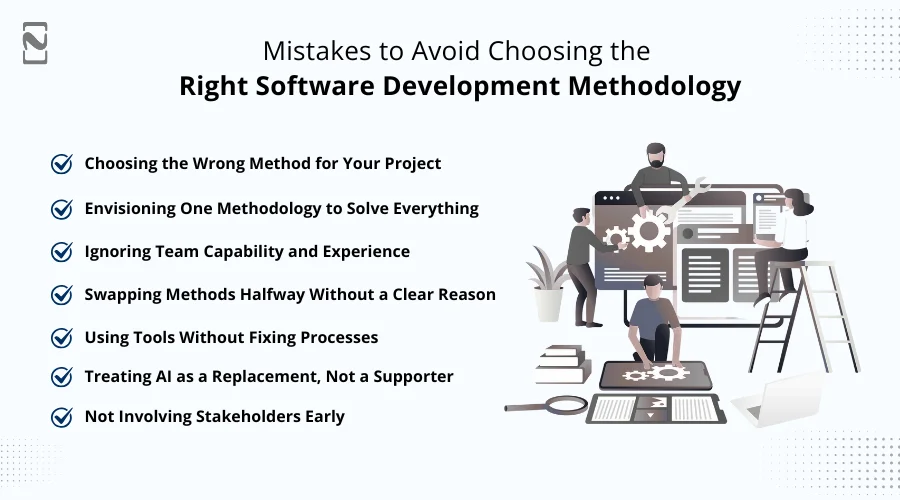
1. Choosing the Wrong Method for Your Project
When you pick a methodology without understanding the project’s scope, size, and goals, you make one of the biggest mistakes.
Result: This leads to confusion, delays, and higher costs.
2. Envisioning One Methodology to Solve Everything
Acknowledging Agile, DevOps, or Waterfall as “one-size-fits-all” to crack everything without knowing that no single methodology works for all projects.
Result: A guaranteed failure.
3. Ignoring Team Capability and Experience
If your choice is complex frameworks for your small and inexperienced teams, it is not a good idea.
Result: Your unaware and inexperienced team will create friction and decline.
4. Swapping Methods Halfway Without a Clear Reason
Teams usually change their development methodology in the middle without committing to the one they started with.
Result: It causes budget issues, rework, and timeline chaos.
5. Using Tools Without Fixing Processes
When your teams adopt DevOps pipelines, Agile boards, or AI tools, they skip enhancing planning and communication.
Result: They fail to fix the weak processes or achieve the goals.
6. Treating AI as a Replacement, Not a Supporter
AI supports project planning, testing, and coding, but the other tasks are your team’s responsibility, like analyzing proper needs and making decisions.
Result: AI misuse causes unrealistic expectations.
7. Not Involving Stakeholders Early
When you forget to involve users, clients, and decision-makers early, the project experiences hurdles, whatever methodology you choose.
Result: Requesting late feedback increases the need for rework.
Conclusion
Choosing a software development methodology, you get to know what’s pushing your business to deliver faster value with more confidence.
Every methodology comes up with potencies; the best selection relies on team, goals, and timeline. Be sure you know what your project requires and choose a method that suits you best, not just following trends recklessly.
Whether you are a startup developing your first MVP or an enterprise improving your old systems, the right software development company will assist you in selecting the right approach to reduce risk, save time, and launch a robust product.
If you want help to choose the best development approach for your project, our experts will guide you with a business-focused strategy crafted for 2026 and ahead.
FAQs

Niketan Sharma, CTO, Nimble AppGenie, is a tech enthusiast with more than a decade of experience in delivering high-value solutions that allow a brand to penetrate the market easily. With a strong hold on mobile app development, he is actively working to help businesses identify the potential of digital transformation by sharing insightful statistics, guides & blogs.
Table of Contents
No Comments
Comments are closed.