


Why do you need AI real estate website development when you already run a real estate business and are getting leads from your website?
Just go deeper and think, aren’t you getting lower engagement and conversions over time? If your answer is ‘yes’, then you are on the right page.
Let us help you!
Traditional websites follow a basic model, where you have to manually manage property listings, users face difficulties in quickly finding properties, and above all, with no insights into property trends and buyer behavior, you fail to personalize the results.
| Morgan Stanley states that AI holds the caliber to automate 37% of tasks in real estate, which results in $34 billion in increased operating efficiencies. |
Thus, a real estate agency, broker, marketplace owner, proptech startup, investor, project manager, developer, or end user, stakeholders are demanding AI real estate website development for smart property search, faster decision making, conversational AI chatbots, personalized recommendations, and more.
How to build an AI real estate site?
This step-by-step real estate website development guide 2026 will help you get answers to every crucial and minute query you have for AI real estate website development.
Let’s get started!
What is an AI Real Estate Website?
As the terms say, an AI real estate website is a platform that lists properties and leverages the power of artificial intelligence technologies, like machine learning, predictive analytics, and Natural Language Processing (NLP), to personalize user experiences, automate processes, and deliver intelligent property insights that traditional real estate websites lack.
Regarding traditional sites, they rely on basic filters and static listings. Here, AI-driven real estate websites come to the rescue, learning from market data, user behavior, and interactions to consistently enhance search accuracy, lead conversion, and recommendations.
AI vs traditional real estate websites, yes, let’s just clear up your thoughts.
| Traditional Website | AI Real Estate Website |
| Static listings | Dynamic and data-driven listings |
| Basic search filters | Intelligent and intent-based search |
| Manual lead handling | Automated lead scoring and follow-ups |
| Same content for all users | Personalized experiences |
| Limited analytics | Predictive insights and forecasting |
Simply put, modern real estate businesses should build an AI real estate website to transform their standard property listing platform into a conversion-focused digital solution to stay competitive.
Why Build a Custom AI Real Estate Website – Market Research and Analysis
In recent years, the size of AI in the real estate market has surged at a staggering rate.
- Morgan Stanley Research depicts that, by 2030, AI innovations could boost productivity by $34 billion for the real estate industry.
- According to the Business Research Company, in 2029, the valuation of AI in the real estate market will likely grow at a CAGR of 34.1% and reach $975.24 billion, up from $301.58 billion in 2025.
| “Our recent works suggest that operating efficiencies, primarily through labor cost savings, represent the greatest opportunity for real estate companies to capitalize on AI in the next three to five years.”
– Ronald Kamdem, Head of U.S. REITs and Commercial Real Estate Research at Morgan Stanley. |
-
- McKinsey & Company once said that, while utilizing AI in their work, they witnessed real estate companies gaining 10% or more in net operating income (NOI) through robust customer experience, effective operating models, new revenue streams, tenant retention, and smarter asset choices.
- The global AI in real estate market is predicted to be valued at $7.61 billion by 2033 at a CAGR of 18.48%.
-
- Real estate portals and proptech platforms, like Zillow, are already reaping the benefits of AI for chatbots, pricing intelligence, and search optimization, experiencing better lead qualification, higher user retention, and rapid transaction cycles.
- Proptech startups magnetized about 42% of total real estate tech funding.
Market research clearly reveals that custom AI real estate websites work exceptionally well by delivering personalization, predictive insights, and automation.
Tip: Build a custom real estate business solution to respond better to dynamic market demands while upholding a competitive edge and long-term scalability.
Top Benefits of Developing an AI Real Estate Website
Acknowledge the AI real estate platform as a personal agent that understands buyers’ requirements, before they themself realize.
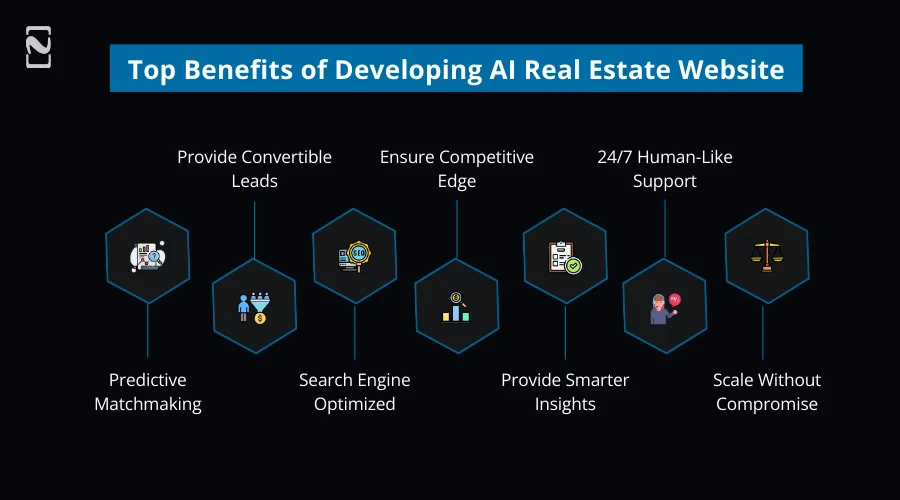
1. Predictive Matchmaking
There’s no need to struggle with endless filters.
AI is here to study user behavior, contextual preferences, and market trends to proactively recommend the exact property.
AI real estate website development helps you to make the buyers feel understood, increase engagement, and save time for agents.
2. Provide Convertible Leads
Obviously, not all the leads that reach you aim at the same needs.
AI evaluates the score leads and engagement patterns based on preparedness to act.
The agent targets high-potential prospects, increasing efficiency and revenue.
3. Search Engine Optimized
AI guarantees all the listings, updates, and pages are optimized constantly for AI-driven platforms and search engines.
This means you will attain higher traffic, better visibility, and smarter content delivery.
4. Ensure Competitive Edge
Besides giving you a boost by providing features, AI maintains a sustainable competitive edge by offering proprietary data, personalization, and predictive insights that your competitors can’t replicate easily.
5. Providing Smarter Insights
AI turns raw market and property data into actionable insights.
AI helps in:
- Predicting pricing trends
- Mark the properties likely to sell fast
- Recognize high-demand neighborhoods
So, you don’t have to guess; you can accomplish accuracy with informed decision-making.
6. 24/7 Human-Like Support
AI-powered chatbots and assistants manage inquiries, instantly answer questions, and schedule viewings.
This saves your users from feeling unattended, while your team becomes free from repetitive work and is properly utilized for other, more valuable tasks.
7. Scale Without Compromise
With the growing users and listings, AI learns and updates.
During complications, your AI real-estate platform automatically evolves, avoiding the need for hiring more resources.
Tip: Don’t acknowledge an AI real estate website as a future tool; it’s the present that you should adopt for your business’s expansion.
Different Types of AI Real Estate Websites You Can Build
AI technology has paved the way for real estate platforms, permitting businesses to create user-focused and intelligent experiences.
You can create different types of AI real estate websites depending on your business model and audience.
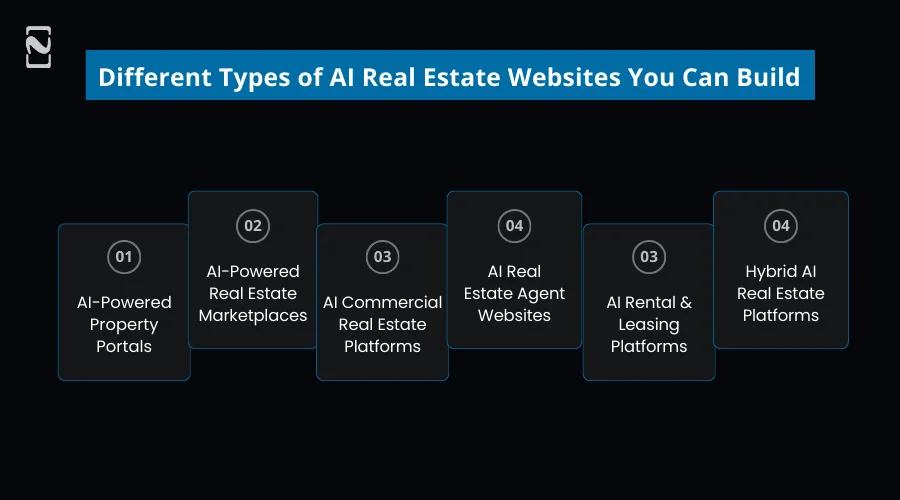
► AI-Powered Property Portals
- Purpose: It’s a centralized platform that allows multiple brokers, agents, and property owners to list their properties.
- Top AI Features: Smart property search with NLP, property recommendation engines, AI chatbots for real estate, predictive pricing, and virtual tours.
- Benefits: The AI real estate portal boosts property discoverability, increases engagement, and improves user experience.
- Examples: Redfin and Zillow
► AI-Powered Real Estate Marketplaces
- Purpose: These are full-scale platforms connecting sellers, buyers, and investors with automated transaction powers.
- Top AI Features: Matchmaking algorithms, market trend analytics, predictive investment insights, and virtual negotiation assistants.
- Benefits: The marketplace results in faster deals, boosted transparency, and offers insights to investors and users.
- Examples: Anyone.com and Opendoor.
► AI Commercial Real Estate Platforms
- Purpose: These platforms are tailored for commercial properties, such as warehouses, office spaces, and retail locations.
- Top AI Features: Market demand forecasting, predictive occupancy analytics, investment ROI predictions, and intelligent lease management.
- Benefits: AI commercial real estate platform offers businesses and investors actionable insights and data-backed decision support.
- Examples: CompStak and CREXi
► AI Real Estate Agent Websites
- Purpose: These dedicated platforms benefit small agencies and individual real estate agents.
- Top AI Features: Lead scoring, automated appointment scheduling, personalized property suggestions, and AI-driven content creation for listings.
- Benefits: Saves agent time, creates personal branding, and boosts lead conversion.
- Example: Localized AI agent portals like LocalizeOS.
► AI Rental & Leasing Platforms
- Purpose: These websites are particularly focused on lease or rental properties.
- Top AI Features: Rent prediction models, tenant screening AI, lease recommendation engines, and dynamic pricing.
- Benefits: It optimizes rental pricing, enhances property management efficiency, and ensures better tenant-landlord matching.
- Examples: Rentberry and Zillow Rentals
► Hybrid AI Real Estate Platforms
- Purpose: These real estate platforms fuse various functionalities (including commercial, rental, and residential) with AI.
- Top AI Features: Personalized recommendations, AI chatbot support, lead scoring, virtual tours, and dynamic market insights.
- Benefits: It grabs a wider audience, elevates platform retention, and boosts revenue streams.
- Example: Custom enterprise-grade AI portals for proptech companies.
Tip: While you decide which type of AI real estate website you should develop, target your business goals, audience, and the required level of AI integration.
Features to Consider While You Develop an AI Real Estate Website
What AI features does a real estate website need?
Stakeholders usually have this query whenever they research and plan AI real estate website development.
Here, we will put forth the 12 must-have AI real estate platform features that convert leads and help real estate businesses stand ahead of the curve.
| Features | Description | AI Component |
| Smart Property Search | Advanced search with filters for price, location, amenities, and lifestyle preferences | NLP-based search and intent recognition |
| Personalized Recommendations | Suggest properties based on user behavior, past searches, and preferences | Machine learning algorithms |
| AI Chatbot / Virtual Assistant | Provides instant answers to queries, schedules appointments, and handles FAQs | Conversational AI, NLP |
| Predictive Pricing & Valuation | Estimates property value and trends using historical and market data | Predictive analytics & regression models |
| Automated Lead Scoring | Identifies high-potential leads by analyzing user behavior and interactions | Machine learning classification models |
| Property Visualization | Virtual tours, 3D staging, and image recognition for property media | Computer vision & AR/VR integration |
| AI-Generated Content | Automatic generation of property descriptions and blog content | Natural Language Generation (NLG) |
| Dynamic Notifications & Alerts | Send personalized alerts about new listings, price changes, and trending properties | Recommendation engines & predictive analytics |
| Data Analytics & Insights | Tracks user behavior, traffic patterns, and conversion metrics | AI dashboards & predictive reporting |
| CRM Integration | Connects AI insights to agent workflows for follow-ups and engagement | AI-driven automation & predictive scoring |
| Advanced Security & Fraud Detection | Detects suspicious activity or data breaches | AI-based anomaly detection |
| SEO & AI-Friendly Content Structuring | Automatic tagging, schema generation, and content optimization | NLP and AI content analysis |
AI-powered real estate platform features will ensure your business outshines the competition, combining automation, personalization, advanced analytics, and predictive insights.
Steps to Develop an AI Real Estate Website
How to build an AI real estate site?
When you create an AI-enabled real-time website, you should know you have to design an intelligent ecosystem that blends the strength of predictive analytics, user experience, and automation.
Below, let’s check out the structured process that you can develop an AI real estate website.
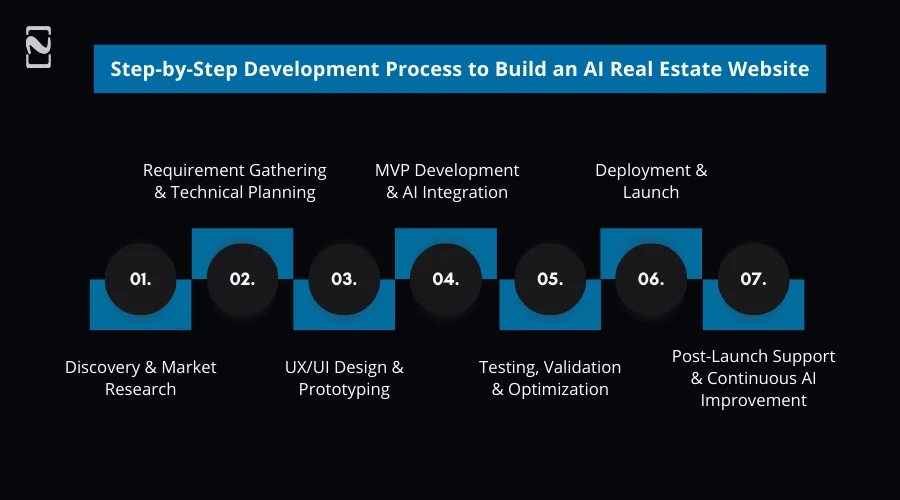
Step 1: Discovery & Market Research
Purpose: Understand your competitors, target audience, and business goals.
You define user personas (agents, buyers, and sellers), analyze leading AI real estate websites, market gaps and AI features, and set business objectives and KPIs.
Roles Involved: Product Manager, Business Analyst, and Market Researcher.
Time Required: 2-3 weeks
Thus, you can be sure the AI features you chose are aligned with your real estate needs, not just generic predictions.
Step 2: Requirement Gathering & Technical Planning
Purpose: Outline technical, functional, and AI needs.
You must identify must-have AI features, decide on the technology stack you can include to suit your platform’s functionality, and plan integration points and AI data pipelines.
Roles Involved: Product Manager, Solution Architect, AI Engineer, and Business Analyst.
Time Required: 2-3 weeks
This step lets you plan for AI early, avoid technical debts, and enjoy data-driven decision-making.
Step 3: UX/UI Design & Prototyping
Purpose: Create a user-focused experience that fuses AI insights and intuitive design.
In this phase, you will create interactive prototypes and wireframes, AI-informed personalization flows, and craft for web, mobile, and accessibility.
Roles Involved: UX/UI Designer, Product Manager, and AI Consultant.
Time Required: 3-4 weeks
AI is mandatory to share the complete user journey from search to recommendation.
Step 4: MVP Development & AI Integration
Purpose: AI real estate website MVP development with core features.
In this phase, you take care of frontend and backend development, smoothly integrate AI models for recommendation, search, chatbots, and pricing, and perform initial testing of AI functionalities.
Roles Involved: Frontend Developer, Backend Developer, AI Engineer, and QA Engineer.
Time Required: 6-8 weeks
Here, you focus on early AI development to let your platform begin learning and improving from actual interactions.
Step 5: Testing, Validation & Optimization
Purpose: Ensure the AI website performs smoothly and delivers precise predictions.
The team of website testers performs functional testing of every feature and user testing for search relevance and personalization.
Besides, model retraining and fine-tuning are done with security and compliance checks.
Roles Involved: QA Engineer, AI Engineer, Product Manager, and Security Analyst.
Time Required: 3-4 weeks
Step 6: Deployment & Launch
Purpose: Make an AI real estate platform live for the end users.
You set up the cloud infrastructure, configure analytics dashboards, and monitoring tools.
Also, you start with initial marketing and the user onboarding.
Roles Involved: DevOps Engineer, Product Manager, AI Engineer, Marketing Specialist
Time Required: 1-2 weeks
The launch incorporates AI monitoring tools to track user engagement and model performance in real time.
Step 7: Post-Launch Support & Continuous AI Improvement
Purpose: Optimize, refine, and scale the platform constantly.
You monitor user engagement, AI predictions, and conversion rates. Ahead, you add new modules or advanced AI features.
Regularly perform model retraining and performance tuning.
Roles Involved: AI Engineer, Product Manager, Marketing Analyst, and Support Team.
Time Required: Ongoing
Tip: Early AI integration and planning at each stage will help you make your AI platform scalable, intelligent, and user-centric.
Advanced Tools and Tech Stack Required for AI Website Development
An AI-powered real estate website development demands a meticulously selected technology stack where real estate AI tools for websites and the latest technology perform seamlessly together.
Below is a table of the best AI tools for real estate websites, category-wise, that you can consider while you develop an AI real estate platform. Here, check the real estate AI tech stack explained well!
| Category | Tools / Technologies | Purpose of an AI Real Estate Website |
| Frontend Development | React.js, Next.js, Vue.js | Build fast, SEO-friendly, and interactive user interfaces |
| Backend Development | Node.js, Python (Django/FastAPI), Java | Handle business logic, APIs, and AI service integration |
| AI & Machine Learning | TensorFlow, PyTorch, and Scikit-learn | Power recommendations, pricing predictions, and lead scoring |
| Natural Language Processing (NLP) | OpenAI APIs, spaCy, Hugging Face | Enable smart search, chatbots, and AI-generated content |
| Computer Vision | OpenCV, Amazon Rekognition | Property image analysis, visual search, and fraud detection |
| Data Management | PostgreSQL, MongoDB, and Elasticsearch | Store property data, user behavior, and enable fast searches |
| Big Data & Analytics | Apache Spark, Google BigQuery | Process large datasets for market insights and trends |
| Cloud Infrastructure | AWS, Google Cloud, and Microsoft Azure | Scalable hosting, AI model deployment, and storage |
| DevOps & CI/CD | Docker, Kubernetes, and GitHub Actions | Automated deployment, scalability, and reliability |
| Security & Compliance | OAuth 2.0, SSL, GDPR & PCI frameworks | Secure user data and ensure regulatory compliance |
| CRM & Marketing Tools | HubSpot, Salesforce, and Zapier | Lead management, automation, and conversion tracking |
| Monitoring & Analytics | Google Analytics, Datadog, and Prometheus | Track performance, AI accuracy, and user behavior |
Note: You should focus on your business objectives, data volume, target market, and AI maturity level while you pick an ideal tech stack. Here, the key is to choose tools and technologies that can evolve with the growing AI capabilities.

Cost to Develop an AI Real Estate Website
Well, the exact AI website development cost in 2026 demands complete project details, including the required AI features, scalability, AI models, integration, security, and more.
However, we can at least know the average AI real estate website cost, which ranges between $25,000 and $180,000+.
Cost usually falls into three levels. Let’s check this in the table below.
| App Level | Key Capabilities Included | Estimated Cost (USD) | Time Required |
| Basic AI Website (MVP) | Smart search, basic recommendations, AI chatbot, property listings, and admin panel | $25,000 – $45,000 | 10–14 weeks |
| Mid-Level AI Platform | Predictive pricing, lead scoring, advanced search, CRM integration, and analytics dashboard | $50,000 – $90,000 | 14–20 weeks |
| Advanced / Enterprise-grade AI Platform | Custom ML models, real-time market insights, visual search, AI-driven automation, and high scalability | $100,000 – $180,000+ | 20–28 weeks |
What are the factors affecting cost?
- Custom vs pre-trained AI models
- Number and complexity of AI features
- Volume and quality of real estate data
- Security, compliance, and scalability needs
- Third-party integrations
Tip: Don’t just start with a full-fledged platform; opt for building a data-ready MVP. Start small, then scale into automation and advanced prediction.
Monetization Strategies for an AI Real Estate Website
In the end, real estate agents, brokers, and marketplaces can develop an AI real estate website to convert insights, data, and user intent into distinct revenue streams.
Let’s talk about AI monetization models that you can opt for for your business.
-
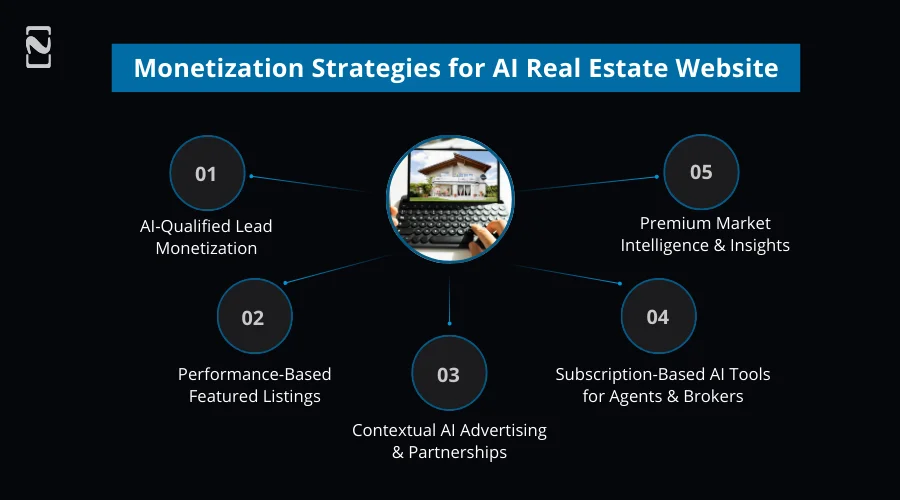
AI-Qualified Lead Monetization
You should focus on selling leads based on readiness, predicted conversion, and intent, along with inquiries.
Using budget signals, behavior, and engagement depth, AI scores users. Thus, you can charge premium pricing for high-quality leads.
Why it’s best: Real estate agents have to pay for the outcomes, not volume.
-
Performance-Based Featured Listings
Website owners charge property agencies or owners only when AI-enabled promotions deliver measurable conversions or engagement, like inquiries, clicks, or views.
Why It’s Best: With the improved platform performance, revenue scales and fosters trust.
-
Contextual AI Advertising & Partnerships
Utilize AI to display highly relevant ads display, such as insurance, mortgages, and relocation services, based on real-time user intent, despite generic impressions.
Why it’s best: You get higher CTRs without disrupting the user experience.
-
Subscription-Based AI Tools for Agents & Brokers
You can offer annual or monthly access to AI-powered tools like listing optimization, smart follow-ups, automated insights, and buyer intent analytics.
Why It’s Best: Unlocks recurring revenue with low churn.
-
Premium Market Intelligence & Insights
Real estate businesses can monetize advanced analytics, such as demand heatmaps, pricing forecasts, investment risk scoring, and neighborhood growth predictions.
Why it’s best: Insight-driven and high-margin revenue.
Custom-Built vs. Off-the-Shelf AI Real Estate Websites: Which One is Suitable for You?
You must strategically decide whether to opt for a custom-built AI real estate website or an off-the-shelf solution, as this choice impacts data ownership, scalability, and long-term ROI.
Yes, you are going right, both the options leverage the potential of AI, but they differ notably in performance, scalability, and business control.
Here is a comparison between these two in a tabular form for your better understanding.
| Criteria | Custom-Built AI Website | Off-the-Shelf AI Website |
| AI Capabilities | Fully customizable AI models trained on your data | Pre-built and generic AI models |
| Personalization Level | Deep personalization based on user behavior and intent | Limited personalization options |
| Scalability | Highly scalable as data and business grow | Scaling is usually restricted by platform limits |
| Data Ownership | Full ownership of user and market data | Data is often shared or platform-controlled |
| Integration Flexibility | Seamless integration with CRM, MLS, and APIs | Limited or paid integrations |
| Brand Differentiation | Unique UX and proprietary features | Similar design and functionality across users |
| Time to Launch | Longer development timeline | Faster deployment |
| Initial Cost | Higher upfront investment | Lower initial cost |
| Long-Term ROI | High as AI enhances with time and data | Limited by the capabilities |
1. When to Choose an Off-the-Shelf AI Solution:
An off-the-shelf platform is for you if you:
- Have a limited budget,
- Need to launch faster with lower technical effort,
- Are you verifying a business idea, trying your luck in a new market, or
- Want basic features like chatbots, search, and listings
Best For: Small agencies, solo agents, and startups.
2. When to Choose a Custom-Built AI Real Estate Website:
Custom is an ideal option if you:
- Seek a competitive edge that your competitors find challenging to copy.
- Want advanced features, like lead scoring or predictive pricing.
- Need complete control over data and AI models, or
- Plan to scale across user bases or regions.
Best for: Enterprises, growing startups, and proptech platforms.
Verdict:
- Custom-built platforms help you own the market.
- Off-the-shelf solutions help you enter the market.
Things to Consider Before Developing an AI Website for the Real Estate Industry
Before you invest in AI web development for real estate businesses, you should evaluate operational, technical, and market factors to attain long-term success.
So before you start development, address the most critical considerations below:
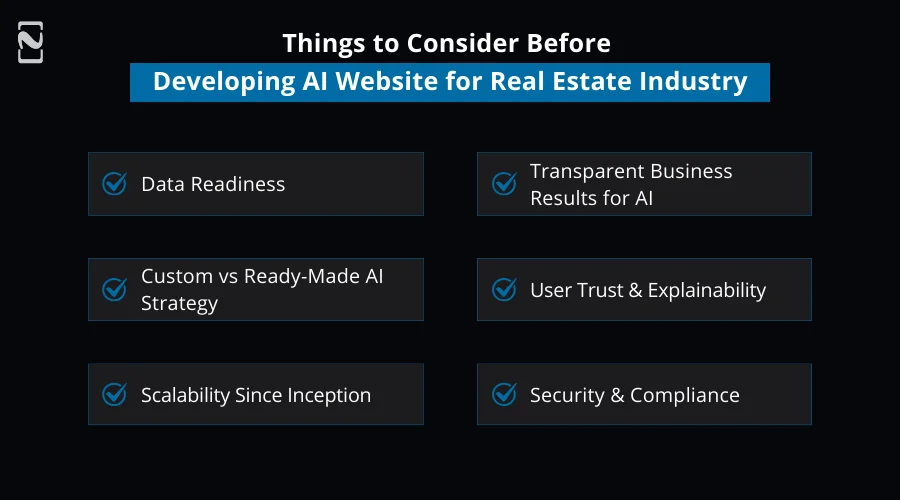
1. Data Readiness
This is non-negligible for AI real estate web development. The data behind AI decides its performance.
You should access:
- Past transaction data and pricing,
- Property listing consistency and accuracy, and
- User intent signals and behavior.
Why It’s Significant: No matter how advanced the technology you use, only robust data will make your AI features a win.
2. Transparent Business Results for AI
Businesses should decide upfront what they expect from AI to deliver.
They can decide from:
- Operational automation,
- Higher-quality leads,
- Pricing intelligence, and
- Improved property matching.
Why it’s significant: AI with defined results is not an expensive feature; it’s a growth driver.
3. Custom vs Ready-Made AI Strategy
Determine at the start only what your platform requires:
- Pre-built AI tools to accomplish cost efficiency and speed, or
- Custom AI models well-trained on your data, which offers a long-term advantage.
Why It’s Significant: As we discussed in the previous section, this decision directly influences differentiation, data ownership, and scalability.
4. User Trust & Explainability
Real estate decisions are acknowledged as a make-or-break one. To be sure, AI should be:
- Easy to understand,
- Transparent, and
- Explainable to users.
Why it’s significant: White-box AI reinforces trust and increases adoption.
5. Scalability Since Inception
You need to ensure AI systems scale with:
- Surging users,
- Growing listings, and
- Expanding regions.
Why It’s Significant: Early retrofitting scalability will be safe and economical.
6. Security & Compliance
AI platforms you create should manage personal and sensitive financial data.
You need to ensure:
- Better access control and encryption.
- Secure data pipelines, and
- GDPR / CCPA readiness.
Why It’s Significant: Compliance success boosts growth and avoids penalties.
Tip: Ensure your AI real estate strategy is outcome-focused, data-driven, trustworthy, and scalable.
Challenges and Their Solutions to Overcome While Building an AI Real Estate Website
No doubt, AI-powered real estate website development brings advantages, but you should also be prepared to encounter data, adoption, and technical challenges.
So, be sure you identify these early and combat them following the right strategies to come up with a scalable platform that can run successfully in the real estate market.
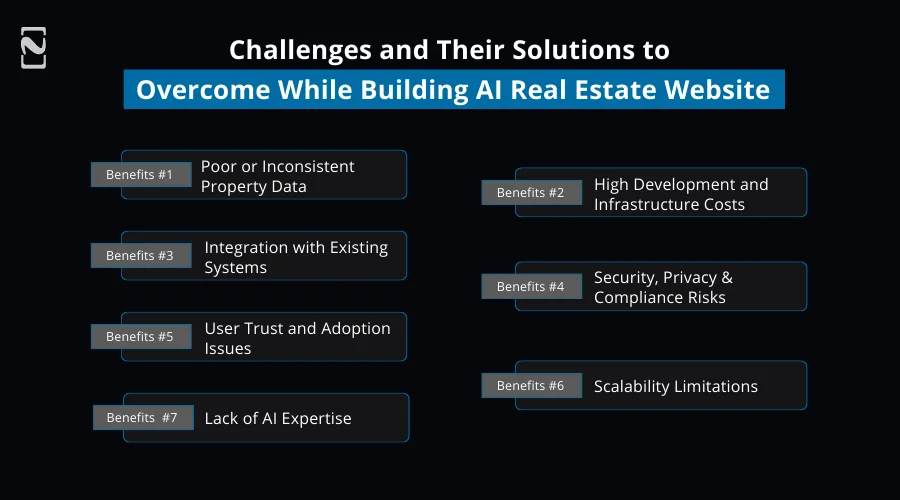
Challenge #1: Poor or Inconsistent Property Data
As you know, AI models depend heavily on structured and high-quality data. And with poor listings, missing attributes, and outdated pricing, it can reduce accuracy.
Solution:
- Leverage automated data cleansing and validation,
- Seamlessly implement data normalization pipelines, and
- Integrate several trusted data sources.
Challenge #2: High Development and Infrastructure Costs
Obviously, for AI development, you need higher investment in storage, compute, and expertise. Well, sometimes it’s challenging for small agencies and startups.
Solution:
- First, go for AI-ready MVP development,
- Before expansion, prioritize high-ROI AI features, and
- Employ scalable infrastructure and cloud-based AI services.
Challenge #3: Integration with Existing Systems
Integrating AI with legacy systems, CRM, and MLC can be error-prone and complex.
Solution:
- Opt for microservices for modular integration,
- Use API-first architecture, and
- Plan connections during the architecture phase.
Challenge #4: Security, Privacy & Compliance Risks
Doubtlessly, managing sensitive data, personal or financial, elevates regulatory risks.
Solution:
- Perform routine AI audits and security testing,
- Ensure CCPA, GDPR, and local compliance, and
- Encrypt data in transit or at rest.
Challenge #5: User Trust and Adoption Issues
Well, users may hesitate to accept AI recommendations for crucial financial decisions.
Solution:
- Unveil the reasoning behind pricing and recommendations,
- Offer explainable AI insights, and
- Permit users to customize AI preferences.
Challenge #6: Scalability Limitations
As listings and users grow, you may notice AI performance falling.
Solution:
- Craft AI pipelines for real-time and batch processing,
- Implement auto-scaling and load balancing, and
- Leverage cloud-native infrastructure.
Challenge #7: Lack of AI Expertise
Real estate companies mostly lack in-house AI specialists.
Solution:
- Upskill your internal teams with time,
- Partner with an experienced AI development company, and
- Utilize managed AI services at the start.
Tip: Ensure addressing all such challenges early to avoid risks and turn AI into a lasting competitive advantage.
Future Trends of AI in Real Estate Website Development
AI has now become more than nice-to-have; yes, a core driver of innovation in the real estate industry.
AI technologies reshape how users search for properties, how platforms convert visitors into customers, and how agents operate.
Below, we will unwind key future AI trends that will transform real estate website development in the upcoming years.
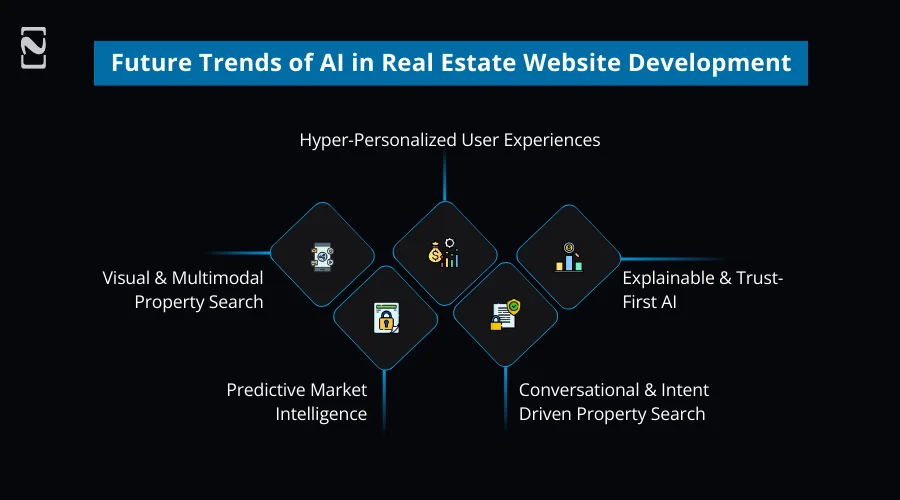
1] Hyper-Personalized User Experiences
Based on every user’s intent signals and behavior, AI will dynamically tailor dashboards, property recommendations, pricing insights, and alerts.
Significance: Hyper-personalization directly boosts retention and leads to quality.
2] Explainable & Trust-First AI
AI systems will make it clear why a price, a property, or recommendations are suggested, fostering trust and increasing transparency in high-value decisions.
Significance: Trust surges adoption in real estate transactions.
3] Conversational & Intent-Driven Property Search
Soon, there will be no need for filters, as AI will facilitate natural conversations.
Users will search using chat or voice, and AI will instantly interpret lifestyle needs, intent, and budget limitations.
Significance: It will lead to higher engagement, rapid discovery, and better conversion.
4] Predictive Market Intelligence
Gone will be the days when real estate websites, powered by real-time AI analytics, will show data to predict outcomes, like demand surges, price appreciation, and investment risks.
Significance: Investors and buyers make data-driven and smarter decisions.
5] Visual & Multimodal Property Search
Users will soon search the properties using 3D tours, maps, videos, and images, and AI will interpret not only text but also visual intent.
Significance: It diminishes search friction and enhances property engagement.
Tip: Prioritize personalization, intent understanding, trust, and predictive insights to rule the next phase of digital real estate with an AI real estate website development.

Why Choose Nimble AppGenie as an AI Real Estate Development Partner?
Well, it’s crucial to choose the right development partner when you build an AI-powered real estate.
You don’t have to carry the load and go hunt for an ideal one as Nimble AppGenie stands out as a reliable real estate app development company.
We are the trusted tech partner for startups, enterprises, agencies, and real estate businesses looking for AI real estate website development services.
Why Nimble AppGenie is the right choice:
- Proven Track Record & Industry Recognition
- Create Custom Real Estate Solutions
- Deep Expertise in AI-Enabled Solutions Development
- End-to-End Development Support
- Utilize Latest Tech Stacks
- Transparent Communication
- Global Presence across the USA, UK, UAE, Singapore, India, and Canada
Still need proof?
Real-Time Case Study: AI Real Estate Website Development by Nimble AppGenie
Client: Mid-sized real estate brokerage (North America) (Name Kept Hidden)
Objective: The client wanted to improve pricing accuracy, lead quality, and engagement using AI.
Solutions We Offered: A custom AI-powered real estate website incorporated with key AI features like smart property recommendations, automated lead scoring, pricing, and AI chatbots.
Tech Stack Chosen: React.js, Node.js, Python (AI models), PostgreSQL, and AWS.
Timeline Taken: 20 weeks (end-to-end development)
Results:
- 38% higher user engagement
- 45% increase in qualified leads
- 30% reduction in manual agent workload
Output: The platform got a new face from a static listing website to a data-driven, conversion-focused AI real estate ecosystem, assisting the clients in closing deals and scaling faster.
Collaborate with our AI website developers to build a custom AI real estate platform to scale without compromise, get convertible leads, and ensure a competitive edge.
Conclusion
We would like to wrap up by recommending that real estate businesses stay ahead of the curve with AI real estate website development.
Or, those who upgrade their legacy systems can integrate AI into their real estate websites.
You can choose between an off-the-shelf or a custom-built AI real estate website based on your business goals, scalability needs, and budget.
Hire AI developers from a reputed development firm and bring your AI real estate business idea into reality.
Contact us now!
FAQs

Niketan Sharma, CTO, Nimble AppGenie, is a tech enthusiast with more than a decade of experience in delivering high-value solutions that allow a brand to penetrate the market easily. With a strong hold on mobile app development, he is actively working to help businesses identify the potential of digital transformation by sharing insightful statistics, guides & blogs.
Table of Contents
No Comments
Comments are closed.