


Training a team today is not as easy as it used to be. Some people work in the office, some work from home, and many spread across different locations. Due to this, more and more companies are turning to e-learning to keep everyone trained and updated.
And yes, it is working. A 2024 report by LinkedIn on career development and workplace learning states that among companies with mature career development initiatives, 68% had online learning programs.
But, if we keep numbers aside, the main reason e-learning is growing is simple: It fits into the way people live and work now. People can learn at their own pace, repeat lessons, and access everything from their laptop or mobile phone.
Thus, in this blog, we will discuss what corporate e-learning solutions are, the benefits, the types available, and how to choose the right one. If you’ve been thinking about updating your company’s training, this blog will make the decision really easy.
So, let’s begin!
What are Corporate e-Learning Solutions?
Let’s understand this in simple terms. Corporate e-learning solutions mean training of employees through online or digital platforms.
Instead of bringing every employee to a physical classroom, these solutions help them to access training content anytime, anywhere with their laptop or mobile phone.
It helps to develop new skills, onboard new hires, ensure compliance, and improve overall business performance. Corporate e-learning solutions do not just digitize traditional training.
They make learning measurable, flexible, and scalable. Managers can track their progress in real-time. This reduces wasted time, improves knowledge retention, and ensures everyone is trained consistently.
The global eLearning statistics for corporate training platforms are forecasted to reach $334.96 billion by 2030.
Types of Corporate eLearning Solutions
Now, once you know what a corporate e-learning solution is, let’s understand the multiple types of solutions.
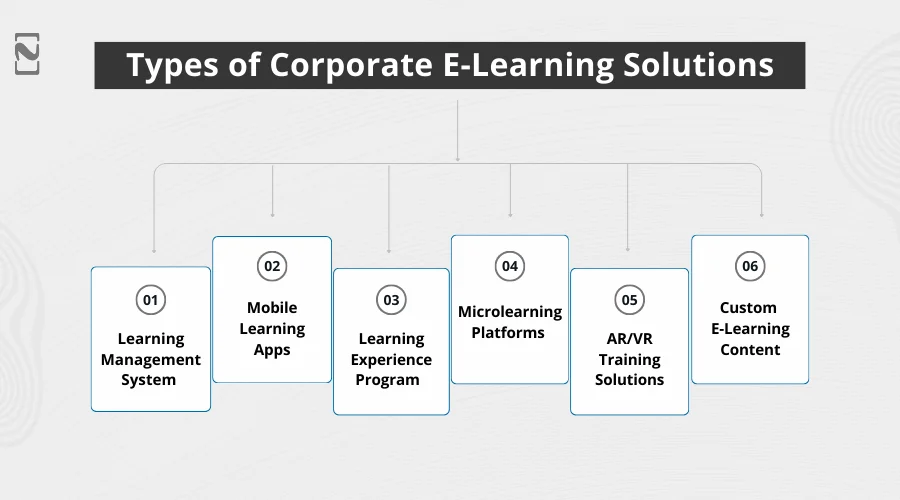
1. Learning Management System
LMS, or learning management system, is a platform where companies can upload training courses. It helps them track who has completed the training and how well they did. LMS makes it easy to manage training for many employees at the same time.
Why it’s useful:
- Central place for training content
- Track employee progress easily
- It is useful for onboarding, compliance, and regular training.
2. Mobile Learning Apps
A mobile eLearning platform like Udemy allows employees to access training on their mobile phones or laptops. This is useful for remote teams or employees who travel a lot.
Why is it useful:
- Learn anytime or anywhere
- Fits into the employee’s schedule easily
- Makes learning flexible and easy
3. Learning Experience Program
The learning experience program is more personalized than LMS. They recommend courses based on what employees need and what interests them. Employees can choose the program they want to learn, which makes the training more engaging.
Why is it useful:
- Personalized learning paths
- It is best for upskilling and career growth
- It encourages self-directed learning
4. Microlearning Platforms
Microlearning platforms provide short lessons that typically consist of a few minutes to complete. These small, focused lessons are really easy to fit into a busy workday.
Why is it useful:
- Quick and easy to complete
- Helps employees retain information better
- Perfect for refresher courses or skill updates
5. AR/VR Training Solutions
Many logistics companies use Augmented Reality or Virtual Reality for training. These technologies create realistic simulations where employees can practice skills safely.
Why is it useful:
- Hands-on and immersive learning
- Useful for jobs that need physical skills
- Reduces mistakes by practising in a safe environment
6. Custom E-Learning Content
Sometimes, many companies need training that is unique to their business. Custom e-learning content is designed specifically for the company’s requirements.
Why is it useful:
- Tailored to the business process
- Focused on real challenges employees face
- Makes training more relevant and effective
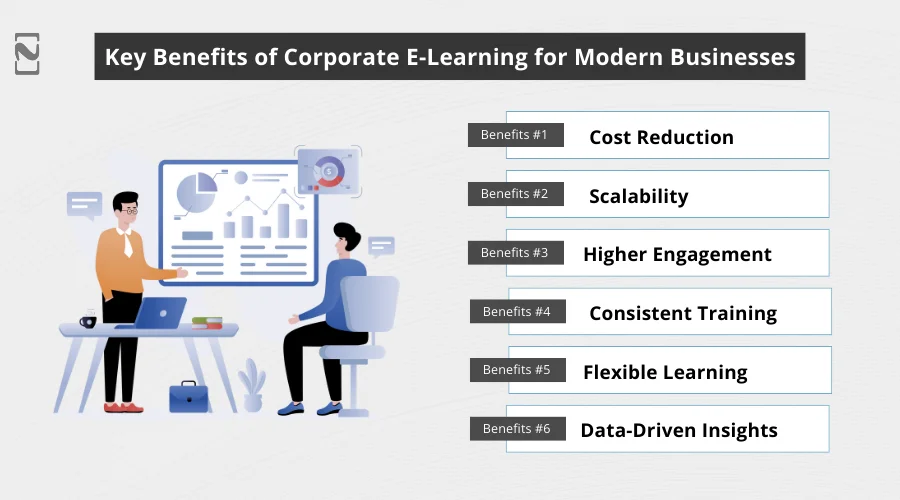
Key Benefits of Corporate E-Learning for Modern Businesses
Corporate e-learning solutions bring many benefits to businesses. It is not just about saving money. It also helps employees learn faster, stay motivated, and perform better. Let’s have a look at the following benefits of corporate educational apps.
Cost Reduction
Traditional employee training is really costly. Companies used to spend money on trainers, hotel stays, and training venues. E-learning reduces these costs because employees can access courses online anytime.
You don’t need to repeat sessions or pay for extra trainers. Companies can train more employees at the same time and save money while still giving high-quality training. It makes learning affordable for everyone in the company.
In 2023, quality training made up the largest share of the corporate training market, contributing to almost one-fourth of the total global revenue.
Scalability
E-learning can grow with your business. You can train one team or thousands of employees without extra effort. Unlike classroom training, you do not need to organize multiple sessions or repeat the same lessons.
Employees across different offices, cities, or countries can learn the same material at the same time. This makes it easy to expand training programs as the company grows, without worrying about time, space, or resources.
Higher Engagement
Employees lose focus during traditional training. But with e-learning, employees can access interactive videos, quizzes, games, and microlearning lessons. These features make learning fun and more interesting.
When learners are engaged, they remember more and apply skills better. E-learning also allows employees to learn at their own pace, which reduces stress. Engaged learners are more motivated and confident. This makes the company stronger and more productive.
The corporate training market revenue was $361.5 billion in 2023, and it’s expected to grow to $805.6 billion by 2035. This means the industry will grow at about 7% each year from 2024 to 2035.
Consistent Training
Not all classroom training is the same. Trainers may deliver lessons differently, which can confuse employees. Corporate e-learning solutions ensure that every employee gets the same quality of training. The content is standardized and clear, so everyone learns the same material correctly.
Consistency helps teams work together better, reduces errors, and ensures company policies and procedures are followed correctly. It creates fairness and equality in learning for all employees.
Flexible Learning
E-learning allows employees to learn when it suits them. They can take courses during work breaks, after hours, or while traveling. This flexibility reduces stress and allows people to learn at their own pace.
However, employees can revisit lessons if needed and focus on topics they find difficult. Flexible learning fits modern lifestyles and makes it easier for everyone to gain new skills without disrupting their daily work.
Data-Driven Insights
E-learning platforms track employee progress automatically. Managers can see who has completed courses, scores on quizzes, and areas where learners need improvement. This data helps companies make smart decisions about training.
You can identify skill gaps, adjust lessons, and measure the effectiveness of programs. Using these insights, businesses can improve performance and productivity. Data-driven learning ensures training is not just done, but done well.
How to Choose the Right E-Learning Solution for Your Business?
If you are looking for the best corporate e-learning solutions for your business, then you should follow the major steps that can assist you in finding the right solution. So, here are the steps you must take into consideration.
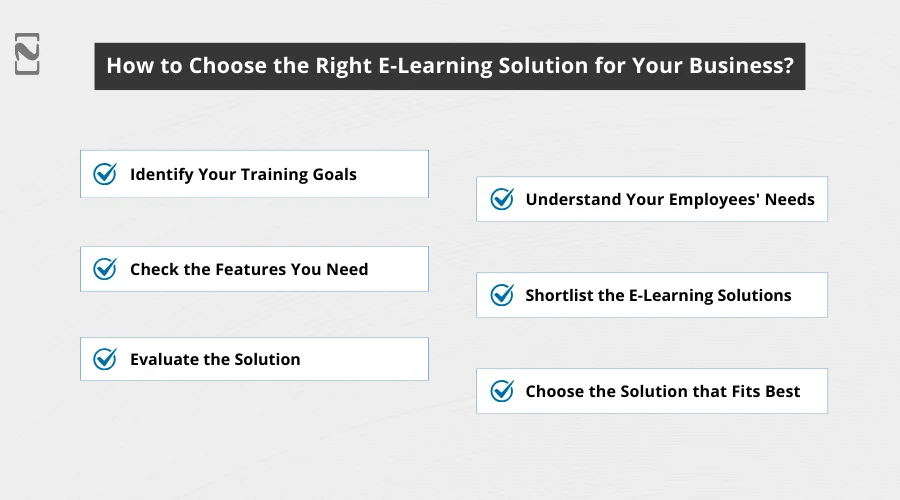
1] Identify Your Training Goals
First of all, you need to be very clear about why you need it. Every business has different training requirements, so you should begin by listing what you want to achieve. Do you want to train new employees faster? Do you want compliance courses that everyone must complete?
Are you trying to upskill your team in areas like communication, leadership, or product knowledge? Or do you want ongoing training to support career growth? When you know exactly what the training should be, choosing the right corporate e-learning solutions becomes much easier.
A clear set of goals will guide you towards the features, tools, and type of content you need. Without clear goals, you may choose a platform that doesn’t solve your real problems.
The US alone market size for corporate e-learning is forecasted to hit $3.44 billion by 2034, at a CAGR of 4.29% from 2025 to 2034.
2] Understand Your Employees’ Needs
Your employees are the ones who will use the training, so the solution must match their abilities and work style. Some employees are comfortable with technology, while others may prefer simple and easy tools.
Additionally, some work in the office, others work remotely or in the field. You have to consider how much time they can really spend on training. Do they prefer longer sessions or short lessons?
Do they learn better with interactive videos, activities, or simply reading? Knowing their requirements will help you choose a solution that they enjoy using, not one that feels like extra work.
When employees find training really easy and fun, they are more likely to complete it on time and know better. A good e-learning solution always fits the learner, not the other way around.
3] Check the Features You Need
As you know, different e-learning platforms come with different features. So, you should make a simple checklist of the features that you must have before making a decision. For instance, do you need an extensive content library with ready-made courses?
Do you want the ability to upload your own training videos and documents? Is mobile learning important? Do you want quizzes, certifications, assessments, or gamification in education solutions?
Another essential feature is reporting. It can track who completed the course, their scores, and their progress. If you already use HR tools, make sure the corporate e-learning solution can integrate with them.
A platform can look attractive, but if it does not include the features you need for your team, it will not help you achieve your goals effectively.
4] Shortlist the E-Learning Solutions
After you carefully check the features, the next step is to create a shortlist of corporate e-learning solutions that align with your needs. This will help you avoid confusion due to the multiple solutions in the market.
You can start by eliminating solutions that clearly do not fit your needs. Maybe they are too complex, too costly, or lack important features. You can keep only 3 or 4 platforms that align with your business needs.
Besides, you can look at each platform’s features, user experience, mobile access, reporting tools, and available support. Do not forget to read reviews of other companies to know real user experiences. When you shortlist the solutions, it makes the evaluation process really easy.
5] Evaluate the Solution
Once you have created your shortlist of corporate e-learning solutions, you can now carefully evaluate each one. This means testing them yourself instead of depending only on brochures or sales pitches.
You can ask for a demo or free trial to understand the working of the platform in a real situation. Also, check its loading speed, ease of course start, and features to match your training needs. You can enable managers or a few employees to test it as well, so you can gather different opinions.
Moreover, if you pay attention to details like navigation, course creation, reporting, and mobile devices, it will be helpful. Evaluating each solution properly prevents surprises later and helps you choose something reliable.
6] Choose the Solution that Fits Best
Lastly, choose the right corporate e-learning solution that fits your needs. The right solution should support your training goals, match your employees’ learning style, and fit within your budget. You should think about long-term purposes.
For example, will it work for your company as you grow? Does it offer the support, scalability, and flexibility you need? Also consider how quickly your team can adapt to it because a simple solution that everyone uses is better than a complex one that no one touches.
Now, compare your notes from the evaluations, discuss with your team, and make a choice based on overall value. The goal is to pick a solution that makes training smoother, faster, and more effective for your entire company.
Best Practices for Implementing Corporate E-Learning in Your Organization
These best practices help you roll out e-learning smoothly in your company so employees learn effectively and stay engaged. So, let’s have a look at the best practices that you must follow.
➢ Start Small and Build Up
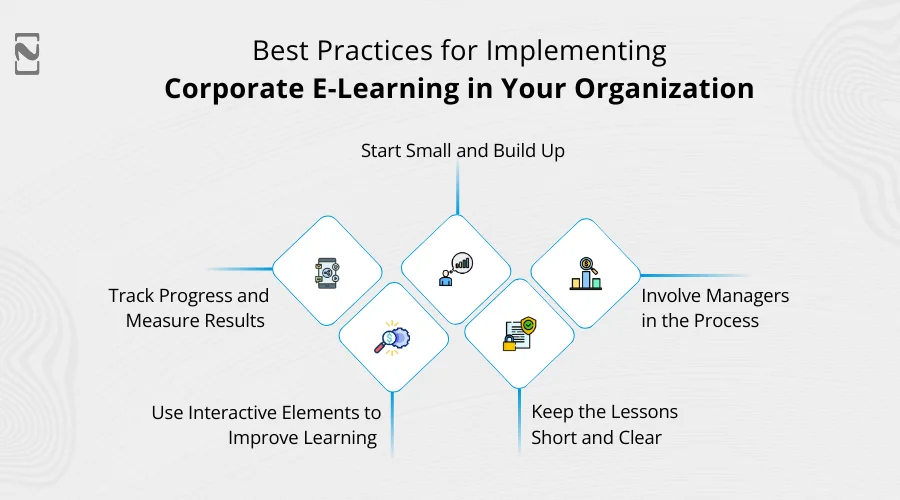
You can start with a few essential courses, like onboarding or compliance. This helps employees get used to the e-learning solution. You can fix issues in advance and slowly add more courses. A small and step-by-step method makes implementation really easy and helps employees adopt e-learning.
➢ Involve Managers in the Process
Managers motivate employees to take training seriously. You can give them access to check reports and ask them to follow up with their teams.
Managers can set learning goals, provide guidance, and share feedback. If managers are involved in the process, they encourage employees and make sure the training aligns with real work needs.
➢ Keep the Lessons Short and Clear
You should break lessons into small focus modules. Also, you can use simple language, practical examples, and visuals. You should avoid long sessions that feel confusing and boring.
It is best to provide short, clear lessons that are easier to complete, remember, and apply. This keeps your employees engaged and ensures they learn effectively without wasting time.
➢ Use Interactive Elements to Improve Learning
Next, you can include quizzes, scenarios, drag-and-drop exercises, or simulations. Interactive content keeps employees engaged and helps them understand concepts better.
Hands-on learning improves retention and builds confidence. You can also provide real-life examples and activities. This makes lessons practical and relevant for everyday work situations.
➢ Track Progress and Measure Results
Lastly, you can monitor course completion, quiz scores, and areas where employees struggle. This shows skill gaps and helps improve content.
Tracking results ensures training is effective and aligned with company goals. It also helps managers demonstrate the value of e-learning in improving performance and productivity.
Future Trends in Corporate E-Learning
Let’s look at the future of corporate eLearning apps trends. These are the trends every business should watch in the coming years. Keeping an eye on them will help companies train employees more effectively and make learning easier for everyone.
1. Immersive Tech Becomes Essential
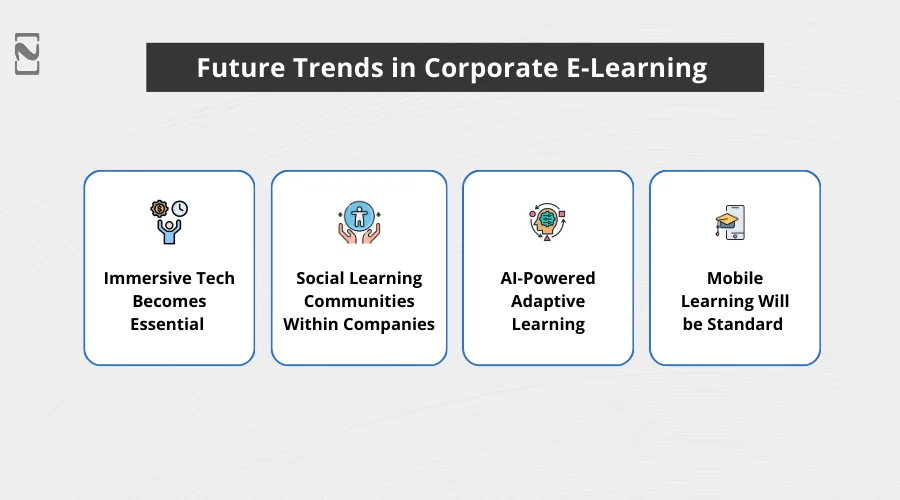
AR, VR, or MR are not limited to fun. They are becoming really crucial for workplace training. These corporate e-learning solutions allow employees to practice tricky and challenging tasks easily and without any real danger or cost.
As per Grand View Research, the market size of immersive corporate training is forecasted to reach $69,590.5 million by 2030.
For instance, factory workers can do safety drills in VR, and technicians can get AR guidance during repairs. If you add these points, badges, or a leaderboard, it makes it really fun and keeps them more motivated to learn.
2. Social Learning Communities Within Companies
Learning does not have to be done alone. There are many apps now that allow employees to discuss ideas, work on changes together, and get feedback. Due to this, training becomes more effective and helps people remember what they learn.
Additionally, it builds teamwork, as managers and employees collaborate on shared projects. However, it improves skills and connects with others.
3. AI-Powered Adaptive Learning
AI in education apps can make learning personalized for everyone. It looks at what employees already know and what they need to learn, then gives lessons that fit them.
As per Mordor Intelligence, AI-driven adaptive learning is projected to grow to $12.66 billion by 2030.
If someone struggles, it slows down or repeats topics. Employees can learn at their own pace, focus on what matters, and remember things better. Learning feels easier and more useful this way.
4. Mobile Learning Will Be Standard
Employees will expect workplace training that works easily on their mobile phones, no matter where they are. For example, at the office, on-site, or at home.
By 2033, corporate mobile learning is expected to reach $156.55 billion.
Smart companies are already providing mobile app-based courses that work offline and sync automatically. This makes learning easy to access, keeps everyone included, and helps teams around the world stay up to date.
Conclusion
Corporate e-learning is no longer optional. It is becoming essential for all businesses, no matter what size. With solutions like LMS, mobile learning, micro learning, and immersive technologies, companies can train their employees faster and more effectively.
E-learning keeps the employees engaged, saves the learning costs, and ensures everyone gets the same quality of training. By adopting the right corporate e-learning solutions, businesses can build smarter and more skilled teams ready for any challenge.
Moreover, if you are in the edutech business and want to build your own e-learning platform, then it is best to consult with an education app development company. They can provide you with the next-gen and robust corporate e-learning platform.
FAQs

Niketan Sharma, CTO, Nimble AppGenie, is a tech enthusiast with more than a decade of experience in delivering high-value solutions that allow a brand to penetrate the market easily. With a strong hold on mobile app development, he is actively working to help businesses identify the potential of digital transformation by sharing insightful statistics, guides & blogs.
Table of Contents
No Comments
Comments are closed.