


In a Nutshell:
- Agile methodology is the latest software development and project management approach that supports teams in delivering value incrementally while quickly adapting to changing needs.
- Widely chosen Agile frameworks like Kanban, Scrum, XP, Lean, and Crystal help organizations apply Agile principles based on workflow, team size, and project complexity.
- Agile vs Waterfall unveils a clear difference in delivery speed, flexibility, and risk management, making Agile perfect for dynamic and evolving projects.
- Agile methodology benefits incorporate improved product quality, faster time-to-market, and increased customer satisfaction, driven by constant feedback and iterative development.
- Agile methodology implementation demands clear roles, iterative planning, and the right tools, backed by sprint cycles, frameworks, and performance metrics.
- Agile methodology approaches and examples exhibit why Agile is widely adopted in software development, digital transformation projects, and mobile app development.
What is Agile methodology? An ultra-modern project management and software development approach, Agile methodology focuses on collaboration, flexibility, and continuous enhancement. Despite focusing on long-term and rigid plans, Agile empowers teams to deliver small work in incremental stages while quickly adapting to dynamic business needs.
Originally crafted for software development, Agile has gained traction across industries, such as mobile app development, product engineering, IT services, and digital transformation. It emphasizes cross-functional teamwork, customer feedback, and faster delivery of value-driven solutions.
Agile breaks projects into easily manageable interactions known as sprints and helps organizations diminish risks, enhance product quality, and accelerate time-to-market.
Today, businesses seeking rapid innovation, scalable project execution, and better stakeholder alignment in competitive markets prefer Agile methodology.
Whether you are a product owner, developer, scrum master, or project manager, you should follow Agile methodology to attain improved product delivery speed and quality.
In this post, you will find Agile methods explained well, Agile vs waterfall, top Agile frameworks, and how to implement Agile methodology.
What Is Agile Methodology?
What is agile methodology in software development?
Agile methodology is an iterative project management and development approach that aims at delivering value in small, consistent increments while adapting to change quickly. It prioritizes customer feedback, collaboration, and flexibility over extensive documentation and rigid plans.
As we discussed, Agile breaks a project into short development cycles, known as sprints or iterations, where teams plan, create, test, and review work regularly.
Thus, stakeholders attain early issue detection, rapid releases, and ongoing enhancements based on actual user feedback.
Agile fosters close collaboration between stakeholders, developers, and customers throughout the software development lifecycle.
The Agile Manifesto guides this methodology that values individuals and interactions, customer collaboration, working solutions, and responsiveness to change.
Today, agile methodology is used widely in mobile app development. software development, and digital project teams to boost quality, speed, and adaptability.
Agile vs Waterfall: Key Differences
Why choose Agile over Waterfall? Let’s get deeper to know.
Agile and Waterfall are different chiefly in execution style and flexibility. Agile follows an iterative process with consistent feedback and regular releases, making it perfect for changing needs.
Waterfall leverages a linear and step-by-step process best suited for projects with a transparent definition and fixed requirements.
Agile vs Waterfall: Differences to Know:
| Aspect | Agile Methodology | Waterfall Methodology |
| Approach | Iterative and incremental development | Linear, sequential development |
| Flexibility | Highly adaptable to changing requirements | Changes are difficult after planning |
| Delivery | Frequent releases in short cycles (sprints) | Single final delivery at project end |
| Customer Involvement | Continuous feedback throughout the project | Limited involvement after the requirements phase |
| Testing | Performed continuously during development | Occurs after development is completed |
| Risk Management | Risks identified and addressed early | Risks are often discovered late |
| Best Suited For | Dynamic projects with evolving needs | Projects with fixed, well-defined requirements |
Top Agile Frameworks
Harnessing the potential of Agile frameworks, you get structured modes to apply Agile principles in real-world projects.
Every framework addresses distinct workflows, team sizes, and business requirements, assisting organizations in picking the most effective approach for ultimate planning, collaboration, and delivery.
What are the main Agile methodologies?
Let’s check them out:
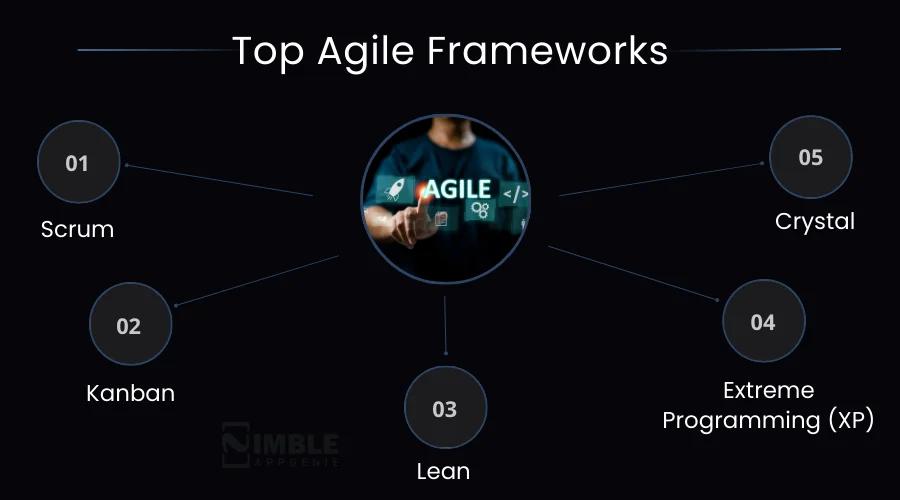
➤ Scrum
- Defined Roles: Product Owner, Development Team, Scrum Master.
- Time-boxed framework using short sprints (usually 2-4 weeks).
Best for: Complex projects demanding frequent feedback and delivery.
➤ Kanban
- Visual workflow management utilizing boards and task columns.
- Target continuous delivery and restrict work in progress (WIP).
Best for: Teams looking for flexibility and consistent task prioritization.
➤ Lean
- Reduces waste and boosts customer value.
- Highlights fast delivery, efficiency, and continuous improvement.
Best for: Startups and teams optimizing processes and costs.
➤ Extreme Programming (XP)
- Focuses on code quality and technical excellence.
- Practices embrace continuous testing, pair programming, and frequent releases.
Best for: Software projects with frequently changing requirements.
➤ Crystal
- Lightweight framework tailored to project complexity and team size.
- Emphasizes people, communication, and adaptability.
Works well for small to medium-sized teams with low-criticality projects.
Why Agile Works: Benefits to Explore
How does Agile improve project success? Absolutely, you need the answer to this. This section is there to answer such queries.
Here we will discuss the benefits of Agile methodology in detail below:
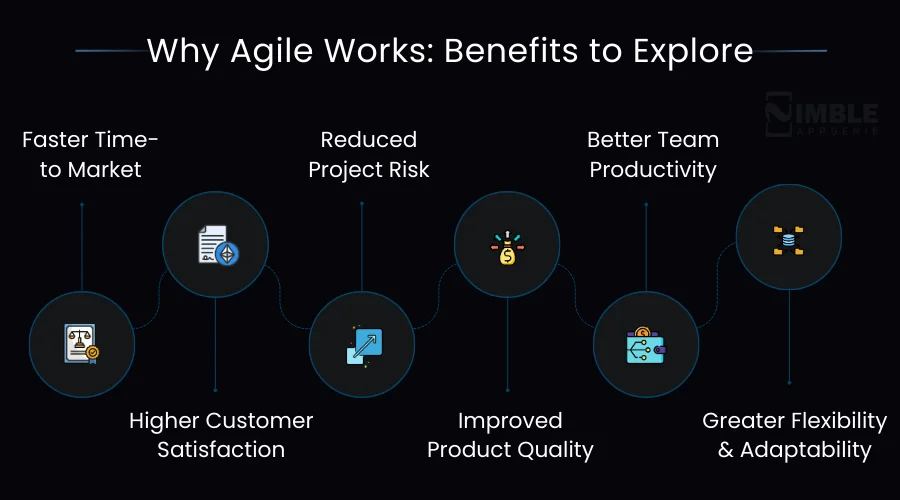
1. Faster Time-to-Market
Agile teams deliver working features faster for about 30-50% through short and iterative sprints.
2. Higher Customer Satisfaction
Constant feedback loops help improve customer satisfaction by about 20-40% compared to legacy models.
3. Reduced Project Risk
Frequent reviews and early testing assist in recognizing issues sooner, diminishing failure risks by approximately 25-30%.
4. Improved Product Quality
Ongoing collaboration and testing mitigate defects by up to 40%.
5. Better Team Productivity
Cross-functional teams usually witness around 15-25% productivity gains because of transparent priorities and collaboration.
6. Greater Flexibility & Adaptability
Agile simply accommodates dynamic needs without overrunning major costs or timeframes.
When Should You Use Agile?
So, after understanding how Agile can be advantageous for the success of your project, there’s no reason left to delay.
Let you know, Agile is suitable for dynamic and complex projects with evolving requirements. It performs well when rapid delivery, adaptability, and frequent feedback are crucial.
► Best Agile Use Cases
- Software & Mobile App Development: Projects with frequent updates and changing features.
- Digital Transformation Projects: Flexibility to swiftly adapt to modifying business goals.
- Startups & New Product Launches: Eases learning from users and iterative testing.
- Customer-Centric Products: Regular feedback increases satisfaction and usability.
► Common Pitfalls
Unclear requirements, large teams, lack of stakeholder engagement, and resistance to change are some of the catches you can block your way.
We will thoroughly talk about these with possible solutions later in this blog. Before that, let’s first find out how to implement agile step by step.
How to Implement Agile in Your Team?
To successfully adopt Agile, you need structured steps, transparent communication, and a work culture open to consistent improvement.
Here’s a practical plan to get started:
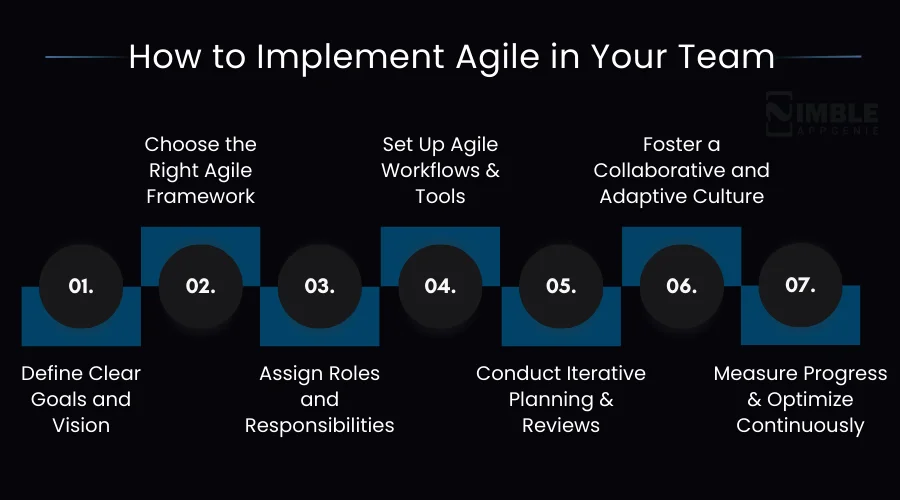
1. Define Clear Goals and Vision
Start by aligning your development team on project goals and desired results.
Be sure that every member of your team understands how valuable Agile methodology is and what it will bring to your organization.
2. Choose the Right Agile Framework
Choose an Agile framework (we have discussed above) that best fits your project type, team size, and workflow requirements.
3. Assign Roles and Responsibilities
In this step, identify the key roles: Product Owner, Development Team, or Scrum Master.
Then, clearly define the accountability to maintain efficiency and transparency.
4. Set Up Agile Workflows and Tools
Leverage the potential of backlog management, visual boards, and tracking tools, like Trello, Jira, or ClickUp.
Ahead, plan iterations or sprints with measurable outcomes for every cycle.
5. Conduct Iterative Planning and Reviews
Divide the project into short cycles, sprints (as we discussed earlier), with routine planning, retrospective meetings, and review.
Promote continuous feedback from team members and stakeholders.
6. Foster a Collaborative and Adaptive Culture
Encourage knowledge sharing, open communication, and self-organizing teams.
Be prepared to adapt processes depending on lessons learnt from every iteration.
7. Measure Progress and Optimize Continuously
Flawlessly track key metrics, like cycle time, velocity, and detect rate.
Next, refine workflows, processes, and priorities according to feedback and performance data.
| Step | What to Do | Outcome |
| Define Vision | Align goals, scope, and success metrics | Clear direction for the team |
| Choose Framework | Select Scrum, Kanban, Lean, etc. | Process tailored to project needs |
| Assign Roles | Identify Product Owner, Scrum Master, Dev Team | Accountability and ownership |
| Set Up Tools | Configure Jira, Trello, and communication tools | Transparent workflow |
| Plan Iterations | Create backlog and sprint goals | Predictable delivery |
| Execute & Review | Run sprints, reviews, retrospectives | Continuous improvement |
| Measure & Improve | Track velocity, cycle time, defects | Optimized performance |
Common Agile Challenges & Solutions
Agile implementation is not achieved without blockages.
Below is a practical Q&A guide you should go through to address the frequent challenges teams face:
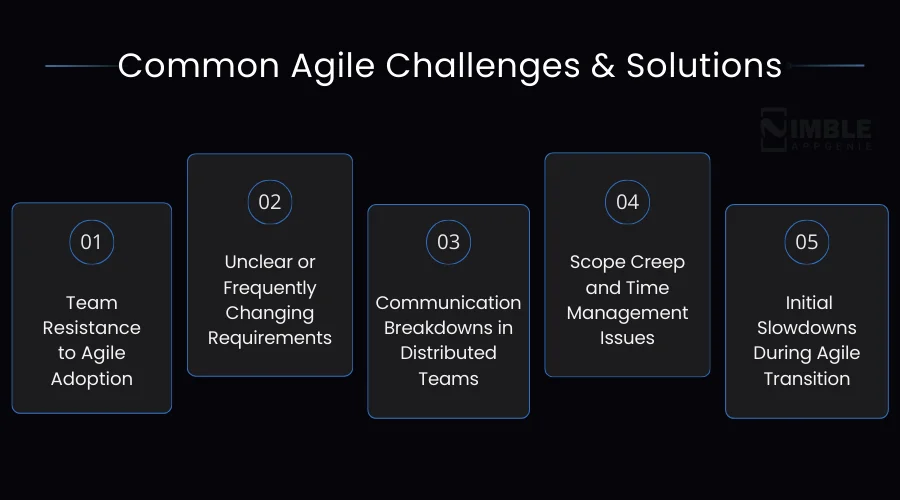
♦ Team Resistance to Agile Adoption
Solution:
The organization should target training, start involving the team in planning, and exhibit early wins to showcase Agile’s benefits. This fosters a continuous learning culture.
♦ Unclear or Frequently Changing Requirements
Solution:
Keeping a well-prioritized product backlog, consistently engaging stakeholders, and holding regular sprint reviews will help you fine-tune and clarify needs.
♦ Communication Breakdowns in Distributed Teams
Solution:
Utilize the collaboration tools, like Trello, Jira, and Slack, to schedule regular stand-ups and implement transparent document practices.
♦ Scope Creep and Time Management Issues
Solution:
Clearly define sprint goals, restrict work in progress (WIP), and supervise progress with routine check-ins to keep the team on track.
♦ Initial Slowdowns During Agile Transition
Solution:
Predict a learning curve, optimize processes iteratively, and evaluate key metrics after every sprint.
Agile Roles Explained
Agile projects depend on clearly defined roles and responsibilities to ensure flawless collaboration, efficient delivery, and accountability.
The three roles are Product Owner, Scrum Master, and the Development Team.
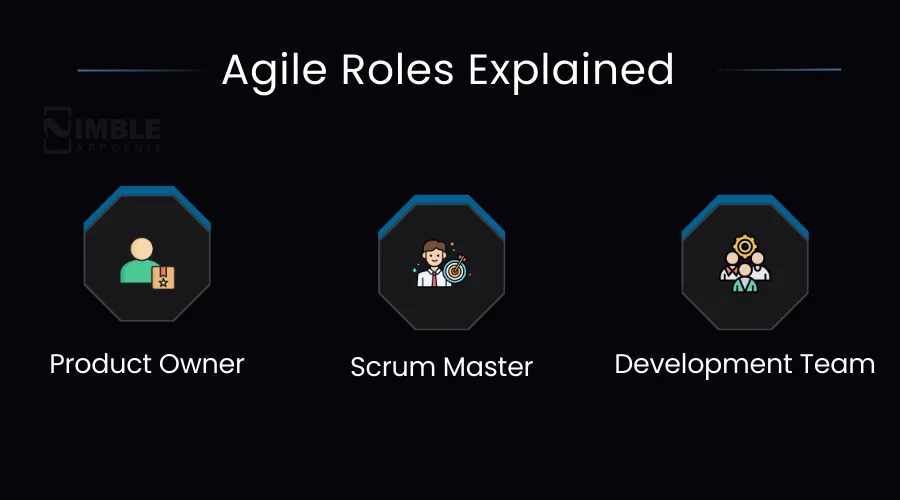
1. Product Owner
It acts as the voice of stakeholders and customers, and ensures the team delivers product features that boost business value. They define priorities, maintain alignment, and clarify needs with business objectives.
Product Owner Responsibilities:
- Prioritize the product backlog based on value.
- Communicate requirements to the team.
- Define user stories with clear acceptance criteria.
- Gather and incorporate stakeholder feedback.
Why It Matters: Ensures the team delivers features that maximize business value.
2. Scrum Master
Serves as Agile coach and facilitator, Scrum Master guides the team through processes, eliminating impediments, and encouraging best practices.
Scrum Master Responsibilities:
- Facilitate Agile ceremonies (sprint planning, daily stand-ups, and retrospectives).
- Coach the team on Agile principles and best practices.
- Release blockers and impediments.
- Protect the team from external distractions.
Why It Matters: This assists the team to stay focused, aligned with Agile principles, and productive.
3. Development Team
It’s a cross-functional group that’s responsible for creating and delivering the product. They plan, test, execute, and constantly enhance the work while collaborating with the Scrum Master and Product Owner.
Development Team Responsibilities:
- Design, develop, test, and deliver working increments per sprint.
- Collaborate closely with the Product Owner and Scrum Master.
- Self-organize to efficiently plan and execute work.
- Constantly improve code quality, processes, and teamwork.
Why It Matters: Drives the actual creation and quality of the product, ensuring iterative progress.
| Role | Key Responsibilities | Purpose / Importance |
| Product Owner |
|
Ensures the team builds features that align with business goals and maximize customer value |
| Scrum Master |
|
Keeps the team productive, aligned, and ensures Agile processes are followed effectively |
| Development Team |
|
Drives the creation and delivery of the product, ensuring iterative progress and high-quality output |
Agile Tools & Best Practices
Leveraging the right tools and following the proven practices helps you successfully implement Agile.
Agile tools automate planning, progress tracking, and collaboration, while best practices assist teams in maintaining efficiency and consistently delivering value.
➤ Essential Agile Tools
- Trello: Visual boards and cards are ideal for smaller teams or lightweight Agile workflows.
- Jira: A robust tool for backlog management, sprint planning, and tracking team velocity.
- Asana / ClickUp: Helps manage tasks, track progress, and coordinate cross-functional teams.
- Confluence / Notion: Centralized documentation for requirements, notes, and knowledge sharing.
- Slack / Microsoft Teams: Facilitates real-time communication and quick decision-making.
➤ Best Practices for Agile Teams
- Short Iterations: Leverage time-boxed sprints to adapt quickly and deliver incremental value.
- Prioritize Transparency: Keep work visible through dashboards, boards, and regular updates.
- Retrospectives: Conduct regular reviews to reflect, learn, and improve processes.
- Continuous Feedback: Engage stakeholders regularly for early feedback and course correction.
- Foster Collaboration: Motivate teamwork, open communication, and shared ownership of outcomes.
- Limit Work in Progress (WIP): Avoid team overload and maintain emphasis on high-priority tasks.
➤ Agile Tools: Quick Overview
| Tool | Primary Use | Best For |
| Jira | Backlog management, sprint planning, and reporting | Medium to large Agile teams |
| Trello | Visual task boards, workflow tracking | Small teams and simple Agile projects |
| ClickUp | Task management, sprint tracking, and collaboration | Cross-functional Agile teams |
| Asana | Project tracking and team coordination | Agile planning with dependencies |
| Slack | Real-time communication and collaboration | Daily stand-ups and quick updates |
| Microsoft Teams | Meetings, chat, and file sharing | Enterprise Agile teams |
| Confluence | Documentation and knowledge sharing | Agile documentation and planning |

Conclusion
Agile methodology strengthens teams to deliver top-quality products swiftly by emphasizing collaboration, flexibility, and constant improvement.
By picking the right Agile framework, following best practices, and defining clear roles, organizations can diminish risks, respond effectively, and boost efficiency to changing business requirements.
Are you looking to adopt Agile for your upcoming project? Partner with an experienced development company, like Nimble AppGenie, to implement Agile in the right way and attain scalable and lasting success.
FAQs
Agile methodology approaches include:
- Kanban for continuous workflows.
- Scrum for sprint-based development.
- XP for high-quality software practices.
- Crystal for small and adaptive teams.

Niketan Sharma, CTO, Nimble AppGenie, is a tech enthusiast with more than a decade of experience in delivering high-value solutions that allow a brand to penetrate the market easily. With a strong hold on mobile app development, he is actively working to help businesses identify the potential of digital transformation by sharing insightful statistics, guides & blogs.
Table of Contents
No Comments
Comments are closed.