

 Free Consultation
 PCI-DSS Compliant
 GDPR Ready
 ISO 27001
 NDA Protected
 AI Services
 AI App Development
 Generative AI Development
 AI Chatbot Development
 AI Integration Services
 AI Consulting Services
 AI For Fintech
 AI Financial Assistant Solution
 AI Insurance Agent Development
 Tech Stack
 OpenAI / GPT-4
 Claude / Anthropic
 Gemini / Google AI
 Llama / Open Source
 LangChain / LlamaIndex
 Pinecone / Pgvector
 AWS / Azure AI


 Fintech Solution
 Core Fintech
 App Development
 Neobank Solutions
 eWallet Solutions
 Lending Software
 Banking Solutions
 BNPL Solutions
 BNPL Solutions
 Insurance App
 Wealth Management
 Crypto & DeFi
 Blockchain Development
  Payroll Software
 DeFi Solutions
 Crypto Wallet
 Crypto On/Off Ramp
 Crypto Exchange
 Trading Platform
 Payments
 Compliance
 Regulations & Compliance
 Fraud Detection
 Lending Ecosystem
 P2P Lending Platform
 Mortgage Software
 Engagement
 Fintech Outsourcing

 Mobile Development
 Mobile App Dev
 iOS App Development
 Android App Development
 React Native
 Flutter Development
 Web Solution
 Node.js Development
 React.js Development
 Angular Development
 App Services
 UI/UX Design
 App Maintenance
 By Stage
 MVP Development
 Industry Solutions
 Healthcare App Dev
 Education App Dev
 Travel App Dev
 Real Estate App Dev
 Logistics Software
 Social Media App

 Hire Mobile Developers
 Hire iPhone Developers
 Hire Android Developers
 Hire React Native Devs
 Hire Flutter Developers
 Hire Web Developers
 Hire Node.js Developers
 Hire Angular Developers
 Hire PHP Developers
 Hire Laravel Developers
 How It Works
 Pre-Vetted Developers
 Ready In 48 Hours
 NDA From Day One
 Replace Guarantee
 Company
 About Us
 Our Work Process
 Portfolio
 Case Studies
 Blog / Insights
 Careers
 Contact Us
 Awards
 Recognition


 Offices



In a Nutshell:
- An AI-powered wealth management app is built by integrating artificial intelligence, predictive analytics, and fintech expertise to deliver individual investment guidance and automated portfolio management.
- AI apps process market trends, user behavior, and financial data in real time to generate smart, data-driven investment recommendations.
- These platforms provide automated portfolio rebalancing, predictive risk analysis, and hyper-personalized investment strategies for banks, fintech startups, and investment firms.
- The development process includes market research, AI model integration, UI/UX design, tech stack selection, and regulatory compliance.
- Building such apps enables companies to create secure, scalable, and intelligent wealth management platforms that streamline investment management and enhance decision-making.
- Partner with an experienced company like Nimble AppGenie to create a scalable AI wealth management platform or integrate AI into digital investment solutions.
How to build an AI wealth management app that helps fintech startups, banks, and investment firms deliver personalized investment insights and self-adjusting portfolio optimization in 2026?
Investors and financial institutions often struggle with efficient portfolio management, risk prediction, and providing tailored investment strategies. AI-powered wealth management apps address these challenges by integrating artificial intelligence, predictive analytics, and fintech expertise to deliver smart, real-time, data-driven recommendations.
These apps provide automated portfolio rebalancing, predictive risk analysis, and hyper-personalized strategies, redefining how businesses and individuals approach wealth management.
Building such an app requires combining AI, predictive analytics, and fintech knowledge to create intelligent, user-centric investment platforms.
This guide covers the step-by-step development process, AI integration, key features, common challenges with solutions, future trends, and essential considerations for creating a competitive AI wealth management platform. By the end, you will have a clear roadmap to develop an AI-powered wealth management app that meets both business and user needs.
What is an AI-Powered Wealth Management App?
An AI-powered wealth management app is a digital platform crafted to help banks, individuals, fintech startups, and investment firms efficiently track portfolios, plan financial goals, and manage investments, all from a web or mobile application. Such applications offer real-time reporting, adaptive investment management, and actionable insights in a user-friendly interface.
By integrating artificial intelligence, wealth management apps streamline portfolio rebalancing, offer personalized investment recommendations, and analyze huge financial data volumes to identify market patterns and risks.
These AI-driven apps analyze historical data, user behavior, and market trends to predict potential risks, suggest optimal investment strategies, and provide tailored financial advice to users’ devices directly.
Wealthfront and Betterment are the top examples of AI‑powered wealth management apps that streamline asset allocation, adjust strategies utilizing AI algorithms, and consistently monitor portfolio performance.
In simple terms, an AI-powered wealth management app saves time and reduces manual errors, empowering banks and fintech firms by delivering personalized, intelligent, and scalable wealth management services to their clients.
Key Capabilities of AI-Powered Wealth Management Apps
- AI-based portfolio rebalancing
- Personalized investment recommendations
- Real-time financial insights
- Predictive risk analysis
- Scalable wealth management services
How AI is Transforming Wealth Management Apps?
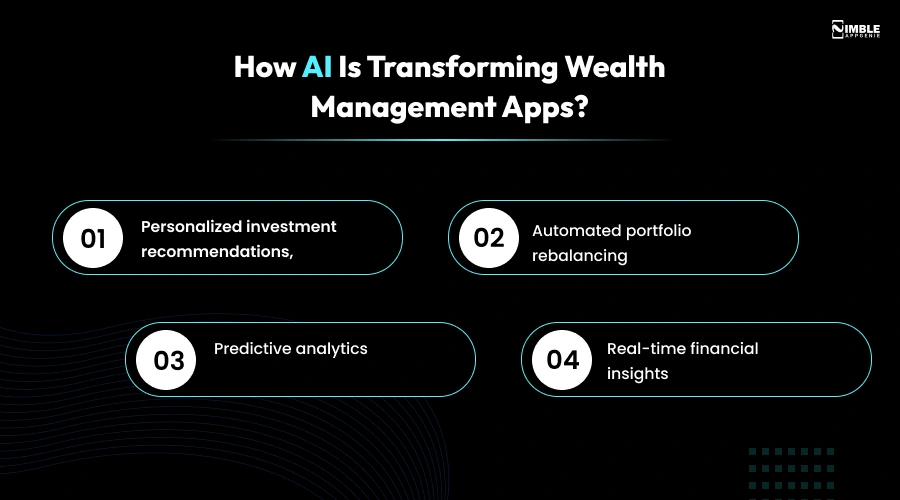
AI transforms wealth management apps by allowing them to deliver:
- Personalized investment recommendations,
- Automated portfolio rebalancing
- Predictive analytics
- Real-time financial insights
AI in wealth management redefines financial services by enabling fintech platforms, investment firms, and banks to process large financial datasets and generate real-time insights for market investment decisions.
Financial institutions integrate AI-powered wealth management app capabilities into their business to deliver predictive investment analysis, automated portfolio management, and personalized financial experiences.
The AI in financial planning and analysis market is projected to grow by USD 48.87 billion between 2024 and 2029, registering a compound annual growth rate (CAGR) of 26.9%. North America rules the market and is responsible for around 40% growth during the 2025-2029 period. This growth is primarily driven by rising business volatility and the increasing demand for greater agility in financial decision-making.
1. Personalized Investment Recommendations
AI algorithms thoroughly analyze user behavior, risk tolerance, historical market trends, and financial goals to suggest customized portfolio strategies tailored to every investor.
2. Automated Portfolio Rebalancing
AI systems constantly track asset allocation and adjust portfolios automatically to maintain optimal diversification and risk-return balance.
3. Predictive Analytics
Machine learning models recognize patterns in market data, offer proactive investment insights, and forecast potential risks to help users make sound financial decisions.
4. Real-time Financial Insights
Advanced AI models evaluate investment opportunities and financial markets, and deliver real-time financial insights through intelligent dashboards for financial advisors and investors.
With the continuous growth of AI adoption, wealth management apps are becoming more data-driven, intelligent, and competent to deliver hyper-personalized investment experiences.
What are the Key Features of an AI-Powered Wealth Management App
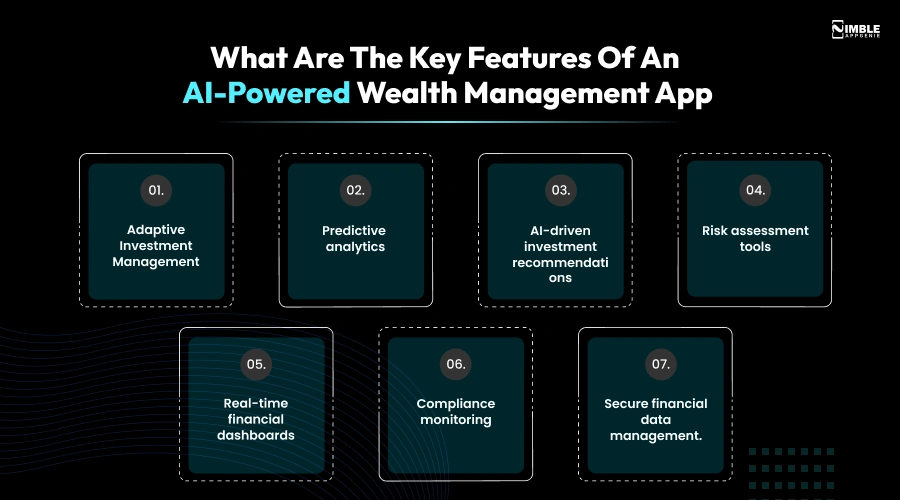
Key features of an AI investment app include:
- Adaptive Investment Management
- Predictive analytics
- AI-driven investment recommendations
- Risk assessment tools
- Real-time financial dashboards
- Compliance monitoring
- Secure financial data management.
AI wealth management requires integrating intelligent features that analyze financial data in real-time, automate investment processes, and deliver personalized portfolio management.
Below are the core features of an AI-powered wealth management app that enables predictive investment insights, smarter portfolio management, and automated financial planning.
| Features | Description | AI Role in Wealth Management Apps |
| AI-Driven Portfolio Management | Enables users to track investment performance, asset allocation, and portfolio growth through a centralized dashboard. | AI analyzes portfolio performance and suggests optimized allocation strategies based on market conditions and user goals. |
| Personalized Investment Recommendations | Provides tailored investment suggestions based on financial goals, investment history, and risk tolerance. | AI algorithms analyze user behavior and market trends to recommend personalized portfolio strategies. |
| Predictive Market Analytics | Offers insights into market trends, asset performance, and potential investment opportunities. | Machine learning models analyze historical financial data to forecast market movements and potential risks. |
| Automated Portfolio Rebalancing | Ensures portfolio allocation stays aligned with the user’s preferred risk level and investment strategy. | AI continuously monitors asset distribution and automatically rebalances portfolios when market fluctuations occur. |
| Smart Risk Assessment | Evaluates the risk profile of each investor to suggest suitable investment strategies. | AI models analyze spending behavior, financial goals, and investment history to determine risk tolerance. |
| Real-Time Financial Insights & Dashboards | Displays real-time analytics, investment performance reports, and portfolio summaries. | AI-driven analytics engines process financial data instantly to provide actionable insights through interactive dashboards. |
| Robo-Advisory Capabilities | Provides automated financial guidance and investment management without human advisors. | AI-powered robo-advisors automate asset allocation, portfolio management, and long-term financial planning similar to platforms like Betterment and Wealthfront. |
| Security & Compliance Management | Protects sensitive financial data and ensures regulatory compliance. | AI systems detect suspicious activity, prevent fraud, and strengthen compliance with financial regulations. |
Including these AI-powered features, you can make your wealth management apps streamline investment decisions, deliver intelligent financial insights, and offer highly personalized portfolio management experiences for modern investors.
Step-By-Step Development Process of an AI Wealth Management App
How to build an AI wealth management app?
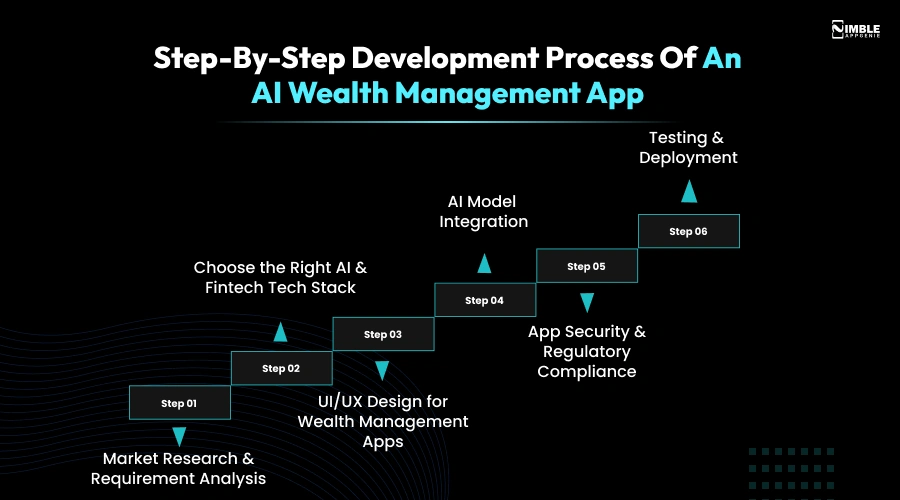
- Step 1: Market Research & Requirement Analysis
- Step 2: Choose the Right AI & Fintech Tech Stack
- Step 3: UI/UX Design for Wealth Management Apps
- Step 4: AI Model Integration
- Step 5: App Security & Regulatory Compliance
- Step 6: Testing & Deployment
You can develop an AI-powered wealth management app by integrating artificial intelligence, predictive analytics, and fintech expertise to deliver personalized investment insights and automated portfolio management.
Below, let’s have a walk-through of a step-by-step process highlighting the key stages to create a scalable, competitive, and intelligent wealth management platform.
Step 1 – Market Research & Requirement Analysis
Before creating an app, you should conduct deep market research to understand competitive apps, user needs, and fintech trends. Identify the core functionalities needed for predictive analytics, portfolio management, compliance requirements, and automated investment recommendations.
This phase ensures your AI wealth management app aligns with investor expectations and business goals.
Step 2 – Choose the Right AI & Fintech Tech Stack
It’s crucial to select the right tech stack for AI financial apps. So, leverage AI frameworks like fintech-ready backend technologies like Node.js, Python, or cloud-based infrastructure for scalable performance, and TensorFlow or PyTorch for predictive analytics.
Considering integrating APIs for banking services, payments, and market data. By following an AI wealth management platform development guide, you can ensure your app is well-optimized for AI-driven features and future scalability.
Step 3 – UI/UX Design for Wealth Management Apps
Designers craft an intuitive, user-centric interface that eases investment management and boosts engagement. Remember to focus on the user experience for finance apps with interactive charts, intuitive dashboards, and clear insights.
Includes investment app personalization algorithms to tailor alerts, recommendations, and notifications per individual investor profiles.
Step 4 – AI Model Integration
By integrating AI models, you can strengthen portfolio optimization, robo-advisory features, and predictive analytics. AI algorithms analyze market trends, historical financial data, and user behavior to offer real-time insights and automated investment recommendations.
Here, the app transforms from a digital tool to an intelligent wealth management platform.
Step 5 – App Security & Regulatory Compliance
Ensure AI-based security for financial apps by implementing multi-factor authentication, encryption, and fraud detection mechanisms.
Fintech firms must integrate regulatory compliance checks to meet local financial regulations and AI regulatory compliance standards, protecting user data and financial transactions.
Step 6 – Testing & Deployment
Test the app thoroughly for performance, functionality, and AI precision. Perform beta testing with real users and simulate different market scenarios to ensure recommendations and portfolio predictions are reliable.
Once you validate your AI-powered wealth management app, deploy it on mobile and web platforms by consistently monitoring performance and updating AI models with the evolving market trends.
Simply put, a step-by-step guide to building an AI finance app helps you plan, design, and deploy an AI-powered wealth management app with predictive analytics, personalized recommendations, compliance operations, and real-time portfolio adjustment.
Which Tech Stack is Best for AI Wealth Management Apps?
The tech stack that combines frontend, backend, AI/ML frameworks, cloud infrastructure, databases, and security tools ensures the development of an app that delivers predictive analytics, automated asset strategy, and personalized investment recommendations effectively.
When you select the best tech stack for an AI wealth app, you should know it impacts real-time analytics, AI performance, integration capabilities, and user experience. Thus, you can create a scalable platform for banks, fintech startups, and investment firms.
► Tech Stack for AI-driven Investment Solutions
| Layer | Recommended Technologies | Purpose / AI Role |
| Frontend | React.js, Angular, Flutter, React Native, D3.js, Chart.js | Build interactive dashboards, responsive mobile apps, and real-time portfolio visualizations |
| Backend | Node.js, Python (Django/Flask), Java/Spring Boot, GraphQL, REST APIs | Scalable server-side operations, data integration, and AI service hosting |
| AI / Machine Learning | TensorFlow, PyTorch, Keras, Scikit-learn | Predictive analytics, portfolio optimization, robo-advisory features, risk scoring |
| Database / Storage | PostgreSQL, MySQL, MongoDB, Redis, Memcached | Store structured and unstructured financial data; enable fast analytics and caching |
| Cloud & DevOps | AWS, Google Cloud, Azure, Docker, Kubernetes, CI/CD pipelines | AI model hosting, scalable infrastructure, containerization, continuous deployment |
| Security & Compliance | End-to-end encryption, OAuth 2.0, JWT, and AI-based monitoring tools | Secure user data, prevent fraud, ensure regulatory compliance, and AI-driven monitoring |
Cost & Timeline to Build an AI Wealth Management App
How much does an AI finance app cost to build?
The cost of digital wealth app development starts from $20,000 and goes up to $100,000 for an MVP development. It includes core features like basic AI-driven investment recommendations, portfolio tracking, and simple analytics, which takes 3 to 5 months.
On the other hand, a full-featured AI-powered wealth management app with automated portfolio rebalancing, predictive analytics, compliance modules, and real-time dashboards can range from $150,000 to $300,000+. It needs 6 to 12 months to launch.
The cost of developing an AI-driven financial solution is affected by several factors, including the number of integrations, the complexity of AI algorithms, regulatory compliance requirements, security, and the scale of personalization features.
By planning for such variables, investment firms and fintech companies can build cost-effective and intelligent AI wealth management apps that meet user expectations and business objectives.
► A Quick Scan of Cost & Timeline to Build an AI Wealth Management App
| App Type | Core Features | Estimated Cost | Development Timeline |
| MVP | Basic AI-driven investment recommendations, portfolio tracking, and simple analytics | $20,000 – $100,000 | 3–5 months |
| Full-Featured App | Predictive analytics, automated portfolio rebalancing, real-time dashboards, and compliance modules | $150,000 – $300,000+ | 6–12 months |
► A Swift Review of Factors Affecting the Cost to Develop an AI Wealth Management App
| Factors | Description |
| AI Complexity | Sophisticated AI algorithms for predictive analytics, robo-advisory, and personalization. |
| Integrations | Number and type of integrations: banking APIs, payment gateways, market data feeds. |
| Features | Range and depth of app functionalities, including dashboards, alerts, and portfolio management tools. |
| Compliance & Security | Regulatory compliance measures, encryption, fraud detection, and secure transactions. |
| Scalability & Personalization | Level of user-specific customization and ability to scale for multiple users or markets. |
Challenges of Developing AI-Powered Wealth Management Apps and Solutions
Building intelligent financial platforms involves various challenges, such as:
- Data privacy,
- Complex AI integration,
- User trust, and
- Scalability.
Effectively address these to ensure your app delivers reliable investment solutions for fintech startups, investment firms, and banks.
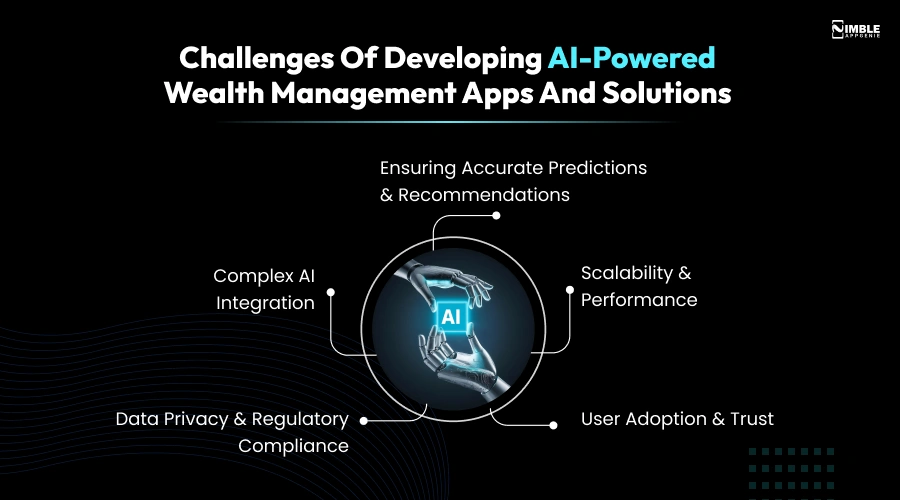
Challenge #1. Data Privacy & Regulatory Compliance
Solution: To do this, you need to implement AI-based security for finance apps, including multi-factor authentication, encryption, and real-time fraud detection. Also, integrate compliance checks into the constantly updating policy and development lifecycle to ensure AI regulatory compliance and meet dynamic financial regulations.
Challenge #2: Complex AI Integration
Solution: Follow a structured AI app development framework using financial data APIs, modular AI models, and automation tools to integrate gradually predictive and advisory functionalities without hindering app performance.
Challenge #3: Ensuring Accurate Predictions & Recommendations
Solution: In a finance app, remember to use clean, varied datasets and advanced predictive analytics. Consistently train and validate AI models to boost precision and ensure that investment insights stay reliable and actionable.
Challenge #4: Scalability & Performance
Solution: During digital wealth management solution design, optimize architecture, utilize cloud-based services, and design AI pipelines to ensure AI-powered financial app scalability without disrupting speed or reliability.
Challenge #5: User Adoption & Trust
Solution: Create transparent interfaces that provide personalized financial planning tools and explain AI-driven recommendations. Educate users on how AI in wealth management reinforces data-driven investment decisions.
Why Choose Nimble AppGenie for Building an AI Wealth Management Platform
Nimble AppGenie is a reliable AI-based wealth management app development company helping fintech startups, banks, and investment firms launch intelligent financial platforms.
With years of experience in AI integration, fintech architecture, and regulatory compliance, a fintech app development company can help you attain the proficiency in fintech architecture, regulatory compliance, and AI integration required for AI wealth management platforms.
The team of AI experts provides services for custom fintech solutions, combining their proficiency, secure financial infrastructure and predictive analytics to create solutions that streamline investment management and improve financial decision-making.
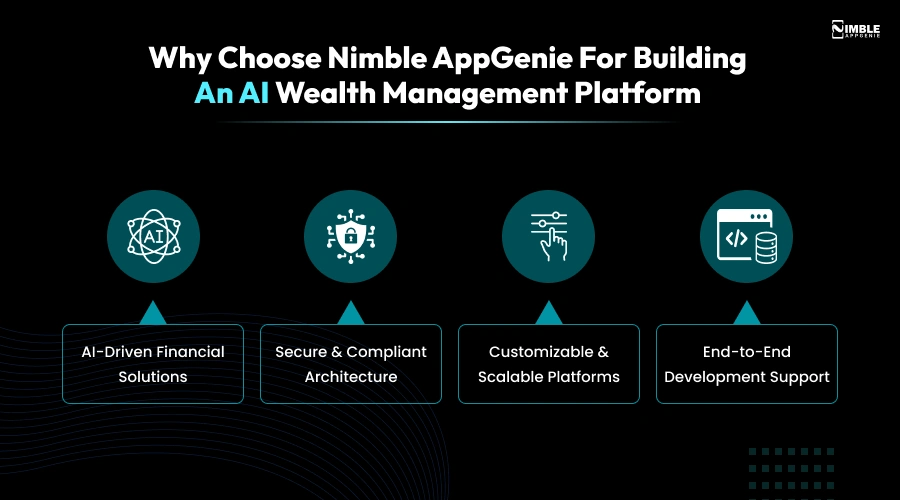
What Makes Us a Trusted Partner
- AI-Driven Financial Solutions
- Secure & Compliant Architecture
- Customizable & Scalable Platforms
- End-to-End Development Support
Contact Nimble AppGenie to create secure AI wealth management apps for your fintech businesses and deliver personalized data-driven investment insights.
A fintech client partnered with an AI wealth management developer to integrate predictive analytics and automated portfolio management, resulting in increased efficiency gains.
Let’s check below.
Case Study: AI-Powered Wealth Management App Implementation
- Client: Confidential Fintech Platform (Name withheld due to NDA)
- Industry: Digital Wealth Management
- Solution: AI-Powered Wealth Management App
Challenge:
The client wanted to build an AI-powered wealth management app to deliver streamlined portfolio management and personalized investment strategies. Their existing system was dependent on manual financial analysis, which made it challenging for them to generate real-time insights, handle large datasets, and scale advisory services for an expanding user base.
Solution We Offered:
- An AI-driven wealth management platform designed with intelligent portfolio optimization, predictive analytics, and automated advisory features.
- Machine learning algorithms that analyze historical market data, investor behavior, and risk profiles to generate personalized portfolio strategies.
- AI-based portfolio rebalancing automatically adjusted asset allocations in response to market fluctuations and individual investor goals.
- Real-time dashboards and predictive analytics modules that provide actionable insights for investors and financial advisors, promoting faster, smarter decision-making.
Results Attained:
The AI-powered fintech platform we created delivered:
- Personalized investment recommendations,
- AI investment app features
- Predictive analytics in finance apps
- Dynamic portfolio management, and
- Scalable financial advisory services.
With consistent financial data analysis, the platform diminished manual workload, improved investment precision, and enhanced user experience for investors handling diversified portfolios.
Note: This case showcased how AI in wealth management apps can improve traditional financial platforms into automated ecosystems, holding the caliber of personalized financial planning, predictive analytics, and continuous portfolio optimization.
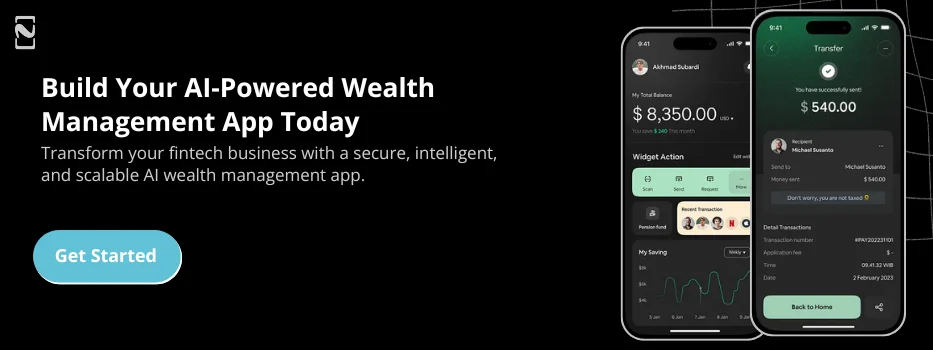
Future Trends in AI-Powered Wealth Management Apps
The future of AI-powered wealth management apps is moving toward more intelligent, predictive, and personalized financial platforms:
- NLP-Based Customer Support
- Predictive Investment Analytics
- Hyper-Personalized Investment Portfolios
- Generative AI for Investment Strategies
- Sentiment Analysis from News & Social Media
- Blockchain Integration for Transparency & Security
- NLP-Based Customer Support & Virtual Advisors
Besides adopting AI in wealth management to transform digital investment platforms, modern fintech companies are integrating advanced AI investment app architecture to deliver automated portfolio management, intelligent insights, and highly personalized investment experiences.
In 2026, you will witness the AI-powered investment platform trend evolve, and AI-powered wealth apps become more user-focused, scalable, and predictive.
1. NLP-Based Customer Support
Natural Language Processing (NLP) will activate virtual advisors and AI-driven chatbots in wealth management apps. These tools explain portfolio performance, answer financial queries, and offer real-time guidance, boosting customer engagement and mitigating operational workload.
2. Predictive Investment Analytics
AI-powered wealth platforms will more and more use predictive analytics to analyze economic signals, market patterns, and user behavior. This empowers the apps to automate portfolio adjustments and forecast investment opportunities based on real-time financial insights.
3. Hyper-Personalized Investment Portfolios
In the future, AI wealth apps will build hyper-personalized portfolios by deeply analyzing user objectives, spending habits, risk tolerance, and financial history. These intelligent systems consistently refine investment strategies to align with the dynamic market conditions and user goals.
4. Generative AI for Investment Strategies
Generative AI will create personalized portfolio recommendations, simulate market scenarios, and draft predictive investment strategies. Investors can explore multiple “what-if” scenarios to make data-driven decisions confidently.
5. Sentiment Analysis from News & Social Media
AI platforms will analyze financial news, social media, and market reports to gauge market sentiment. This enables proactive portfolio adjustments and helps investors anticipate market trends.
6. Blockchain Integration for Transparency & Security
Blockchain will provide secure, immutable records of transactions, enforce investment rules via smart contracts, and enhance compliance. This builds trust between users and financial institutions.
7. NLP-Based Customer Support & Virtual Advisors
Natural Language Processing (NLP) will power virtual advisors and chatbots that explain portfolio performance, answer queries, and provide instant guidance, boosting engagement and reducing operational load.
These advancements demonstrate how AI-driven wealth management platforms will deliver automated investment experiences and smarter financial planning tools in the coming years.
Conclusion
AI wealth management platforms allows banks, investment firms, and fintech startups to deliver self-adjusting investment portfolios, personalized financial planning, and predictive investment insights.
Businesses can integrate AI in finance to enhance decision-making, improve user experience, and develop scalable digital wealth platforms.
By following a structured AI-powered investment solution development process, you can ensure the creation of a future-ready investment platform.
If you are planning to build an AI-powered wealth management app, hiring experienced fintech developers can ensure smooth AI implementation and accelerate development.
Looking to build a custom AI wealth management platform? Connect with Nimble AppGenie to develop intelligent fintech solutions tailored to your business goals.
FAQs
- Intelligent portfolio oversight
- Predictive analytics
- AI-driven investment recommendations
- Risk assessment tools
- Real-time financial dashboards
- Compliance monitoring
- Secure financial data management

Niketan Sharma, CTO, Nimble AppGenie, is a tech enthusiast with more than a decade of experience in delivering high-value solutions that allow a brand to penetrate the market easily. With a strong hold on mobile app development, he is actively working to help businesses identify the potential of digital transformation by sharing insightful statistics, guides & blogs.
Table of Contents




No Comments
Comments are closed.