


Artificial Intelligence (AI) is no longer a niche technology; with time, it has become a revolutionary global force, reshaping major industries like healthcare, logistics, finance, manufacturing, retail, and beyond.
The swift advancements in generative AI, machine learning, AI-driven analytics, and automation are making the AI market witness exponential growth, clearing the path for remarkable opportunities and new business models.
With the accelerating digital transformation by organizations, businesses are acknowledging AI as their core investment priority instead of an avant-garde concept.
Startups, investors, and businesses should understand AI market statistics to be clear about the focus of the industry in 2026, which sectors will rapidly scale, and where they can find the biggest opportunities and risks.
Precise insights will help companies to make informed tech decisions, startups to lead the pack in a thriving AI-driven economy, and investors to unveil high-growth areas.
Essentially, the AI market forecast 2026 offers data-backed transparency required to reap the rewards of the fastest-growing industries worldwide.
This post will reveal the latest AI industry statistics to save you time for other, more valuable jobs
AI Market Overview
An array of technologies that fortifies computers’ learning and reasoning, makes them perform various advanced tasks that demand human intelligence, like analyzing data, understanding language, and even offering helpful suggestions.
Modern AI incorporates machine learning, deep learning, generative AI, computer vision, NLP, intelligent automation, and robotics technologies that enable businesses to perform smarter, faster, and more effectively.
The included algorithms and models allow systems to pinpoint patterns, solve complex issues, and adapt beyond basic programming.
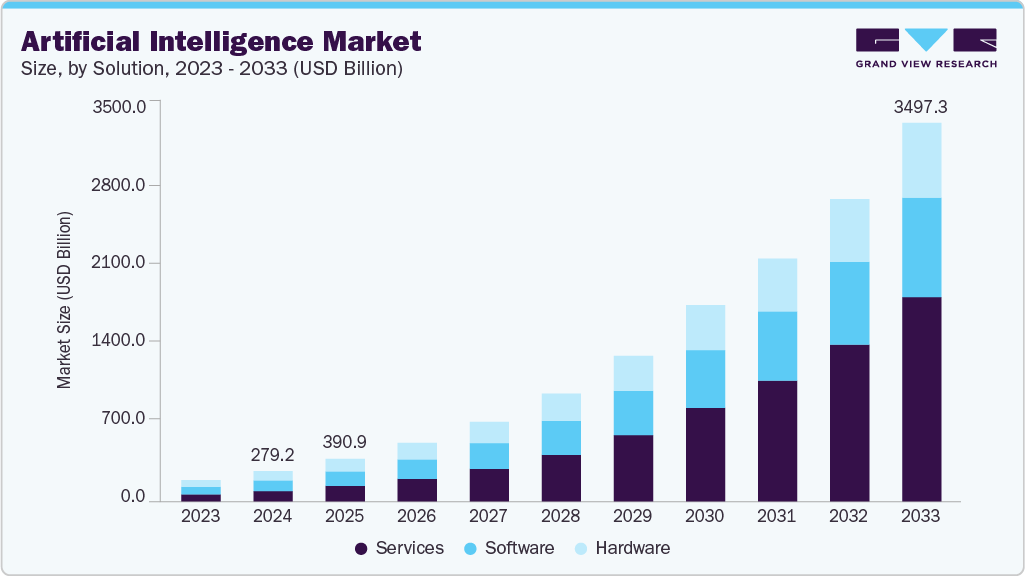
| A report by Grand View Research says the global AI market size will likely reach $3,497.26 billion in 2033 at a CAGR of 31.5% from 2025 to 2033, up from $279.22 billion as recorded in 2024. |
♦ Global AI Market Size Statistics
- 2024: $279.22 billion (Grand View Research)
- 2025: $371.71 billion (Markets and Markets)
- 2032: 1,771.62 billion (Fortune Business Insights)
- 2033: $3,497.26 billion (Grand View Research)
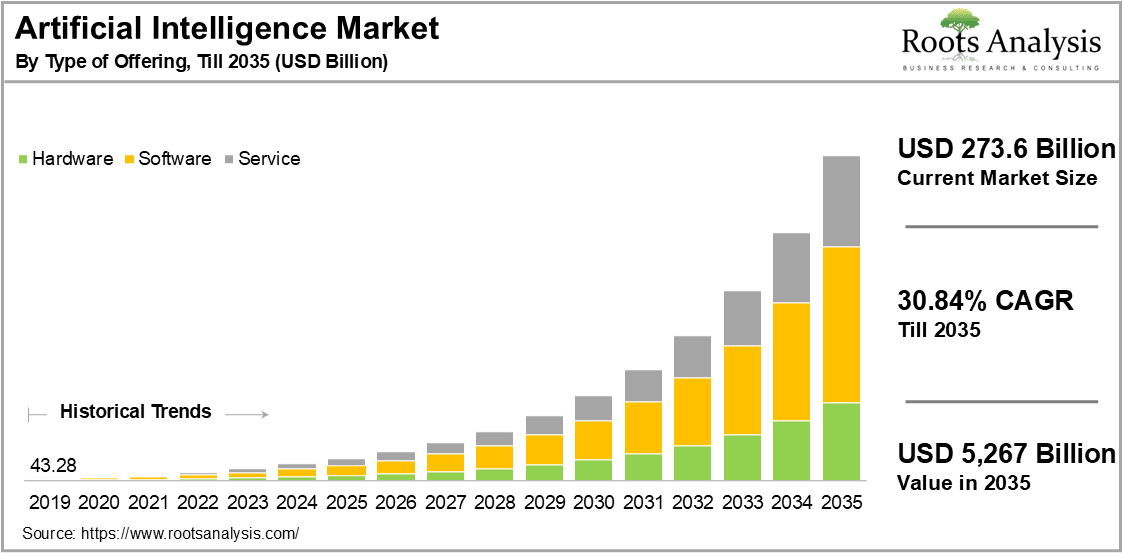
- 2035: $5,267 billion (Roots Analysis)
-
♦ AI Market CAGR (Compound Annual Growth Rate)
- 2025-2032: 29.2% (Fortune Business Insights)
- 2025-2033: 31.5% (Grand View Research)
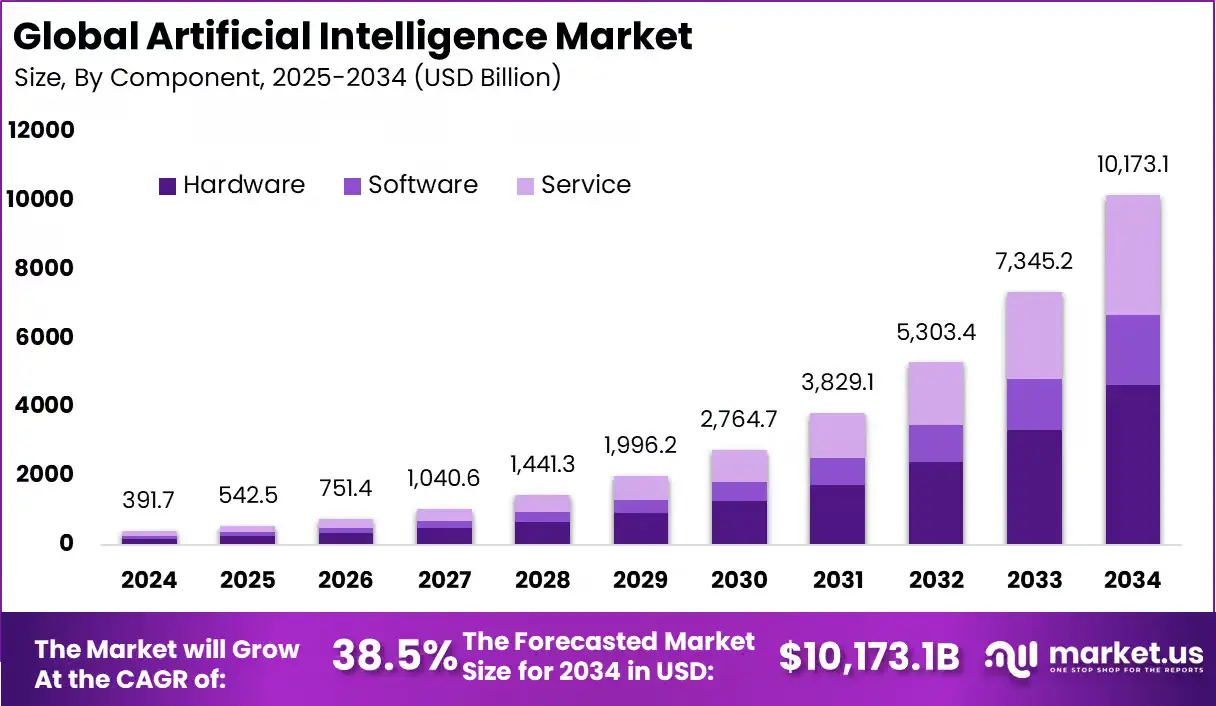
- 2025-2034: 38.50% (Market.US)
Key AI Market Statistics
Let’s break down section-wise to see the artificial intelligence market growth in every corner :
► AI Adoption Statistics
- AI adoption in SMBs and enterprises is swiftly increasing, with reports showing that about 83% are already using it, with 75% of SMBs experimenting with AI.
| Microsoft reports that 85% of Fortune 500 companies are leveraging the benefits of AI. |
- On the contrary, 78% of SMBs are planning to elevate their AI investment trends in the coming years.
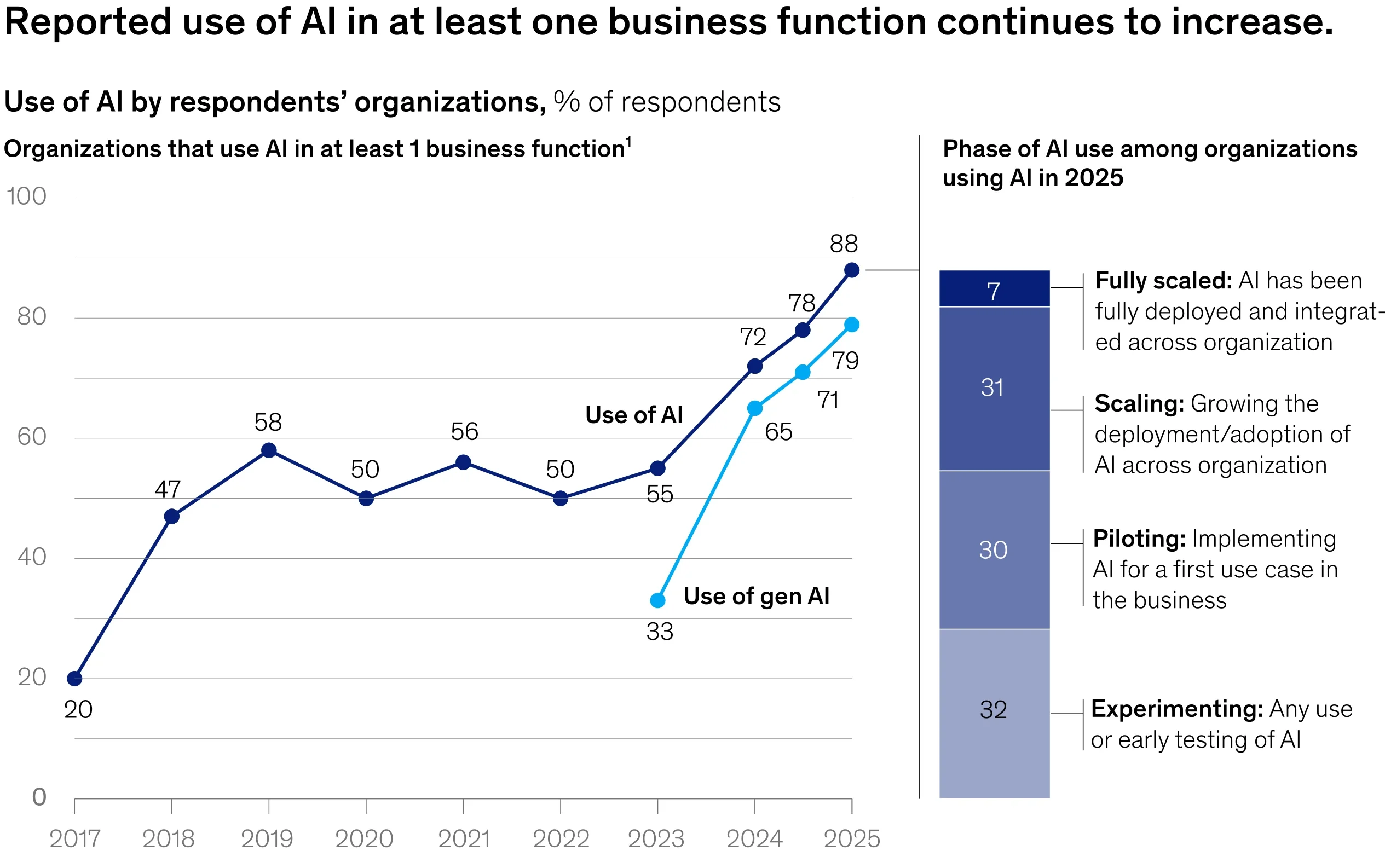
- According to McKinsey, large enterprises have high AI adoption rates, with approximately 88% globally having already chosen AI to perform at least one function.
► AI Investment & Funding Statistics
♦ Corporate R&D Spending
It’s increasing, specifically in AI. Talking about India, high performers, around 1/3rd invest 20% and even more of their digital budget to leverage AI technologies.
♦ VC Funding
AI startups got over 50% of worldwide venture funding in the third quarter of 2025, for the first time this year. And, the funding hit $310 billion by Q3.
♦ AI Startup Stage
The generative AI startups are growing and have witnessed a 3.7 times increase in startup formation. That’s why GenAI app development is very much in trend these days.
► AI Technology Segment Statistics
♦ Generative AI Statistics
Between 2025 and 2027, about 92% of businesses plan to increase their investments. Deloitte predicts that 25% of companies using GenAI will deploy intelligent agents by 2025, making the number double by around 50% by 2027.
♦ Machine Learning
In 2025, the machine learning segment has captured around 40% of share and is predicted to experience the highest CAGR of about 32.60% holding the capability to improve precision and attain accuracy in various tasks.
♦ NLP
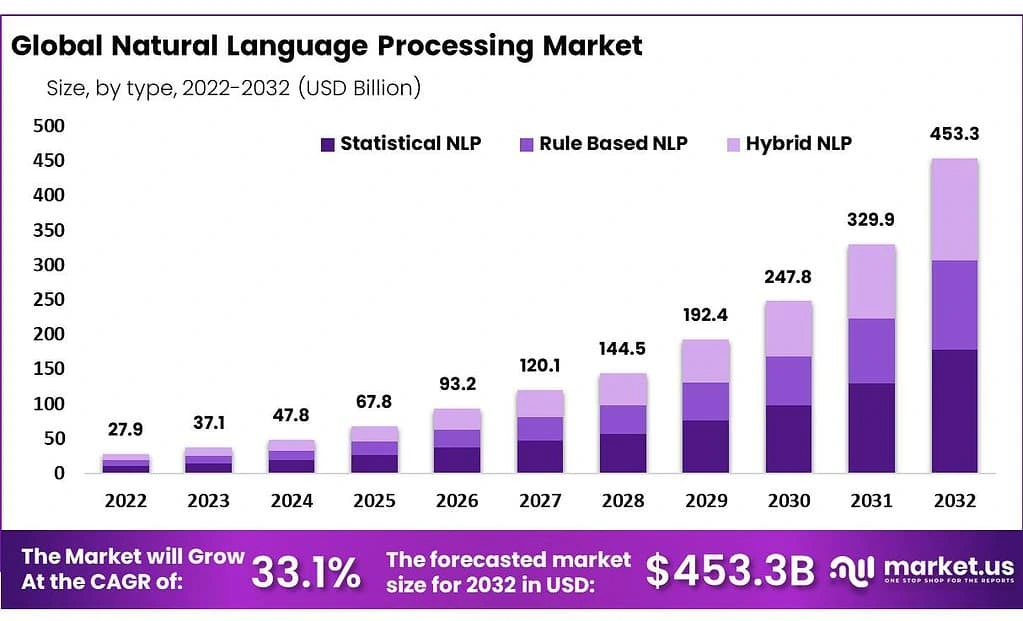
A survey conducted by Market.us showed that by 2032, the NLP market will likely be valued at $453.3 billion.
♦ Computer Vision
In 2024, the global computer vision market expanded to $17.84 billion, and it will likely hit $58.33 billion by 2032 at a CAGR of around 15.9%.
♦ Robotics
The global robotics market is anticipated to be valued at $185.37 billion by 2030 at a CAGR of 20.28%.
AI Workforce Statistics
Currently, the AI workforce is distinguished by a consistent talent shortage globally and notable salary premiums for talented professionals.
♦ Job Growth
As almost every industry demands AI specialists, this has led to an elevated job growth rate.
- A global AI market report by the World Economic Forum expects a fall in jobs, showcasing that AI will increase job creation by 2027.
- The World Economic Forum published the Future of Jobs Report 2025, which unveils that by 2030, the layoffs will be around 22% with the creation of around 170 million new roles and 92 million replaced, consequently a boost in 78 million jobs.
♦ AI Talent Shortage
We witnessed a surge in jobs, but despite that, qualified talent is still not maintaining pace with demand, which is resulting in a great skills gap.
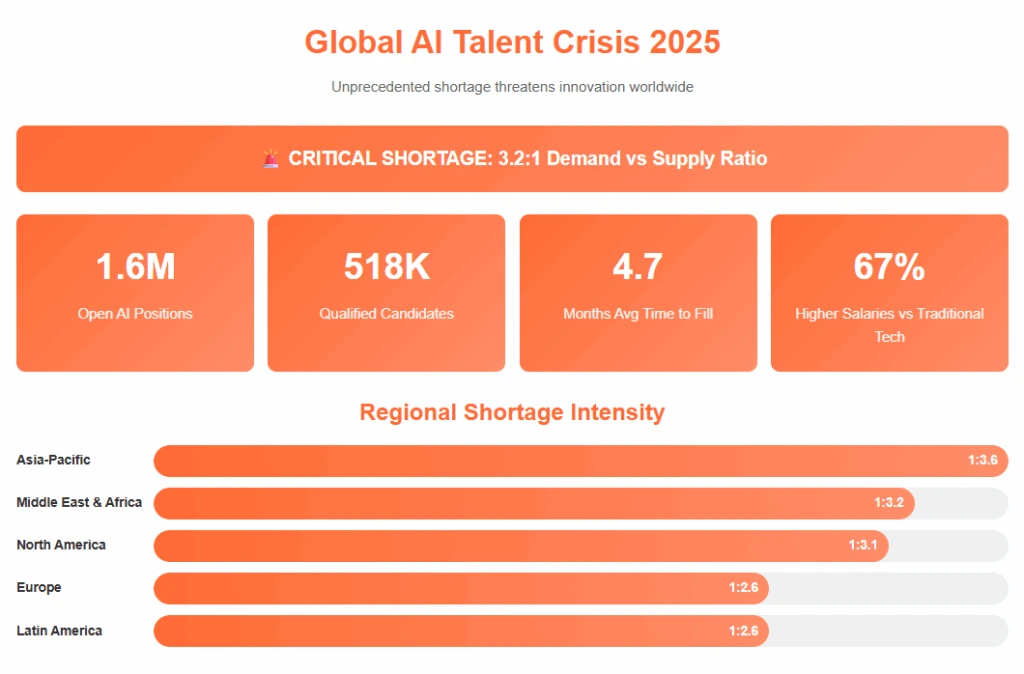
- The ratio of AI talent demand to the available supply was recorded to be 3.2:1, with 1.6+ million open positions, out of which only 518K available qualified candidates.
- The areas that are experiencing key shortages are MLOps (Machine Learning Operations), AI ethics, and Large Language Model (LLM) development.
- Eyeing the figures, nearly 76% of giants report a critical insufficiency of AI talent that stretches the average time-to-fill for AI positions up to 4.7 months worldwide.
♦ Salary Demand
As AI skills are rare in the industry, the competition is too intense, which has led to a year-over-year increase in salary demand.
- AI professionals with in-demand skills typically earn 20 to 30% more compared to similar roles with no such specific skills. However, some professional roles witness premiums of around 56% or even more.
- In the US, an AI professional’s average salary is approximately. $160,000 every year, with senior roles earning $200,000 and more.
- Talking about the top earners, AI Research Scientists and AI Product Managers are the roles that can ask for $250,000 to over $500,000 annually at leading tech firms.
Consumer AI Usage Statistics
Consumers are increasingly using AI tools, like chatbots and virtual assistants, with a robust presence for their quick responses and round-the-clock availability. Overall, over 2/3rd of consumers worldwide have interacted with such AI tools in the last year.
➤ Chatbots
- By 2030, the global chatbot market is expected to expand to $27.29 billion, climbing at a CAGR of 23.3% with a CAGR of 23.3%.
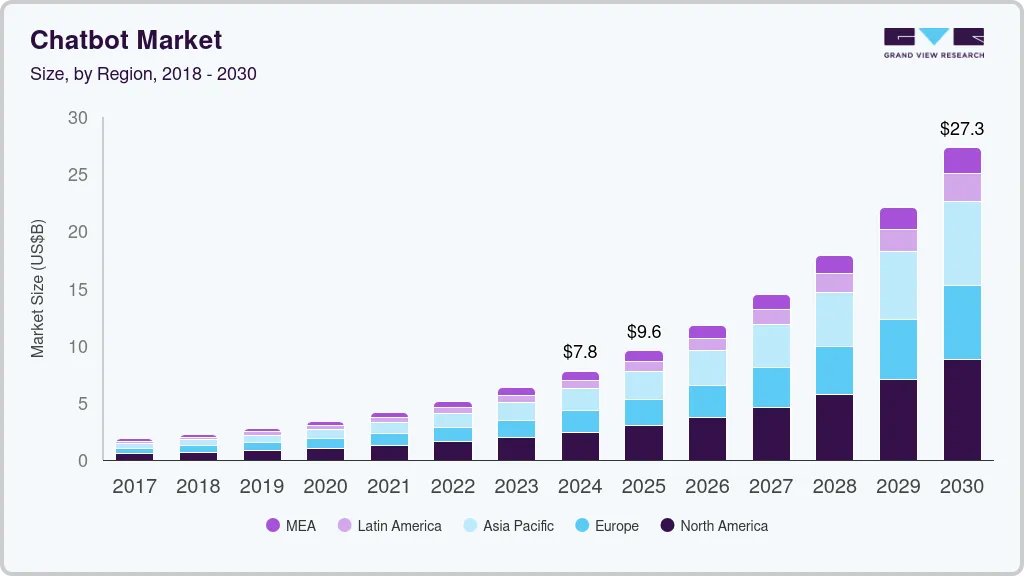
- The key drivers for the increasing adoption of chatbot solutions are consumer preferences for prompt and personalized interactions.
- As businesses utilize bots for managing routine jobs and diminishing costs, customer service and support are anticipated to remain the top application areas.
- E-commerce and retail industries hold a huge market share when considering chatbot adoption in these industries. But the HR and healthcare sectors are witnessing a swift growth in the adoption.
➤ Virtual Assistants
AI-enabled virtual assistants, such as Google Assistant, Alexa, and Siri, are increasingly linked to daily life, specifically in home settings.
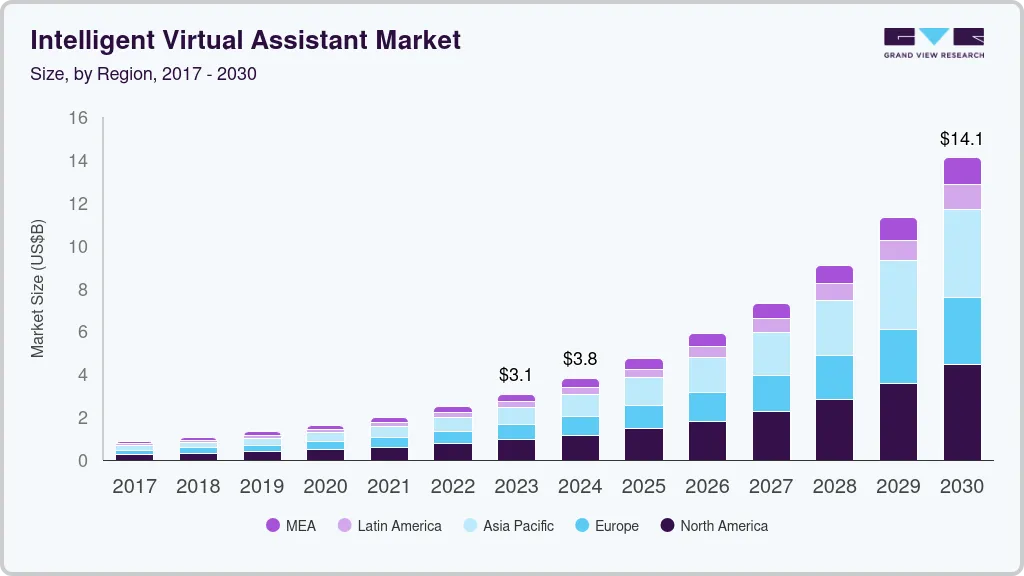
- According to Grand View Research, the global intelligent virtual assistant market is predicted to be valued at $14.10 billion by 2030, up from $2.48 billion as recorded in 2022 at a CAGR of 24.3%.
-
- The virtual assistant market leaders are Alexa by Amazon, Google Assistant, and Siri by Apple, with 44%, 33% and 30% respondents rating them for intelligence, respectively.
- Per a survey conducted by PWC, 50% of respondents chose a voice assistant to make a purchase, and about 25% more are planning to prefer this in the future.
➤ Automation Tools
Consumers go for AI automation tools when their needs extend from simple assistants to more complicated aspects of learning, personal finance, and work.
- About half of professional developers are using AI tools to increase productivity and handle repetitive tasks.
- US adults are leveraging the power of AI for their routine tasks, like managing to-do lists (18%), meal planning (16%), and writing emails (19%).
- 16% of people use AI for their personal financial management, which reveals an edge of possible future growth.
Industry-Wise AI Adoption Statistics
The latest AI market statistics for businesses from different industries are rapidly growing from simple pilot programs to comprehensive implementations.
1] Healthcare
Adoption of AI in healthcare is mounting, reshaping diagnostics, administrative efficiency, and patient care.
- The Strategic Market Research report says the global market size for AI in healthcare is forecasted to intensify and reach around $197.9 billion by 2030 at a CAGR of 41.7%.
- Annually, AI-driven remote patient monitoring will likely save $200 billion worth of the healthcare industry by 2028.
- A JAMA Network Open study found that physicians reduced 30% time spent on EHRs and 30% after-hours charting, utilizing an AI assistant for documentation.
- Private investment in AI for healthcare has increased eightfold.
2] Finance
The finance industry reaps the rewards of AI, notably for risk assessment, customer service, and security.
- The AI in Finance market is predicted to escalate to $190.33 billion by 2030, at a CAGR of 30.6%.
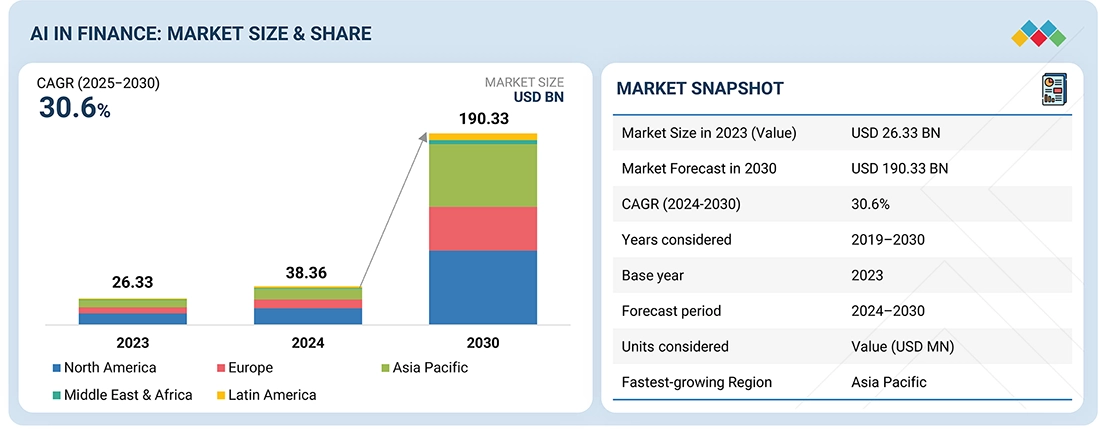
- An increasing number of financial institutions are choosing generative AI, cloud-native AI platforms, and real-time analytics to update legacy systems, diminish costs, and deliver personalized services.
- 80% and more firms plan to soar AI investments, integrating predictive and generative AI, and improving model governance to drive innovation and operational efficiency.
3] Retail & E-commerce
- By 2032, the AI-powered eCommerce market is projected to expand and reach $22.6 billion by 2032.
- Businesses are likely to augment their profits leveraging AI by about 60% by 2035.
- Nearly a third of online retailers are predicted to use advanced AI agents by 2028, which is less than 1% today.
- AI-driven personalization helps boost marketing outcomes, with a caliber for up to 40% increased email open rates and 15% higher conversions by tailoring content to every individual.
4] Manufacturing
AI in manufacturing is pacing with the support for Industry 4.0, especially in predictive maintenance and smart factories.
- The enterprise AI adoption rate in the manufacturing market is projected to hit $337.88 billion by 2035, at a CAGR of nearly 45.43%.
- Predictive analytics and machine learning are the chief technologies chosen for supply chain optimization and quality control.
- Manufacturers are leveraging AI-powered robots and computer vision systems to boost production efficiency and pinpoint imperfections, with giants reporting a 20-30% reduction in levels because of AI.
5] Education
AI in education is diminishing the administrative burdens of educators and offering personalized learning experiences.
- 60% or more of institutions are now including AI tools for administrative efficiency and personalized learning.
- In pilot programs, AI personalized learning has increased the course completion rate by 70% to traditional methods.
- 83% of K-12 teachers utilize generative AI for schoolwork or personal tasks; on the other hand, students feel more motivated with AI-enabled personalized learning.
6] Logistics & Transportation
The logistics and transportation sector opt for AI to manage inventory, optimize routes, and improve overall operational efficiency.
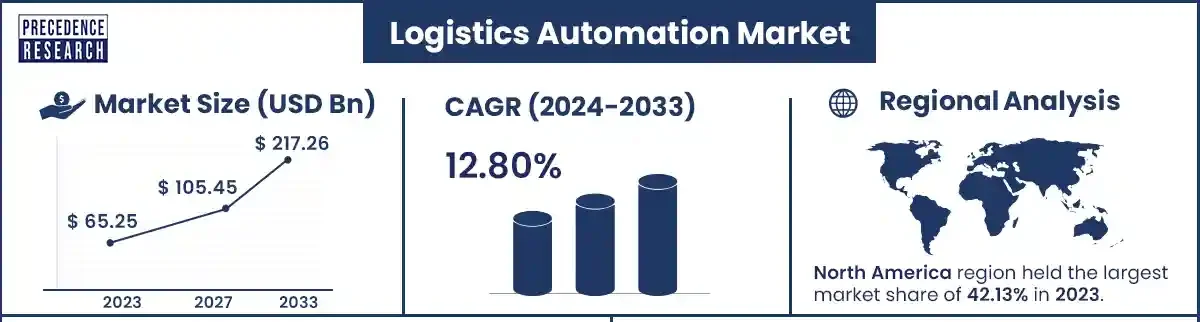
- The logistics automation market is surging at a CAGR of 12.8%, strongly focusing on intelligent systems and warehouse robotics to manage increasing e-commerce demands.
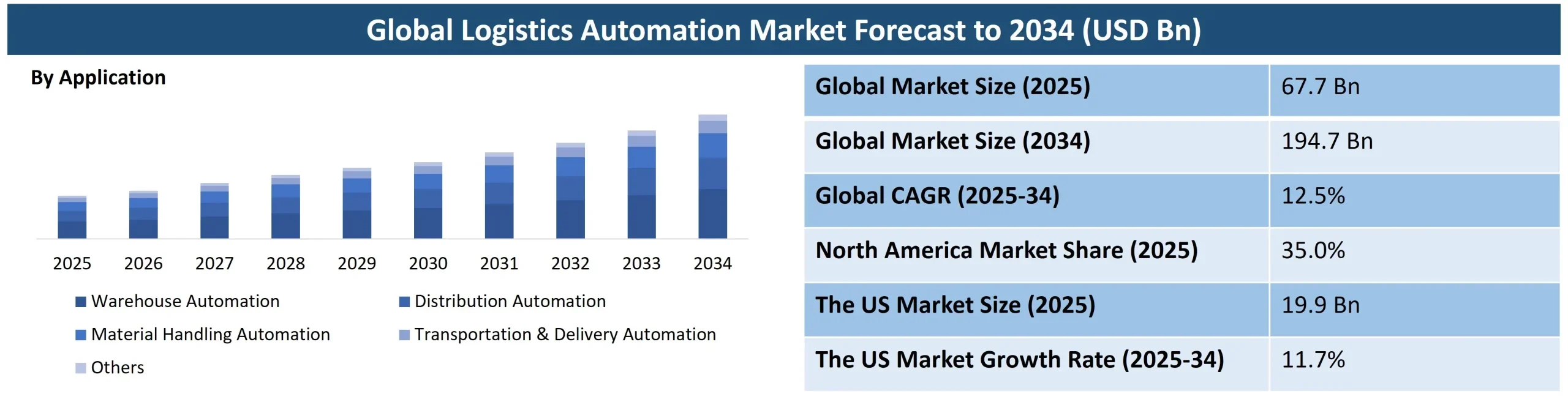
- The global logistics automation market is predicted to expand and reach $194.7 billion by 2034, registering a powerful CAGR of 12.5%.
Generative AI Market Statistics
After going deeper into AI market statistics, let’s take a dive into generative AI statistics.
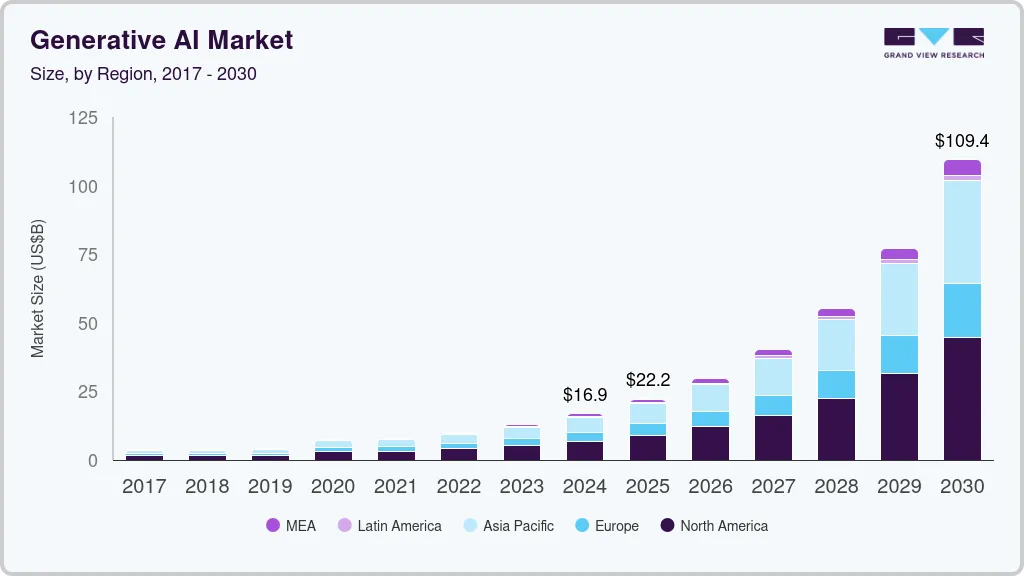
- The global generative AI market is projected to be valued at $109.37 billion by 2030, at a CAGR of 37.6%.
- Generative AI holds the caliber to boost labor productivity from 0.1 to 0.6% annually by 2040, based on technology adoption rates and worker time redeployment into other jobs.
- Increasing use of generative AI-based software benefits with diminished conversion time, better image resolution, rapid availability of output, and enhanced performance drives market growth.
- The BFSI sector is witnessing remarkable growth in generative AI adoption for improving fraud detection, customer service automation, and risk analysis.
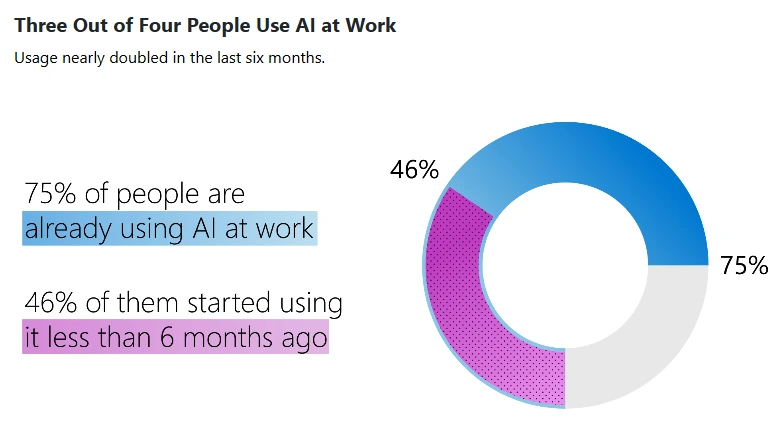
- Today, around 75% of knowledge workers leverage the potential of AI in the workplace, and nearly 46% of users have already been using it for about six months.
- Microsoft, Google (Alphabet), Amazon Web Services (AWS), IBM, Adobe, Meta, and Nvidia are the key players expanding the generative AI space.
- The primary use case of generative AI is content creation, where organizations use the technology for text generation. Besides, it’s also adopted for customer service, healthcare, software development, and finance.
Regional AI Market Analysis
Considering the artificial intelligence market insights, North America holds the largest share, while the Asia-Pacific region is climbing to hit the target.
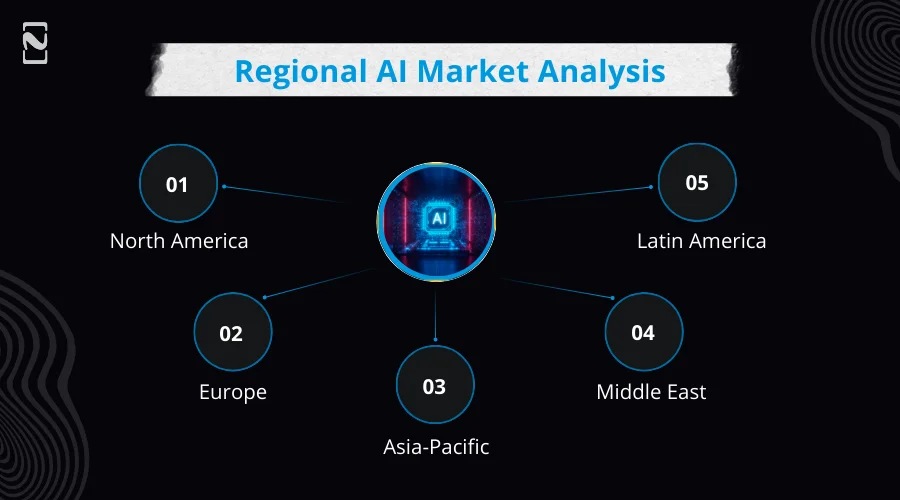
The European market is expanding, aiming for ethical AI and powerful regulation, and the Middle East is swiftly investing in a bid to broaden its activities into various industries.
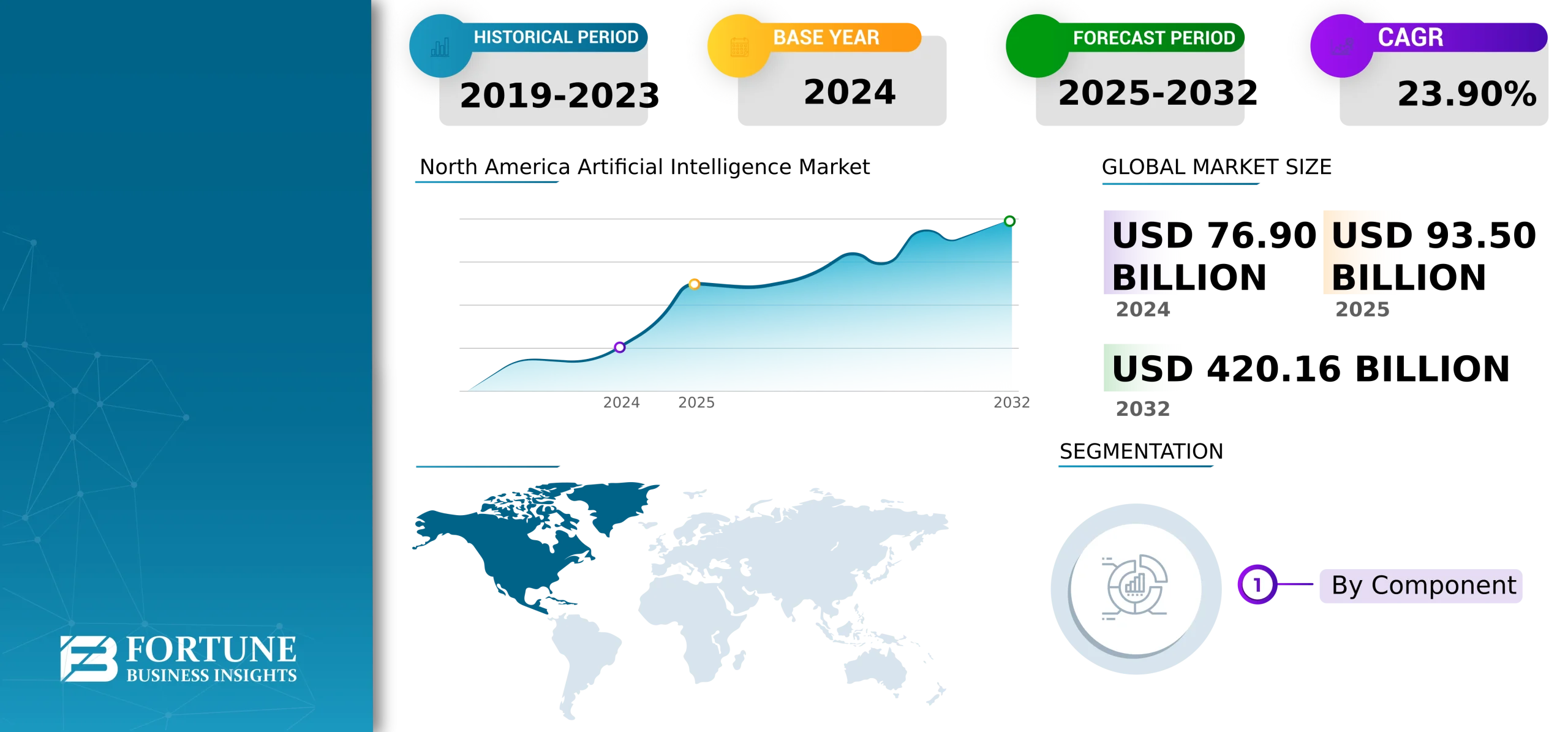
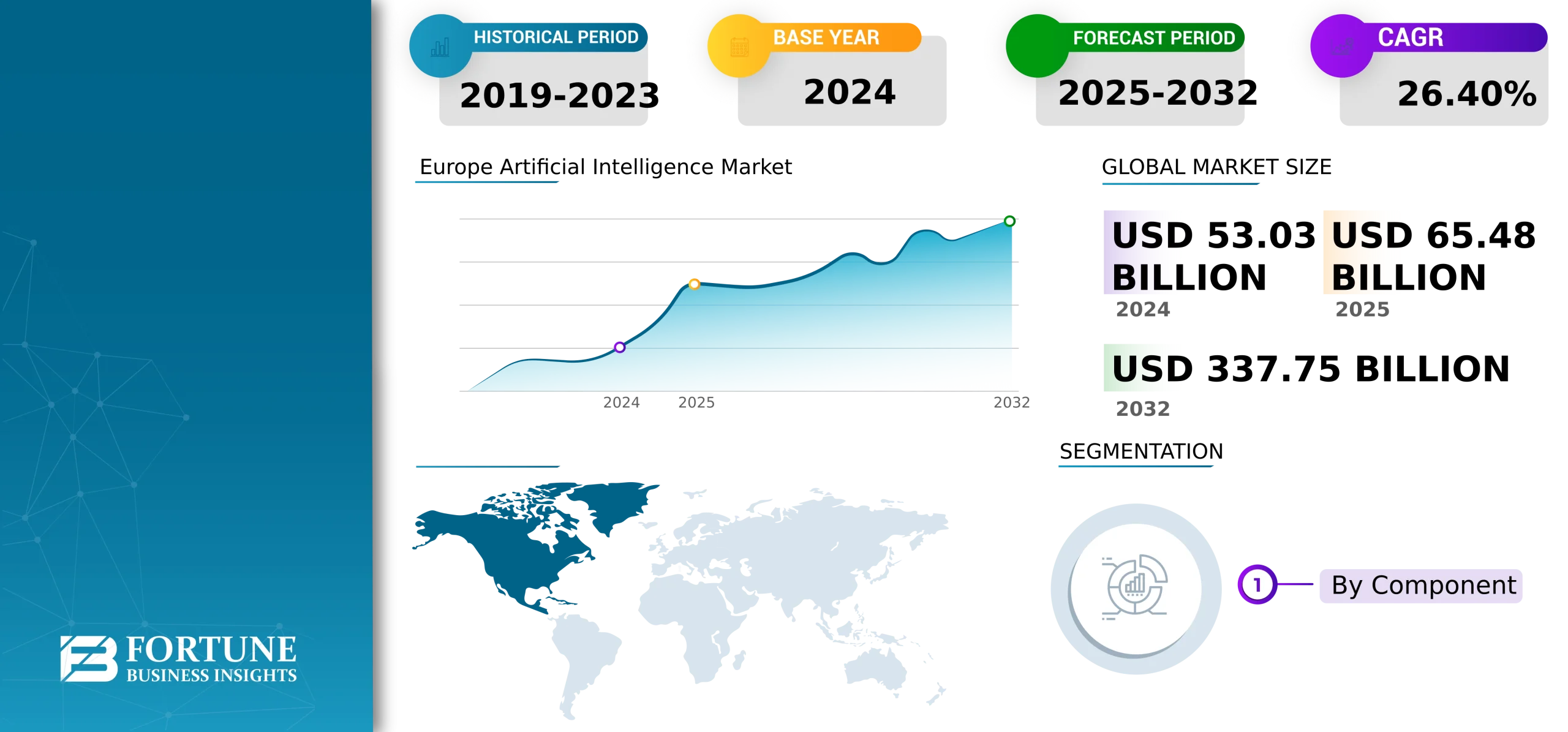
The AI market sizes for major regions as recorded this year are around:
- $65.48 billion for Europe,
- $83.75 billion for Asia-Pacific, and
- $93.50 billion for North America.
► North America
A core hub for AI innovation, specifically in the US, responsible for a considerable share of the global market, is North America.
- By 2032, the North American Artificial Intelligence market size is anticipated to hit $420.16 billion, at a CAGR of 23.90%.
- Chief drivers of this expansion are the established IT infrastructure, powerful government support, and huge investments in R&D from leading tech giants, like Microsoft, IBM, and Google.
- Across distinct sectors, rapid adoption is noticed, with healthcare and the BFSI (Banking, Financial Services, and Insurance) leading the pack in AI solutions implementation.
► Europe
- In AI development, the global force that’s surging is Europe, targeting human-focused approaches with robust regulatory frameworks.
- By 2032, the European Artificial Intelligence market valuation will reach $337.75 billion, showcasing an expansion at a CAGR of 26.40%.
- Market growth drivers include government initiatives, such as the EU’s “InvestAI” initiative and “AI Continent Action Plan,” which incorporate private and public investments to escalate innovation and build AI “gigafactories.”
► Asia-Pacific
One of the fastest-growing markets for AI is the Asia-Pacific region, as it highlights a swift digital shift and powerful government leadership.
- According to Fortune Business Insights, the Asia Pacific artificial intelligence market size is projected to be valued at $673.34 billion by 2032, at a CAGR of 34.70%.
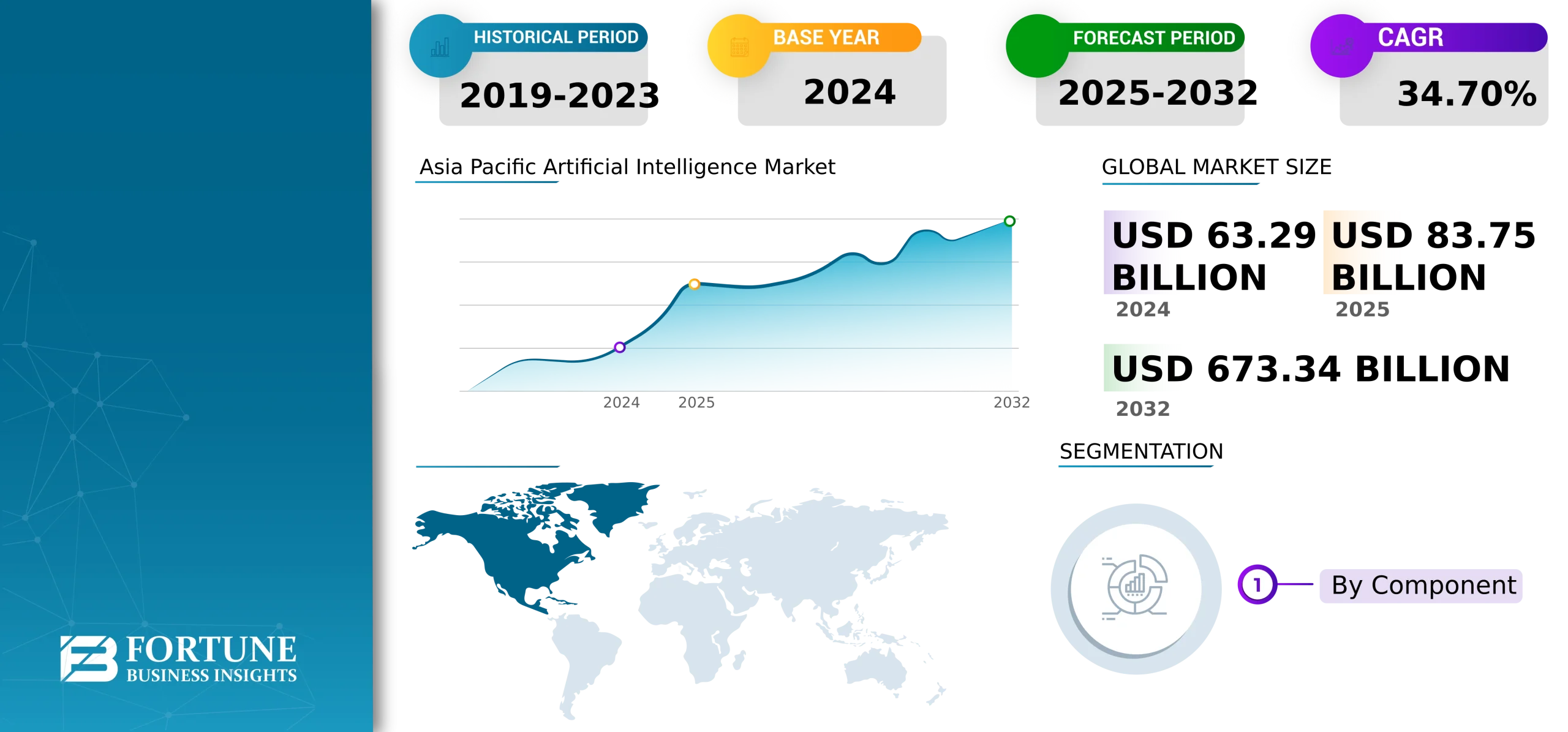
- The reason behind this ultimate growth is the large population of the region that generates a huge data volume, strengthening AI development.
- Countries like Japan, India, and China are heavily investing in AI research and startups, with top local players such as Alibaba adding to the market dominance.
- With a strong focus on healthcare, retail, and manufacturing, AI platforms are expected to witness a surge.
► Middle East
AI transformation is in action in the Middle East, which is acknowledged as a basis for economic diversification, besides oil dependence.
- Research and Markets reports that Qatar’s market is predicted to rise and reach about EUR 1.8 billion by 2030, at a CAGR of nearly 30%.
- The key drivers behind the proliferation are massive infrastructure investment and government-backed national approaches. Ruling techies are collaborating with local entities to create AI hubs and data centers, with AWS, Google, and Oracle investing billions in the UAE and Saudi Arabia.
- The robust emphasis on government service automation, smart city initiatives, and building local AI talent.
► Latin America
However, the Latin American AI market is under development; still, it exhibits possibilities for notable growth, specifically in particular sub-sectors.
- According to Mordor Intelligence, the South American artificial intelligence data center market size is expected to reach $2.37 billion by 2030, at a CAGR of 17.33%.
- The primary growth drivers are escalating adoption of cloud services and the demand for improved data processing caliber. The market puts forth opportunities in trending industries, like agriculture and finance.

AI Market Trends to Watch (2025-2030)
In 2026 and ahead, the AI landscape will likely step into a rapid phase of innovation with authentic AI, hardware breakthroughs, multimodal intelligence surge, and enterprise automation being the key drivers.
Between 2025 and 2030, AI market trends will reshape how businesses create, deploy, and scale AI solutions worldwide.
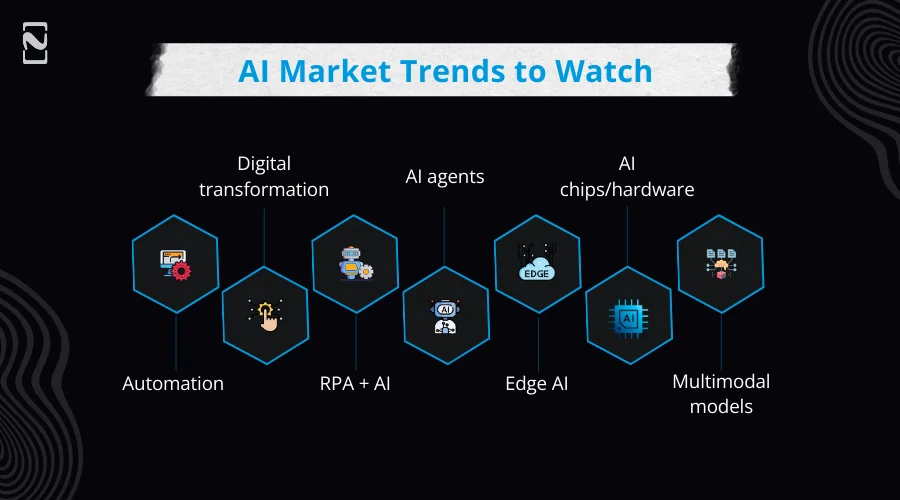
1. Automation – Becoming the Default Operating Model
Automation is advancing into intelligent automation fueled by LLMs, contextual decision-making, and real-time data. So, being limited to redundant workflows is no longer required.
Be it HR, finance, e-commerce, healthcare, or operations, every industry is switching to AI-first automated systems to eliminate manual jobs, reduce costs, and expedite turnaround times.
This period witnesses a transition from simple task automation to comprehensive autonomous workflows.
2. Digital Transformation – Accelerate Through Enterprise AI
Today, an increasing number of enterprises are opting for AI integration into their crucial products, customer experiences, and processes, facilitating predictive planning, automated decision-making, personalized experiences, and real-time analytics.
As AI is accepted as the basis of digital transformation, by 2030, you can expect it to be a core element, driving unmatched shifts in how businesses perform and generate value.
3. RPA + AI: The Expansion Toward Intelligent Automation
Robotic Process Automation (RPA), when fused with AI models, evolves swiftly, building Intelligent Process Automation (IPA).
- RPA manages structured workflows
- AI handles interpretation, unstructured data, reasoning, and decision-making.
As a team, they enable enterprises to streamline complex processes like financial reporting, customer onboarding, service desk workflows, claims processing, compliance checks, and document analysis.
RPA advanced with AI cognition is the future of automation.
4. AI Agents: Autonomous Workflows and Task Execution
One of the most disruptive inventions revamping 2025-2030 is AI agents. These agents can:
- Comprehend goals and tasks,
- Make decisions,
- Interact with tools,
- Execute multi-step workflows, and
- Learn from outcomes
Becoming digital employees, AI agents handle tasks across software development, customer support, analytics, marketing, sales, and operations.
Soon, businesses will move from “AI as a tool” to AI in the face of a workforce multiplier.
5. Edge AI: Real-Time Intelligence Without the Cloud
Organizations can no longer depend on cloud latency; their need for faster, more secure processing surges, making Edge AI an ultimate solution for:
- Autonomous vehicles,
- Robotics,
- IoT devices,
- Smart factories,
- Healthcare wearables, and
- Retail systems.
By 2030, you can expect millions of devices deploying AI locally, powering real-time decision-making, diminished cloud costs, and robust data privacy.
6. AI Chips & Hardware Breakthroughs
The increasing demand for more efficient AI computation is responsible for tremendous innovation in hardware. Specialized chips like NPUs, TPUs, GPUs, and custom accelerators are strengthening futuristic AI workloads.
Key trends incorporate:
- High-performance GPUs for enterprise training
- Energy-efficient AI chips for edge devices
- AI-optimized data center hardware
- Custom silicon for LLM optimization
Consequently, this diminishes AI inference and training costs, empowering increased enterprise adoption.
7. Multimodal Models Revamp the AI Experience
Multimodal AI models hold the caliber to understand and generate text, audio, images, code, sensor data, and video, making them more competent than single-modal models.
Between 2025 and 2030, multimodal models are likely to:
- Fuel smart assistants
- Recast media creation
- Improve robotics perception
- Update customer service
- Foster immersive AR/VR experiences
They are going to be the new benchmark for human-AI interaction, putting forth more intelligent, yet natural digital experiences.
AI Market Challenges
It’s impossible to even imagine how fast the AI market is growing and It’s expanding at an outstanding pace, but various critical challenges are hindering its adoption, long-term sustainability, and scalability.
It’s indispensable to understand these blockages to help businesses reduce risk, plan better, and create next-gen AI strategies.
While the AI industry is growing at an unprecedented pace, several critical challenges continue to impact adoption, scalability, and long-term sustainability.
Understanding these barriers helps businesses plan better, reduce risks, and build lasting AI strategies.
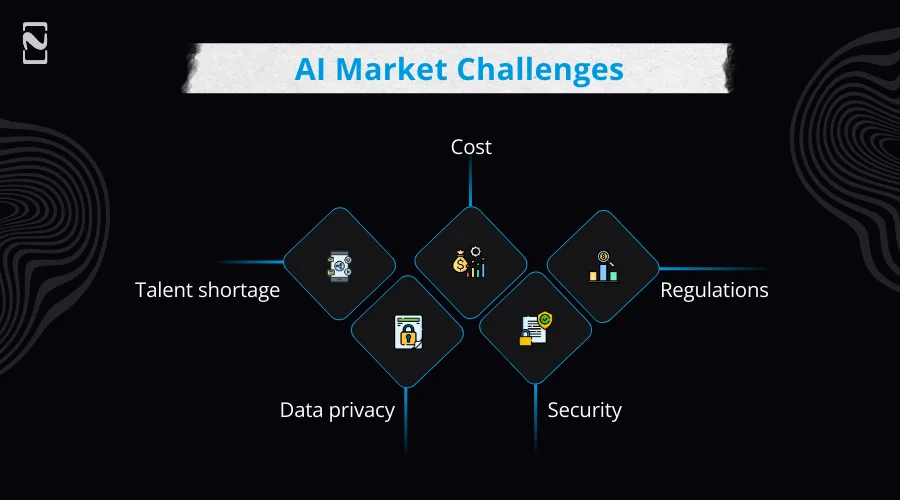
♦ High Cost of AI Development & Deployment
AI system development and scaling demand significant investment in talent, data infrastructure, training, ongoing maintenance, model optimization, and AI hardware (GPUs/TPUs).
Enterprise-grade AI, primarily generative and multimodal models, requires extreme compute power, making the cost factor a chief obstacle for startups and SMBs.
Various organizations struggle with unpredictable cloud bills, complex scaling expenses, and budget overruns.
Solution: Businesses should go for cloud-based AI, leverage open-source models, begin with MVPs, and scale cautiously to mitigate upfront investment.
♦ Evolving Regulations & Compliance Pressure
Governments globally are implementing AI-centric regulations, embracing the EU’s AI Act, rigorous data governance rules in Asia, and climbing U.S. frameworks.
Companies should guarantee transparency, bias mitigation, data governance, and model explainability. Regulatory delay results in delayed AI adoption, as companies worry about fines, compliance risks, and the requirement for redesigning the whole AI architecture.
Solution: Companies must follow international AI frameworks, maintain complete transparency in AI decision-making, and implement model documentation.
♦ AI Security Risks & Model Vulnerabilities
AI systems usually encounter unusual cybersecurity threats, like data manipulation, model poisoning, adversarial attacks, and prompt injections.
Integrating AI into key workflows makes the system prone to thrash by attackers targeting ML models to control outcomes or pull sensitive data.
Solution: Businesses should choose continuous monitoring, regular model vulnerability testing, robust encryption, and zero-trust architecture.
♦ Data Privacy & Ethical Concerns
AI models depend on huge datasets, raising data leak risks, misuse of personal data, and unauthorized access. Privacy issues bring forth major barriers for enterprises, involving consumer behavior, biometrics, financial records, and healthcare data.
Solution: Enterprises must apply anonymization, secure data pipelines, differential privacy, and adhere to GDPR/CCPA-like data governance standards.
♦ Global Talent Shortage & Skill Gap
Absolutely, AI adoption is rapidly increasing, but a significant lack of skilled AI engineers, AI researchers, data scientists, cybersecurity experts, and MLOps specialists is also occurring.
As increasing demand exceeds supply, this leads to competitive hiring and high salaries. The shortage of experienced experts restricts companies from surpassing innovation and surfacing operational risks.
Solution: Firms should use no-code/low-code AI tools, upskill internal teams, connect with an AI development company, and leverage AI-assisted coding.
Future Forecast: What’s Next for the AI Market?
When discussing AI industry growth predictions for 2025-2030, we can say that the AI market is set to grow from hundreds of billions to millions, even trillions of dollars, tomorrow.
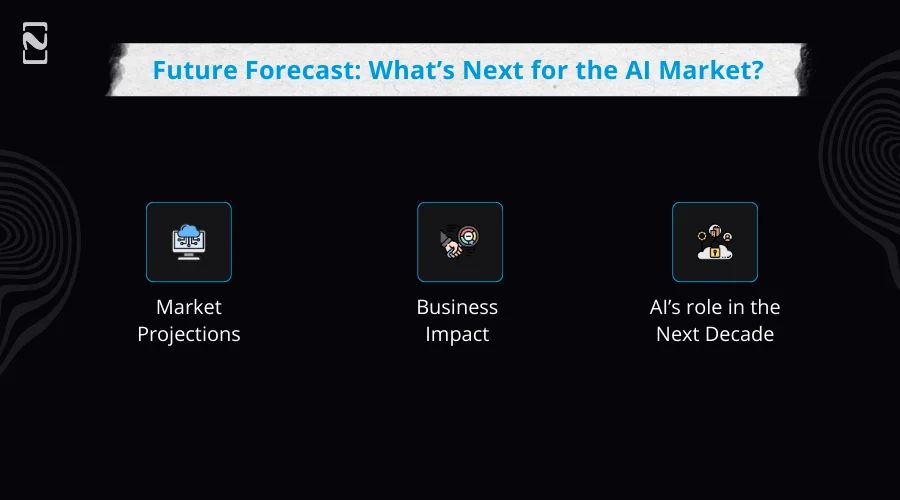
➤ Market Projection
Per PwC’s macroeconomic analysis, AI will likely contribute around $15.7 trillion by 2030 to the global GDP.
The AI revenue forecast tells about technology’s expansion to multiple trillions across distinct segments over the 2030s.
These figures show the swift adoption of generative AI, large-scale enterprise deployments, and AI infrastructure investment.
➤ Business Impact
You can anticipate a shift of AI from pilot projects to material value generation in three ways below:
-
New Revenue Streams
You can expect a surging share of enterprise revenue from AI-powered offerings as companies will monetize AI via subscription models for AI tools, data-driven services, and new product features.
-
Productivity Boosts
Generative AI and automation will raise labor productivity notably. McKinsey projects trillions from enterprise AI use cases in productivity value. Companies adopting AI can accelerate decision-making, freeing human resources for higher-value work and automating repetitive tasks.
-
Operational Transformation
End-to-end AI integration (RPA + edge AI + agents) shortens cycle times, mitigates costs, and enhances resilience, where all three: data quality, governance, and change management are well placed.
➤ AI’s Role In The Next Decade (2025–2035)
-
AI as infrastructure
Soon, AI will become foundational. You can expect significant investments in data centers, edge infrastructure, and specialized chips to support large-scale and latency-sensitive workloads.
-
Agents and Augmentation
Autonomous AI agents and assistant workflows will function as workforce multipliers, changing job designs, not replacing roles.
-
Winners and Losers
Firms that excel in model governance, data pipelines, and AI-native business models will outperform peers. Simultaneously, sectors with weak data practices or legacy systems may lag.
Quick Takeaways – Key Things to Remember
By 2030-2035, anticipate multi-trillion-dollar markets and economic value.
- The most prominent returns will come from new AI-enabled revenue, productivity improvements, and operational transformation, but accomplishment relies on talent, governance, and infrastructure.
- Businesses can grab the decade’s benefits by investing now in governance, data strategy, reskilling, and edge/cloud infrastructure.

Conclusion
AI market statistics are revealing growth at a remarkable rate, driven by swift innovation in automation, intelligent enterprise tools, edge computing, and generative AI.
With yearly global adoption, investment, and revenue scaling, AI is becoming the cornerstone of modern digital strategy.
AI-led personalization, data-driven decision-making, and efficiency improve every major industry, from healthcare and finance to e-commerce, manufacturing, and logistics.
Businesses that integrate AI early earn better customer experiences, faster workflows, and a measurable competitive edge. On the other hand, those who hesitate are falling behind.
The coming decade will witness AI transformation from assistive tools to autonomous agents, strengthening new business models, trillion-dollar economic value, and end-to-end operations.
With ongoing advancements in multimodal AI, regulatory clarity, and specialized hardware, the AI market is ready to reshape how companies innovate, work, and scale.
FAQs

Niketan Sharma, CTO, Nimble AppGenie, is a tech enthusiast with more than a decade of experience in delivering high-value solutions that allow a brand to penetrate the market easily. With a strong hold on mobile app development, he is actively working to help businesses identify the potential of digital transformation by sharing insightful statistics, guides & blogs.
Table of Contents
No Comments
Comments are closed.