

 Free Consultation
 PCI-DSS Compliant
 GDPR Ready
 ISO 27001
 NDA Protected
 AI Services
 AI App Development
 Generative AI Development
 AI Chatbot Development
 AI Integration Services
 AI Consulting Services
 AI For Fintech
 AI Financial Assistant Solution
 AI Insurance Agent Development
 Tech Stack
 OpenAI / GPT-4
 Claude / Anthropic
 Gemini / Google AI
 Llama / Open Source
 LangChain / LlamaIndex
 Pinecone / Pgvector
 AWS / Azure AI


 Fintech Solution
 Core Fintech
 App Development
 Neobank Solutions
 eWallet Solutions
 Lending Software
 Banking Solutions
 BNPL Solutions
 BNPL Solutions
 Insurance App
 Wealth Management
 Crypto & DeFi
 Blockchain Development
  Payroll Software
 DeFi Solutions
 Crypto Wallet
 Crypto On/Off Ramp
 Crypto Exchange
 Trading Platform
 Payments
 Compliance
 Regulations & Compliance
 Fraud Detection
 Lending Ecosystem
 P2P Lending Platform
 Mortgage Software
 Engagement
 Fintech Outsourcing

 Mobile Development
 Mobile App Dev
 iOS App Development
 Android App Development
 React Native
 Flutter Development
 Web Solution
 Node.js Development
 React.js Development
 Angular Development
 App Services
 UI/UX Design
 App Maintenance
 By Stage
 MVP Development
 Industry Solutions
 Healthcare App Dev
 Education App Dev
 Travel App Dev
 Real Estate App Dev
 Logistics Software
 Social Media App

 Hire Mobile Developers
 Hire iPhone Developers
 Hire Android Developers
 Hire React Native Devs
 Hire Flutter Developers
 Hire Web Developers
 Hire Node.js Developers
 Hire Angular Developers
 Hire PHP Developers
 Hire Laravel Developers
 How It Works
 Pre-Vetted Developers
 Ready In 48 Hours
 NDA From Day One
 Replace Guarantee
 Company
 About Us
 Our Work Process
 Portfolio
 Case Studies
 Blog / Insights
 Careers
 Contact Us
 Awards
 Recognition


 Offices



In a Nutshell :
- AI in fintech uses technologies like machine learning, NLP, and predictive analytics to automate financial services.
- It helps banks and fintech companies assess credit risk, detect fraud, automate trading, and improve customer support.
- AI systems analyze large financial datasets in real time to identify patterns and support faster decision-making.
- Financial institutions utilize AI for chatbots, algorithmic trading, fraud detection, regulatory compliance, and risk analysis.
- The adoption of AI in fintech is rapidly growing as companies seek smarter automation and personalized financial services.
Overview of AI in Fintech
Artificial intelligence is transforming financial services by analyzing vast datasets, automating complex processes, and enabling smarter, faster decision-making.
From fraud detection and credit scoring to algorithmic trading and personalized financial advice, AI empowers fintech companies and banks to deliver secure, efficient, and tailored services at scale.
What is AI in Fintech?
Artificial Intelligence (AI) in fintech refers to the utilization of technologies, like natural language processing (NLP), machine learning (ML), and predictive analytics, to streamline and improve financial services.
AI systems analyze large volumes of financial data to detect patterns, identify risks, and generate insights that support faster decision-making.
Financial institutions use AI for:
- Fraud detection
- Credit scoring
- Algorithmic trading
- Risk management
- Customer support automation
- Financial forecasting
By automating complex financial processes, AI helps fintech companies reduce fraud, improve efficiency, and deliver personalized financial services.
How Does AI Work in Fintech?
AI in fintech operates following a structured workflow that transforms raw financial data into actionable insights and automated processes:
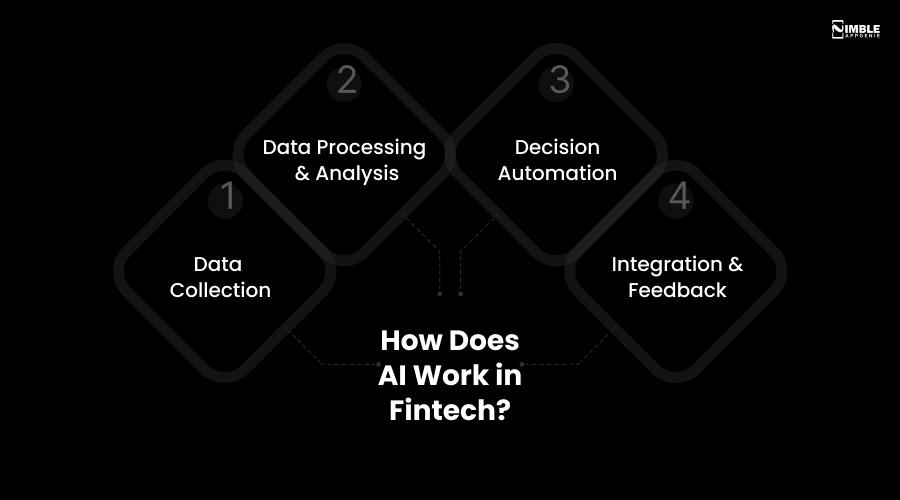
- Data Collection: Gathering transaction histories, market data, customer profiles, and operational metrics.
- Data Processing & Analysis: Machine learning models and predictive analytics analyze the data to detect patterns, assess risks, and forecast trends.
- Decision Automation: AI triggers actions such as flagging fraudulent transactions, executing trades, or providing personalized recommendations.
- Integration & Feedback: Insights are delivered via apps, dashboards, and chatbots, with continuous feedback improving AI accuracy over time.
This workflow enables fintech companies to enhance operational accuracy, reduce risks, and provide personalized financial services at scale.
AI in Fintech Market Statistics
The fintech institutions are increasingly adopting artificial intelligence in financial services for fraud prevention, automation, and data-driven decision-making.
Key statistics include:
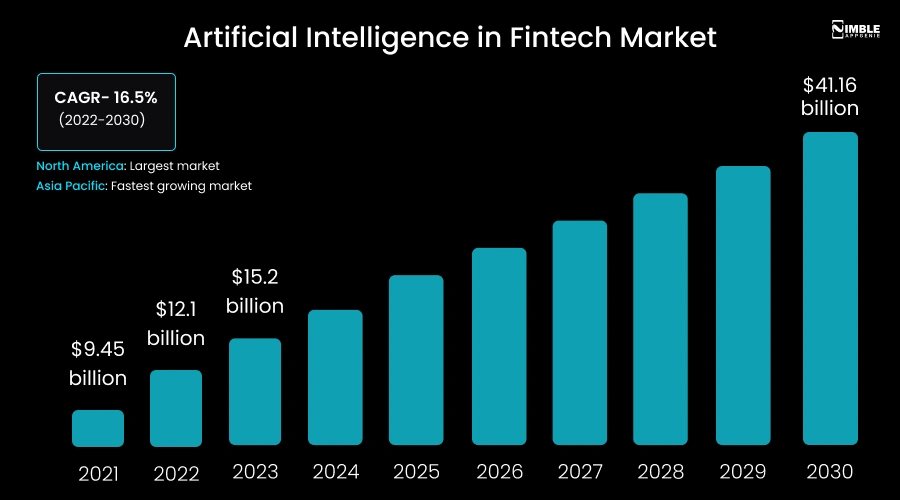
- The global AI in fintech market is projected to reach $41.16 billion by 2030.
- 70% of financial institutions are investing in AI technologies to improve operational efficiency.
- AI-powered fraud detection systems can reduce fraud losses by up to 60%.
- 80% of banks are experimenting with AI-driven automation tools.
- AI-powered chatbots can handle up to 70% of customer service interactions in the banking sector.
Real Examples of AI in Fintech
Several fintech companies are leveraging the power of artificial intelligence to automate complex operations and improve financial services.
| Company | AI Use Case |
| PayPal | Fraud detection using machine learning |
| Stripe | AI-powered payment risk monitoring |
| Robinhood | AI-based trading insights |
| Upstart | AI-driven credit scoring |
| Klarna | AI-powered customer support automation |
What are the Primary Types of AI Used in Fintech?
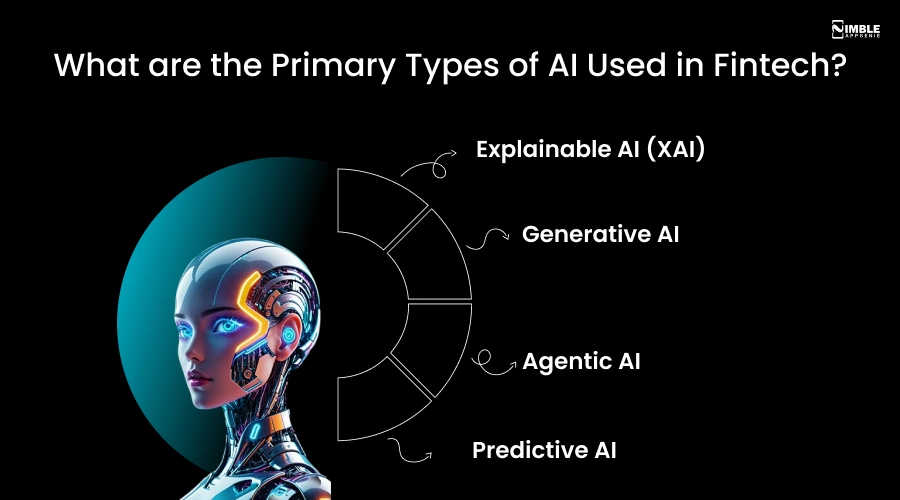
Commonly used AI technologies in fintech include:
Artificial intelligence is reshaping the financial services industry through improved risk analysis, smarter automation, and personalized financial solutions.
In fintech platforms, different types of AI technologies are used to manage tasks, like trading automation, fraud detection, financial forecasting, and customer support.
► Explainable AI (XAI) in Fintech
In fintech, transparency is critical because financial decisions such as loan approvals, fraud detection, and credit scoring must be interpretable and compliant with regulatory requirements.
Explainable AI (XAI) refers to artificial intelligence systems that provide clear explanations for their decisions.
Explainable AI helps financial institutions understand how AI models reach conclusions, allowing them to detect biases, enhance model accuracy, and foster trust with customers and regulators.
Applications of Explainable AI in Fintech:
- Fraud detection systems that explain why a transaction is flagged as suspicious
- Credit scoring models that offer transparency in loan approval decisions
- Customer onboarding systems that justify eligibility verification
- Portfolio recommendation tools that explain investment strategies
- Regulatory compliance and audit reporting for financial institutions
► Generative AI in Fintech
Generative AI, a type of artificial intelligence, generates new content, insights, or financial data outputs based on existing datasets.
In fintech, generative AI is used to create financial reports, automate customer interactions, and provide personalized financial recommendations.
By processing large financial datasets and user information, generative AI enables financial institutions to deliver more intelligent and automated digital financial services.
Applications of Generative AI in Fintech:
- AI-powered chatbots and virtual assistants for banking support
- Automated financial report and document generation
- Personalized investment and financial planning recommendations
- Smart financial assistants in mobile banking applications
- AI-generated insights for financial analysis and forecasting
► Agentic AI in Fintech
Agentic AI refers to autonomous AI systems that can perform tasks independently, execute actions, and make decisions based on predefined objectives.
In fintech, agentic AI serves as an intelligent agent that monitors financial operations and responds to changes in real time.
These AI agents consistently automate workflows, analyze financial data, and optimize financial processes without constant human intervention.
Applications of Agentic AI in Fintech:
- Autonomous portfolio management systems
- Real-time fraud monitoring and prevention
- AI-powered financial assistants in banking platforms
- Automated trading systems that execute trades based on market signals
- Intelligent workflow automation for financial operations
► Predictive AI in Fintech
Predictive AI utilizes machine learning models and historical financial data to predict future financial outcomes. By analyzing transaction patterns, customer behavior, and market trends, predictive AI enables financial institutions to make proactive and data-driven decisions.
Applications of Predictive AI in Fintech:
- Credit risk prediction for loan approvals
- Investment forecasting based on historical market trends
- Customer behavior prediction for personalized financial services
- Fraud detection models that identify suspicious transaction patterns
- Market trend analysis for smarter trading strategies
Read Also: Predictive Analytics in Finance
What are the Benefits of Implementing AI in Fintech?
AI strengthens financial security, increases operational efficiency, and empowers institutions to make informed, data-backed decisions.
Implementing artificial intelligence helps fintech firms to optimize financial operations, detect fraud, analyze markets, and deliver customized financial solutions.
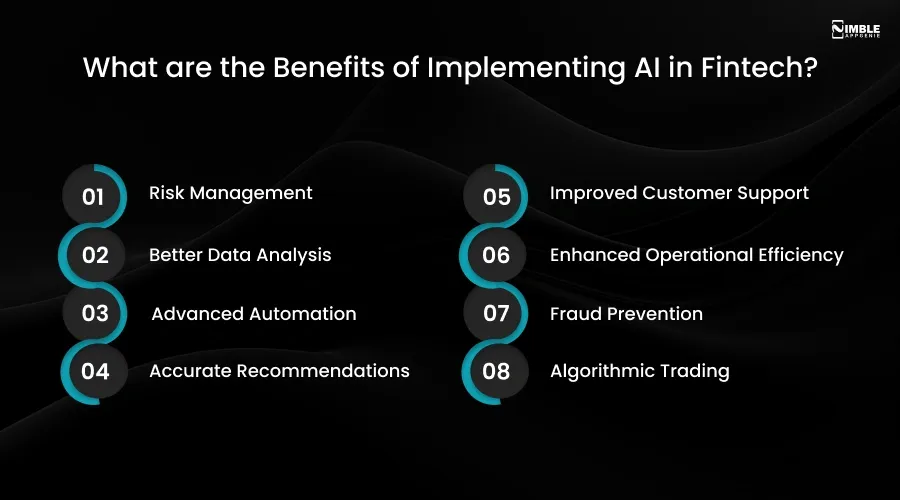
Some of the key benefits of AI in fintech include the following:
1. Risk Management
Identifying and managing risks becomes super easy with the implementation of artificial intelligence. Risks in fintech mainly refer to the chances of a person defaulting on their payments and the poor assessment of an individual’s creditworthiness.
These defaults cost a lot of money for fintech companies. However, with AI algorithms combined with machine learning, you can create a solid risk management mechanism that helps you improve risk management on your FinTech platform.
2. Better Data Analysis
The implementation of AI also helps in better data analysis. Usually, this data is generated by the user and is used to identify user requirements. However, with AI, this data can be used to analyze the entire trajectory of a user since they joined.
These patterns help in identifying the overall value of a customer for your company. Data analysis with AI often implements predictive analytics, allowing you to identify user patterns and make informed decisions.
3. Advanced Automation
Artificial intelligence can be used to automate several operations that usually require a dedicated resource. This yields a lot of cost savings for a company and improves the efficiency of the processes by a significant margin.
This also means that with the help of advanced automation techniques deployed through AI & ML, you can easily automate some of the basic steps that a user or your company has to perform manually.
4. Accurate Recommendations
Recommendations are one of the key players when it comes to pushing and converting your customers for additional services.
But in fintech, it is a service that helps users more than the business. Artificial Intelligence allows you to understand the patterns of a user so that you can identify what type of services they are interested in and recommend similar services.
This helps in converting more users into regular customers and cross-selling your services at the same time.
5. Improved Customer Support
Another sector where the implementation of AI in financial services is beneficial is customer support. With AI-based chatbots and text support, you can easily enhance your turnaround time on any ticket raised by the customer.
It also helps in satisfying a user’s urgent requests, as finances are a delicate matter, and delaying in reverting to a grievance may result in the loss of a customer.
6. Enhanced Operational Efficiency
With AI and machine learning, you can easily enhance operational efficiency. The implementation of AI can help streamline all the processes, making it operationally efficient and secure.
With the help of automation, operations become easier and easier to trace, which means fewer resources are invested in them, making it more operational than ever!
Other than this, AI in fintech can leverage all the user-generated content for better decision-making.
7. Fraud Prevention
AI-powered systems analyze huge volumes of financial transactions in real time to locate unusual patterns and suspicious activities.
By utilizing machine learning algorithms, fintech platforms can rapidly identify possible fraud attempts and take appropriate actions before financial losses occur. This way, organizations intensify security and safeguard users from fraudulent transactions.
Related Read: AI-Powered fraud detection in fintech
8. Algorithmic Trading
AI triggers automated trading strategies by analyzing historical price movements, market trends, and financial indicators. Such intelligent systems can execute trades at top speed based on predictive insights and predefined rules.
Algorithmic trading supports investors and financial institutions in reducing human error, optimizing trading decisions, and boosting investment performance.

What are the Challenges in Implementing AI in Fintech?
When we talk about AI in fintech, the benefits do make a good case for implementation. However, keep in mind that there are significant challenges that you might face.
These challenges include –
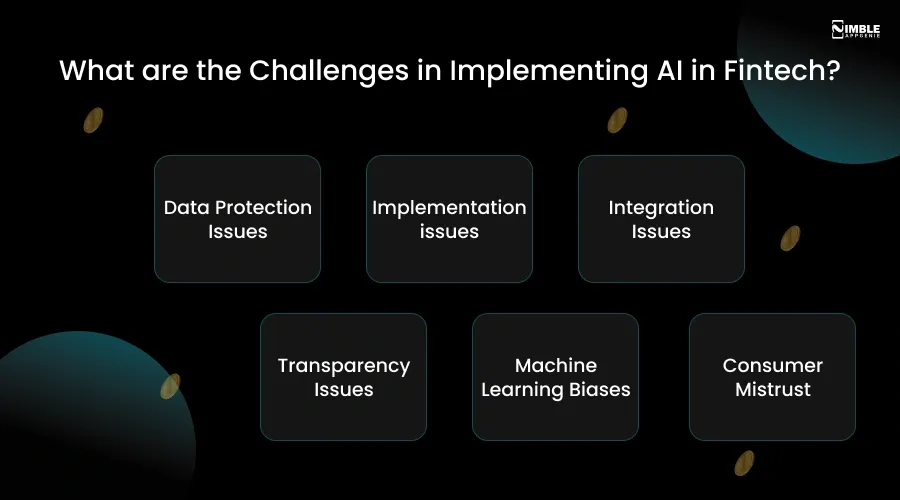
➤ Data Protection Issues
To make the most of artificial intelligence mechanisms that you deploy on your fintech platform, you need to store loads of data.
The real issue begins when you have to securely store this data. This data also holds especially sensitive information about a user and is always vulnerable to leaks and breaches.
➤ Implementation issues
The cost of implementation is one of the biggest challenges. Some fintech businesses are unable to identify the exact use case for which they want to implement AI, making it more complicated for them to rely on AI.
➤ Integration Issues
Not all technologies may be compatible with the legacy systems that are currently being used to power your platform. It is difficult to integrate AI in fintech, as you will also have to upgrade your legacy systems, as they may pose an issue in compatibility.
➤ Transparency Issues
While AI can help in generating decisions faster, sometimes it may lack transparency in the entire decision-making process.
While AI implementations can enhance operations, people often have concerns about the authenticity of those decisions, as they do not know how these were derived.
➤ Machine Learning Biases
This algorithmic bias can often prove to be a problem as AI is usually implemented to simplify the workflow, not to complicate it.
However, you have to run regular audits on implemented algorithms to find if they are getting affected by the ML bias, or if they are working fine or not.
➤ Consumer Mistrust
For common consumers, AI is yet to make a mark, as it has some serious glitches in the model.
Not to mention, when anything is related to finances, consumers prefer interacting with humans more than artificial intelligence. Mistrust is one of the key challenges in the implementation of AI in financial services.
The challenges may vary as per your domain in fintech, as insurtech has different issues than banking. Hence, you need to understand what issues can hamper your platform’s experience and work on them.
If you are unable to manage the implementation, you should ask the development team to guide you through it, as fintech development experts surely know how to implement things better.
What are Some Use-Cases of AI in Fintech?
AI empowers critical operations in fintech by strengthening security, streamlining workflows, and delivering more personalized financial experiences.
Utilizing AI, financial companies analyze transaction patterns, maintain regulatory compliance, provide tailored financial guidance, and automate trading strategies.
The following use cases highlight how AI is applied across real-world financial platforms to improve efficiency, reduce risks, and enhance decision-making.
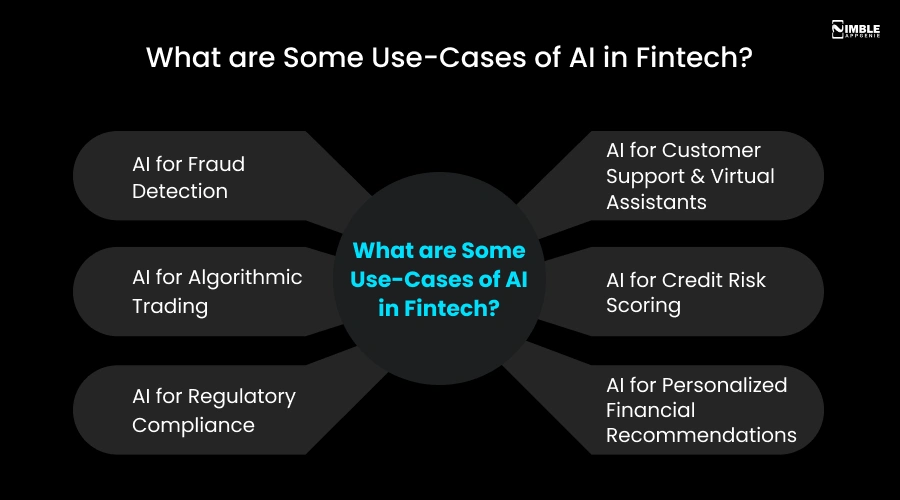
1. AI for Fraud Detection
By analyzing billions of financial transactions in real time, AI-powered systems address unusual patterns and flag suspicious activities. Machine learning models recognize potential fraud more quickly than traditional modes, assisting fintech firms in minimizing losses and safeguarding customers.
Leading fintech platforms like Stripe and PayPal leverage AI to boost transaction security and fraud prevention.
2. AI for Algorithmic Trading
AI systems examine historical market data, financial indicators, and price movements to execute trades based on predictive models automatically.
Fintech platforms can use algorithmic trading to react to market changes faster than humans, optimize investment strategies, and maximize returns with minimal manual intervention.
3. AI for Regulatory Compliance
Adopting AI platforms, financial institutions can streamline compliance monitoring and ensure compliance with the regulatory frameworks.
Machine learning models can maintain audit trails, flag unusual transactions, and help with reporting, diminishing human errors, and ensuring regulatory standards are constantly met.
4. AI for Customer Support & Virtual Assistants
AI chatbots and virtual assistants provide account information, handle routine banking queries, and support transactions.
These AI systems decrease operational costs, enhance response times, and deliver a smooth customer experience.
5. AI for Credit Risk Scoring
Machine learning models analyze borrower data to assess creditworthiness more precisely than traditional scoring methods.
Thus, fintech leaders make rapid lending decisions and diminish default rates.
6. AI for Personalized Financial Recommendations
AI analyzes spending patterns, customer behavior, and market trends to provide tailored savings plans, wealth management strategies, and investment advice.
Personalized recommendations improve engagement and customer satisfaction.
AI in Fintech Architecture
AI in fintech platforms is well-organized into various layers, each accountable for specific jobs ranging from data processing to application delivery.
This layered architecture empowers financial institutions to efficiently generate insights, process transactions, and maintain security across their platforms.
| Layer | Components | Purpose |
| Data Layer | Transaction data, financial datasets | Collects and organizes raw financial information for analysis |
| AI Model Layer | Machine learning models, predictive analytics | Processes data to identify patterns, forecast trends, and automate decisions |
| Application Layer | Banking apps, payment platforms | Interfaces for customers and employees to interact with AI systems |
| Integration Layer | APIs, third-party fintech services | Connects AI models to other applications and external services |
| Security Layer | Encryption, fraud monitoring | Ensures data privacy, integrity, and fraud prevention |
This architecture ensures that AI-driven fintech platforms are scalable, secure, and can deliver actionable insights in real time.
Challenges and Solutions of AI in Fintech
Besides transformative benefits, AI brings several challenges to fintech companies, where they find it difficult to implement such technologies effectively.
You should address these issues to ensure compliance and efficient operations.
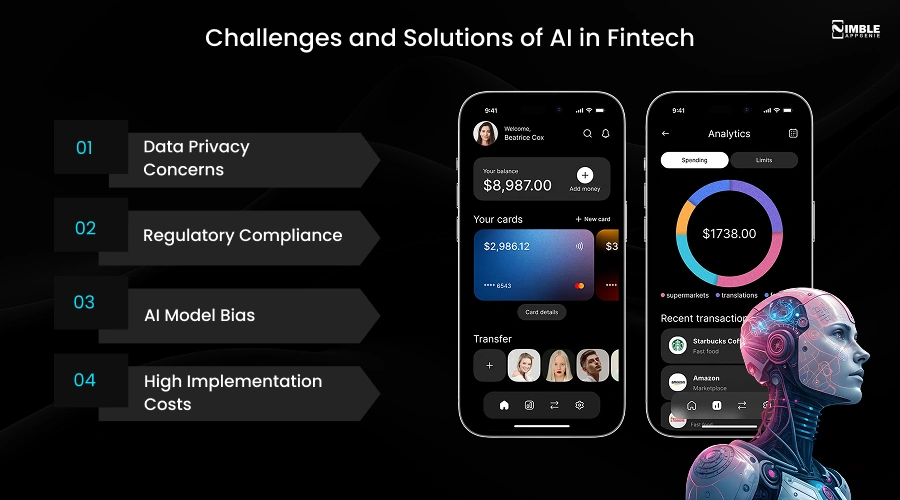
Challenge #1: Data Privacy Concerns
Solution: Implement robust encryption, adhere strictly to data protection regulations like GDPR and CCPA, and anonymize data where possible. Regular audits and secure data storage protocols can further reduce risks.
Challenge #2: Regulatory Compliance
Solution: Use AI systems with built-in compliance monitoring and reporting. Organizations should collaborate with legal and compliance teams to ensure models meet regulatory requirements and maintain detailed audit trails.
Challenge #3: AI Model Bias
Solution: Regularly test AI models for bias, retrain them with diverse datasets, and implement fairness metrics. Transparent explainable AI (XAI) tools can help stakeholders understand decisions.
Challenge #4: High Implementation Costs
Solution: Start with modular AI solutions or white-label frameworks to reduce initial costs. Utilize cloud-based AI services and open-source tools to minimize infrastructure expenses, while scaling gradually.
What are Some Trends Inspired by AI in Fintech?
The fintech industry is evolving rapidly, driven by advances in artificial intelligence.
Key trends to watch in 2026 and beyond include:
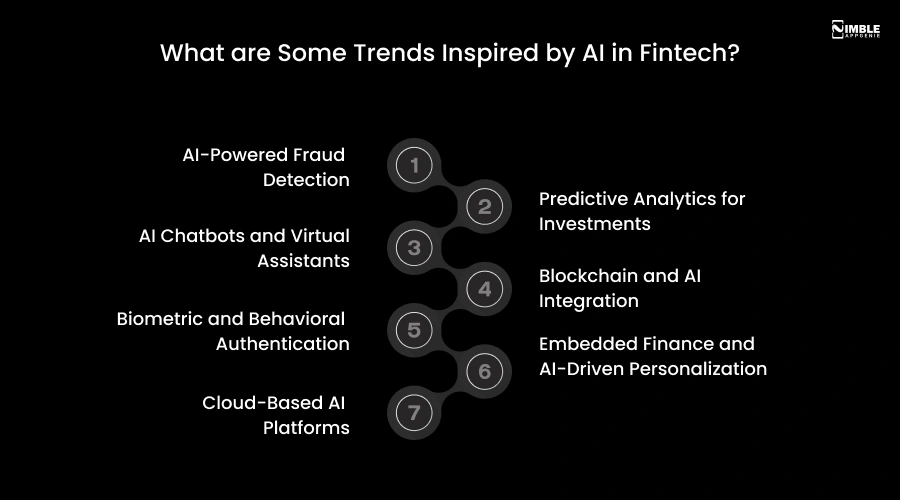
1. AI-Powered Fraud Detection
Machine learning models are becoming more refined at detecting suspicious patterns across millions of transactions. By integrating predictive analytics and real-time monitoring, fintech platforms can reduce fraud losses by up to 60%. (statistics already discussed)
2. Predictive Analytics for Investments
AI-driven predictive analytics helps financial institutions foretell market trends, assess credit risk, and optimize portfolio management. More than 80% of banks are experimenting with AI-based predictive tools to improve decision-making.
3. AI Chatbots and Virtual Assistants
Intelligent chatbots powered by natural language processing are handling up to 70% of customer service queries, providing personalized support, and improving engagement while reducing operational costs.
4. Blockchain and AI Integration
Combining AI with blockchain enables secure, transparent, and faster cross-border payments. Fintech firms are exploring this integration for smart contracts, fraud prevention, and real-time transaction monitoring.
5. Biometric and Behavioral Authentication
AI-powered biometric systems (facial recognition, fingerprint scanning) and behavioral analytics are becoming standard for secure authentication, helping diminish identity theft and enhance user trust.
6. Embedded Finance and AI-Driven Personalization
Fintech platforms are embedding AI into payment systems, lending apps, and investment platforms to deliver hyper-personalized financial experiences, providing users with tailored investment advice, savings plans, and lending options.
7. Cloud-Based AI Platforms
Cloud AI solutions permit fintech firms to scale operations, reduce infrastructure costs, and implement machine learning models faster. Cloud adoption is expected to accelerate the deployment of AI in fintech by 2026.

Conclusion
Artificial intelligence offers some cutting-edge solutions and helps streamline several integral processes. There are several challenges that you might face while implementing AI in fintech.
However, the ease of access and benefits that AI offers overshadow these challenges completely and hence make it more desirable to integrate them.
To integrate AI in fintech, you will need two things: conviction and a team. The above information should be enough to bring conviction on how crucial using AI is for your business.
AI in fintech can prove to be highly beneficial, and hence, you must connect with a trusted fintech app development company. Hope all these insights help you understand the impact of AI.
FAQs
AI enhances fraud detection by analyzing large volumes of transactions in real time, recognizing unusual patterns, and flagging suspicious activity. This helps fintech companies control financial fraud more quickly and accurately than traditional methods.
AI in fintech provides multiple advantages, including automated customer support, real-time fraud detection, personalized financial recommendations, predictive risk management, and cost reduction, enabling smarter and more efficient operations.
AI-powered chatbots and virtual assistants manage routine queries, offer account information, and assist with transactions. This diminishes response times, lowers operational costs, and boosts overall customer satisfaction.
AI models analyze credit history, borrower data, and behavioral patterns to assess creditworthiness. This enables faster, more precise lending decisions and helps fintech lenders reduce default risk.
By analyzing investment behavior, spending patterns, and market trends, AI delivers tailored financial advice and investment recommendations. This ensures users receive personalized insights for saving, investing, and wealth management.
Implementing AI can be costly and complex, demanding data quality, regulatory compliance, and skilled personnel. Financial institutions must handle these challenges to deploy AI effectively and safely.
AI in fintech platforms is organized into layers: data collection, machine learning models, application interfaces, integration APIs, and security. This structure enables real-time insights, scalability, and secure financial operations.

Niketan Sharma, CTO, Nimble AppGenie, is a tech enthusiast with more than a decade of experience in delivering high-value solutions that allow a brand to penetrate the market easily. With a strong hold on mobile app development, he is actively working to help businesses identify the potential of digital transformation by sharing insightful statistics, guides & blogs.
Table of Contents




No Comments
Comments are closed.